



The Alcázar de Colón was the first construction of the Spanish monarchy in America.
Today marks 529 years since Christopher Columbus ' arrival in America, in whose honor we will take a walk through the Alcázar de Colón, the place where Diego Colón, son of Christopher Columbus, and his wife María de Toledo, niece of King Ferdinand of Spain, lived.
This building was constructed around 1512. This Gothic and Renaissance-style palace is one of the most popular museums in the Colonial City and also the most architecturally impressive. Overlooking the Plaza de España on one side and the Ozama River on the other, it is the oldest viceregal residence in the Americas and the first fortified palace, now a museum exhibiting 16th-century furniture, art, musical instruments, and weapons. Spiral staircases lead to the couple's well-preserved bedrooms and the luxurious reception hall, illuminated by crystal chandeliers, where events for the Spanish aristocracy were held.
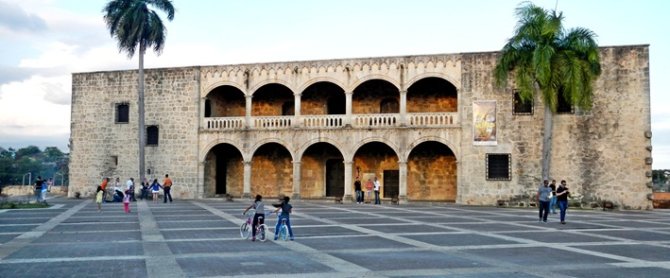
In the early days of the Americas, the Alcázar de Colón and the Plaza de España bore witness to that nascent civilization, to the first colonists who left behind a world known only to them in Europe, drawn by the promise of gold and riches they could never have attained in their homeland. It was erected at a strategic point in the city of Santo Domingo, near the mouth of the Ozama River. Its Gothic-Mudéjar style is marked by Renaissance and Isabelline influences. This magnificent building was commissioned by Don Diego de Colón, the eldest son of the admiral, who served as administrator of the West Indies by order of King Ferdinand the Catholic.
Called by some as the Viceroy's Palace of Don Diego Colón, this monument is an epic building constructed in the city of Santo Domingo de Guzmán, during the time of colonization, worthy of honor for the authorities who arrived in the New World.
Construction began in late 1510 on a plot of land located on the banks of the Ozama River. King Ferdinand the Catholic ordered its construction as a gift for Columbus's eldest son. By 1512, it was inhabited by Don Diego Columbus and his family, who at that time was serving as Viceroy of the Indies, the third governor of Hispaniola.
Architecture
The imposing building is a two-story, rectangular structure with five arches on each level, exuding an air of solemnity and sobriety. The main staircase is spacious and U-shaped. In addition, there are two other staircases: a spiral staircase and a smaller one, on the ground floor of which is a recreation of the Chapel of Mary of Toledo.
The colossal mausoleum was built with coral stone from the Santa Bárbara quarries. Limestone and wood were also used, and its construction was overseen by Spanish architects. The walls are approximately 85 cm thick and cover an area of 1,525 square meters. The main entrance is in the late Gothic style and features a prominent arch framed by ornamental motifs carved in stone.
The Alcázar de Colón is the only known residence of any member of the Columbus family in the New World, making it a historical monument. It was home to three generations of the Columbus family, from 1512 until 1577, when it was abandoned by the Columbus family, who returned to Spain for health reasons.
During Francis Drake's invasion in 1586, the fortress was besieged and eventually sacked by pirates. Subsequent neglect significantly damaged its infrastructure. Over time, and after several renovations, it was declared a National Monument in 1870.
Today, the importance of the Alcázar de Colón Museum lies in its mission to research and preserve the historical memory related to the Viceroyalty period in the Dominican Republic, in order to educate Dominicans and foreigners about the historical significance of this museum and the memories held within its foundations. It was the first house of its kind built in the Dominican Republic.
Tourism
The Viceroyal Palace of Columbus, with its museum, offers you the opportunity to delve into the colonial history of the era in one of its 22 rooms on the first floor, filled with typical artifacts from that period. On the second floor, you'll find a reception hall, a small chapel, and the marital bedroom of Doña María de Toledo.
Schedules
From outside the palace you can walk around and enjoy the architecture and construction of the time, its walls and forts or walk through Plaza España and enter the colonial streets to other destinations such as the Ozama Fortress, the Primatial Cathedral or the Street of the Ladies.
From Tuesday to Saturday, the museum is open from 9:00 am to 5:00 pm, and on Sundays from 9:00 am to 4:00 pm. The entrance fee is 100 pesos, but the price may vary depending on the date of your visit. Children under 8 years old are free. If you visit the museum, bring balls, skates, a bicycle, or anything else you'd like to play with. Your children will thank you for it, having a blast in Plaza España, an ideal place for outdoor play.







