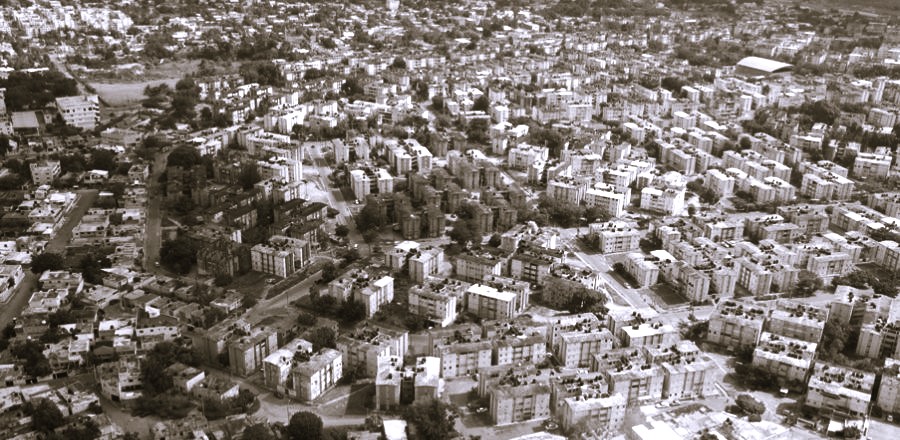
With the economy reoriented towards agriculture, a city battered by hurricanes, and insufficient resources, the Guzmán administration produced three housing projects in Santo Domingo. Two remained unfinished. The most ambitious was halted. What was built, however, defined typologies that would be repeated for decades
SANTO DOMINGO. – With the arrival of the Dominican Revolutionary Party to power in August 1978, there was a shift in official economic policy that directly affected the housing sector, and the State had to relinquish the construction leadership that had characterized the twelve years of Balaguer, and the growth of the city occurred mainly through private initiative, both formal and informal.
According to Dr. Natalia Ulloa Cáceres's doctoral thesis, "Social Housing in Santo Domingo. Opportunities for Recycling the Existing Housing Stock," the economic policy of "induced demand" was implemented starting in 1978, which considerably reduced state investments in infrastructure, emphasizing public spending through increased employment and wages.
However, the combination of that change in model with the devastating consequences of Hurricanes David and Federico in 1979 forced Guzmán's government to maintain a public housing presence, albeit a limited one.
What was built during that period was small in volume, but significant in typological terms: the solutions adopted set precedents that would be repeated in later administrations.
Three projects that defined a policy
The two most rigorous academic investigations available on Dominican social housing, Ulloa Cáceres's thesis and the master's thesis of architect Evelyn Vanessa González Mueses, "On Dominican social housing in the 20th century: Case of Santo Domingo", identify three large housing projects produced during Guzmán's term, all in Santo Domingo.
There is no accessible academic documentation that records state housing projects in the interior of the country during this period, although both authors point out that the state housing program had national reach in previous periods.
Whether that scope extended to the Guzmán period, and how housing policy responded to the destruction of homes in provinces such as San Cristóbal, Peravia and Azua, remains to be documented in primary sources.
Juan Pablo Duarte Housing Complex
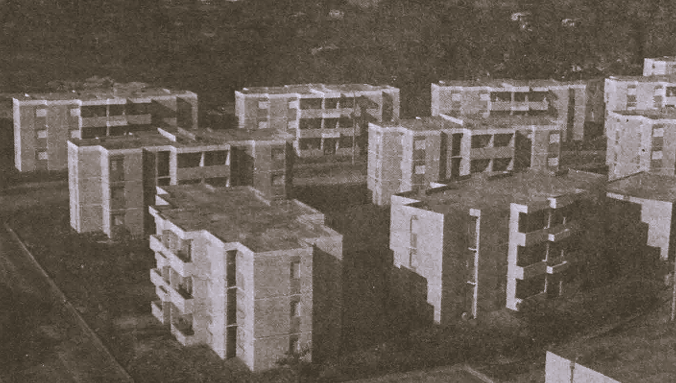
Located in Santo Domingo East, on the right bank of the Ozama River near the Duarte Bridge. Designed by architect José Tomás Hernández, one of the professionals most involved in the housing policies of the Balaguer administrations, as documented by Ulloa Cáceres in a footnote to his thesis.
The dominant building type is the multi-family block, and the thesis documents this with aerial and building photographs published in AAA Magazine. The same H-shaped floor plan that characterized this complex continued to be used in other phases of the Invivienda project and in other locations throughout the country, making Juan Pablo Duarte a typological benchmark of the period.
The studies consulted do not record the total number of units or the area of each apartment.
Invivienda Santo Domingo
It is the most extensive and best-documented project of the period. Designed in 1978 by architect Manuel Salvador Gautier, Ulloa Cáceres describes it as the project with the largest number of housing units planned up to that date in the Dominican Republic.
A grid-pattern sector was designed with blocks occupied by multi-family buildings with an H-shaped floor plan, usually built with four levels, and is located in the eastern part of the city.
Due to the country's economic readjustments and a lack of resource planning, the project was halted in 1984, under the administration of President Salvador Jorge Blanco. In 1987, it was restarted by the State Works Coordinating and Oversight Office, which completed the first phase of 560 apartments with basic infrastructure services.
In 1988, it was transferred back to the National Housing Institute (INVI) for its continued construction and management. In its current state, the complex combines three- and four-story residential blocks, single-family homes, and two-story duplexes. The urban layout consists of a grid of superblocks.
Ulloa Cáceres also documents how its inhabitants have transformed the complex over time: the addition of terraces and balconies has become, according to the architect Natalia Ulloa, a transformative element not only of the facades but of the transition space between the buildings and the street, which can be interpreted as reflecting a marked interest in living outside the home or the search for intermediate but delimited spaces.
Lots and Services in Sabana Perdida
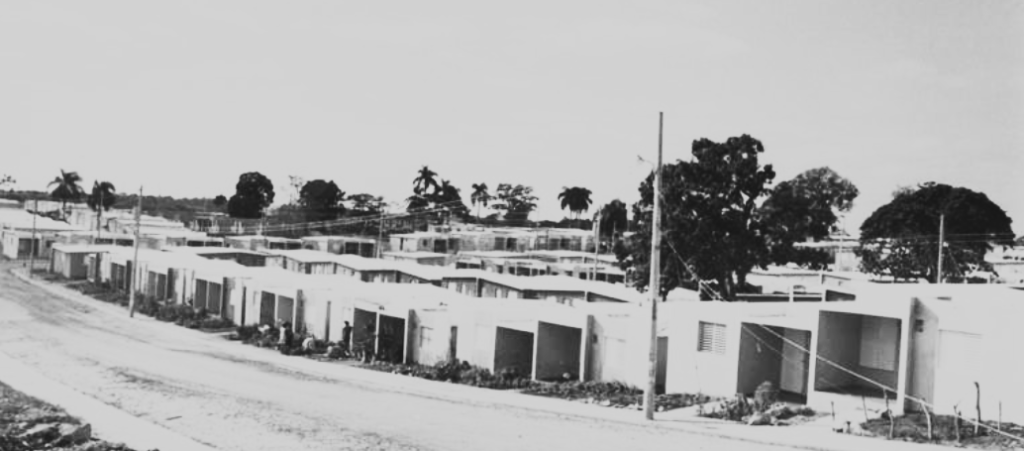
The third project of the period was the Lots and Services project in Sabana Perdida, in the northern part of the capital. Conceived under a model of less state intervention than the previous ones, instead of delivering finished units, the program provided families with lots with basic infrastructure so they could build their own homes.
The project was inaugurated in 1989 by President Balaguer, in his third term, but with a profound difference compared to what was planned during Guzmán's term: it had been projected for 1,020 homes and only 455 were delivered. Of those, 323 were attached and 122 corresponded to the typology called progressive housing, with two bedrooms.
This arrangement delivered the partially constructed unit so that the family could expand it according to their own investment pace, explicitly acknowledging that the State could not complete what it had promised.
What Guzmán inherited and did not resolve
To understand the magnitude of what Guzmán inherited, and the scale of what he was unable to resolve, Ulloa Cáceres offers a contrasting fact. The last major state project completed during those twelve years was Jardines del Embajador, built between 1967 and 1978 and designed by the architect Pedro José Borrell Brentz.
It was the first publicly funded housing project in the Dominican Republic to incorporate elevators, as its tallest buildings reached ten stories. Another notable detail is that it was designed for high-ranking government officials, which was reflected in the spaciousness of its units and the quality of the finishing materials used.
According to Ulloa Cáceres, this project was in a category that could be considered luxurious compared to other projects built during the same period, and it broke with the social housing model developed up to that point. Its construction, which began in 1967, extended until 1978, the year of the transition to democracy, although it is unclear under which of the two governments the final handover took place.
That contrast, between the luxury with which the State had built for its officials and the precariousness with which it responded to the families who lost their homes in a category five hurricane, summarizes the housing legacy that Guzmán received and that his government failed to overcome.
The structural diagnosis
Ulloa Cáceres has a political thesis that runs throughout his research and that he applies with equal force to the Guzmán period as to the previous ones: from the time of Trujillo onwards, the production and allocation of housing by the Dominican State was more linked to a clientelist strategy of the party in power than to guaranteeing the fulfillment and protection of a fundamental right.
The author understands that housing policies, in their conception, planning, construction, and allocation, were conditioned by their performance in partisan politics. Therefore, she argues that institutional weakness may be a factor that has prevented the social housing problem from being addressed systematically and continuously.
The researcher concludes by questioning whether, as of 2017 (the date of her thesis), a housing policy as such truly exists in the Dominican Republic. The history of Guzmán's term, with three projects initiated, one stalled, one delivered with less than half of the planned units, and thousands of families decades later still waiting in emergency shelters, is the most accurate illustration of this diagnosis.
Sources: Natalia Ulloa Cáceres, Social Housing in Santo Domingo: Opportunities for Recycling Existing Housing Stock, doctoral dissertation, Department of Architectural Projects, September 2017. Evelyn Vanessa González Mueses, On Dominican Social Housing in the 20th Century: The Case of Santo Domingo, MAAPUD 5, master's thesis. Ciudad Alternativa / Carmen Jiménez (EFE), "Life Under a Zinc Roof: The Other Side of the Dominican Republic's Paradise," October 16, 2017, ciudadalternativa.org.do. Ciudad Alternativa, "Victims and Refugees Due to Neglect," ciudadalternativa.org.do.
Series: History of social housing in the Dominican Republic. (Chapter XII).
Recommended readings: