


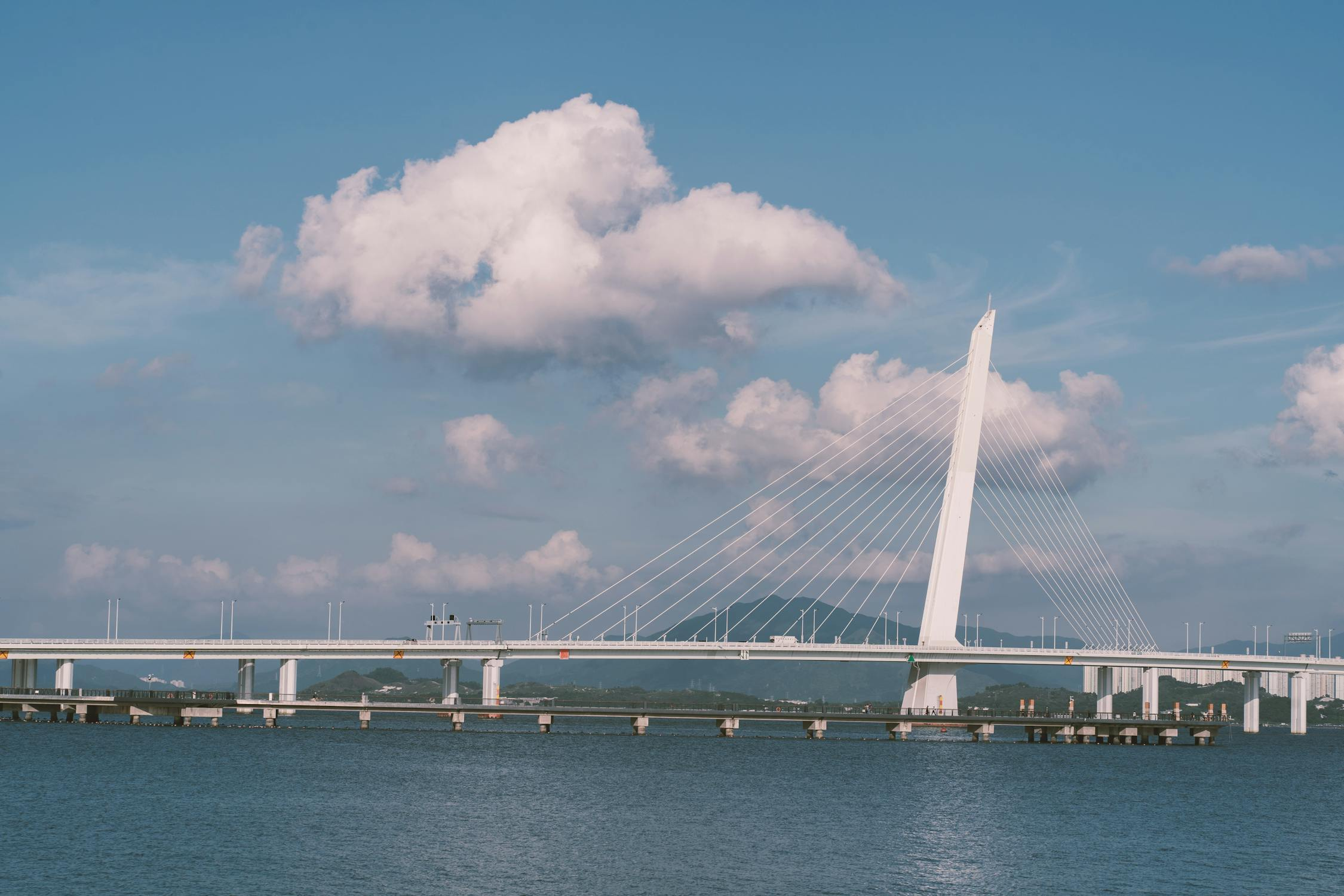
The Hong Kong-Zhuhai-Macau Bridge is one of the most astonishing megastructures in modern engineering. Opened in October 2018 after nearly a decade of construction, the bridge spans 55 kilometers, making it the world's longest sea-level bridge. This ambitious project connects the cities of Hong Kong, Zhuhai, and Macau, significantly improving mobility in the Pearl River Delta region of southern China. Its total construction cost exceeded €18 billion, and its design is remarkable not only for its monumental length but also for the technical challenges overcome to bring it to fruition.
A bridge that defies the ocean
The construction of the Hong Kong-Zhuhai-Macau Bridge was no easy feat. In addition to spanning one of the world's busiest shipping lanes, it faced unique geological and climatic challenges. The bridge, comprised of three main sections, crosses the Pearl River Delta, an area known for its harsh weather and seismic activity. One of the most impressive aspects of this project is the construction of a 6.7-kilometer underwater tunnel, extending beneath the ocean to allow large vessels to pass through the waterway without disrupting port traffic.
The tunnel is connected by two artificial islands, created specifically for this project, which serve as access points. The islands and the tunnel form a crucial part of the infrastructure, allowing maritime and vehicular traffic to coexist without interruption. This ingenious design reflects the advanced planning and execution of the project, which successfully overcame large-scale engineering challenges.
Improvement in regional connectivity
One of the main objectives of the bridge was to improve connectivity in the Pearl River Delta region, a vital economic area for China. Before the bridge's construction, the journey between Hong Kong and Macau or Zhuhai could take several hours, as transport relied on ferries or long-distance overland routes. Now, thanks to the new infrastructure, travel time between these three cities has been significantly reduced, to as little as 30 minutes in some cases.
This bridge has transformed transportation in the region, facilitating not only daily commutes but also trade and tourism. Furthermore, it has directly impacted the economic expansion of Zhuhai, one of the less developed of the three cities, which is now better connected to the major financial centers of Hong Kong and Macau. The project has also been integrated into China's long-term development plans to promote interconnectivity in the Greater Bay Area.
An economic and logistical colossus
The Hong Kong-Zhuhai-Macau Bridge is more than just a connection between cities. This project is part of China's strategic plan to enhance regional cohesion and transform the Greater Bay Area into a hub of innovation and technology that rivals other world-class metropolitan areas, such as the San Francisco Bay Area or the Tokyo area. The infrastructure not only facilitates passenger transport but also the movement of goods, relieving pressure on other modes of transportation, such as ferries and land routes.
The bridge is estimated to have a lifespan of at least 120 years, and its construction has generated thousands of direct and indirect jobs during the building phase and its ongoing maintenance. However, this colossal project has also been criticized for its high cost and environmental impact. Environmental organizations have pointed out that the bridge's construction has affected local marine life, particularly the population of Chinese white dolphins, an endangered species.
A future of opportunities
Despite the controversies, the Hong Kong-Zhuhai-Macau Bridge represents a significant advancement in engineering and economic development. Experts emphasize that this type of infrastructure is key to regional growth and that its impact will become more apparent in the coming years. The project has become a symbol of China's technical capabilities and its ambition to dominate transportation and mobility globally.
Source: https://www.eleconomista.es/







