


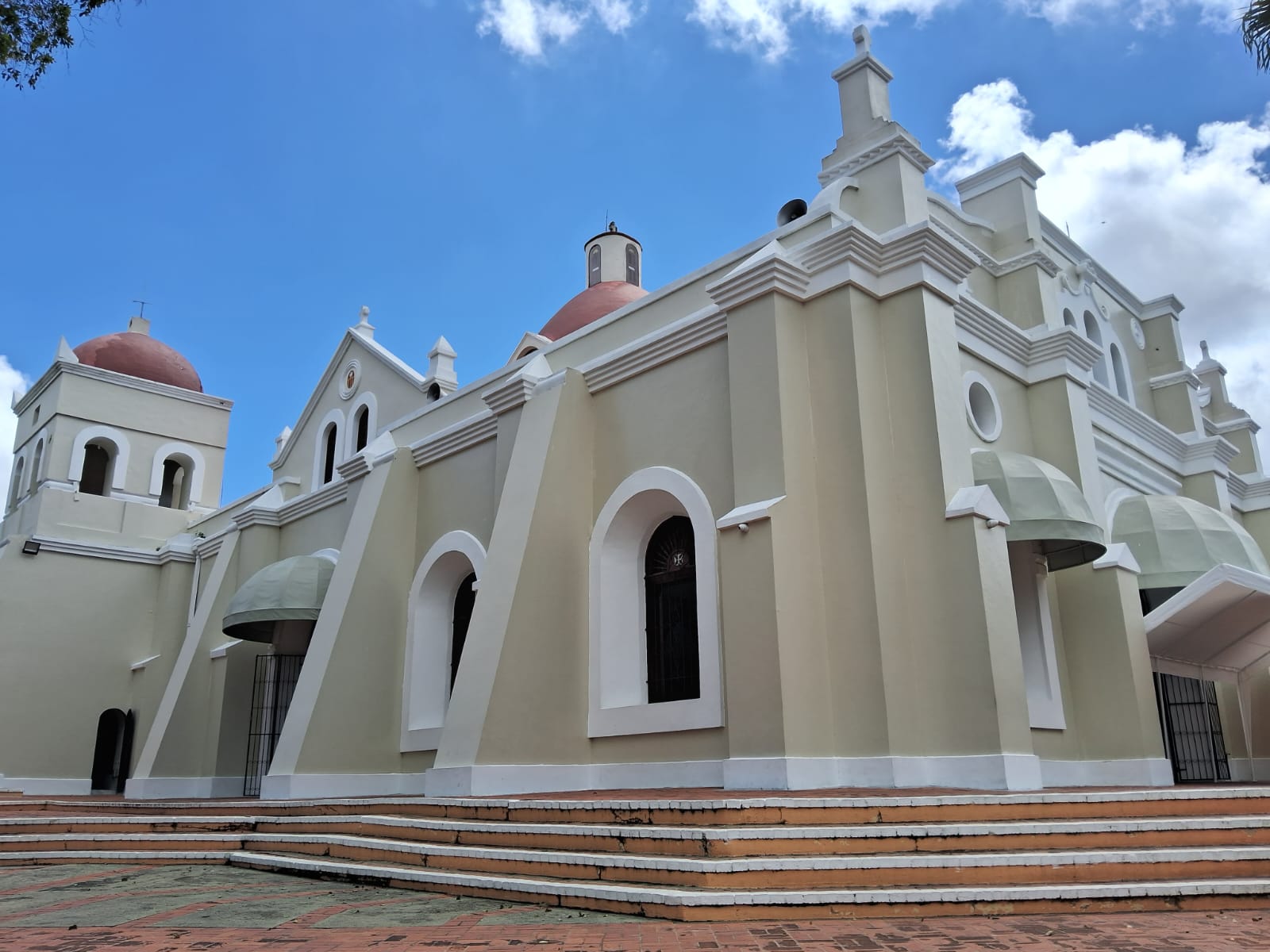
From below, the promontory looks like a promise; above, it is a spiritual balcony, built from a cross, with a mortar of history, faith and community
SANTO DOMINGO – There are steep paths that are not traversed solely with one's feet, but also climbed with memory, faith, and that inner silence that urban life often forgets. Such is the path to the National Shrine of Our Lady of Mercy, a place where Dominican history intertwines with devotion.
The temple that now crowns the hill is not the first. As is the case with many places of faith in America, this place is a superposition of eras and stories.
The first references to a hermitage date back to the 16th century, built around a cross that, according to various traditions collected in Dominican historiography, was already an object of early veneration.
By the middle of the 20th century, the Diocese of La Vega had consolidated its character as a national sanctuary, with the intention of occupying the landscape and turning it into a landmark, dedicated to the Marian devotion of the Virgin of Mercy, Patron Saint of the Dominican people.
Form, style, and function
The current sanctuary, whose construction began in 1880 with the approval of figures such as Fernando Arturo de Meriño and Roque Cocchía (Rocco), was built by the master builder Onofre de Lora, representative of a construction tradition based on the craft rather than on academic training.
This does not imply lesser value, but a different nature: it is part of a tradition where architecture is understood as a collective expression, linked to faith, territory and historical continuity rather than to the formal canon.
As is the case with many works partially documented in the General Archive of the Nation, the available information prioritizes the historical context over the technical details of the design.
The architecture of the sanctuary, with its wide nave, dominant altar, and strategic location, is eclectic in character with a neoclassical predominance and responds more to the functional need to accommodate pilgrims and assert its presence in the landscape than to a stylistic pursuit.
It is designed to be seen from below, to mark the hill; not to impose itself through ornamentation, but through location.
Inside, the logic is different: a spacious nave, subdued lighting, a dominant central altar, and understated ornamentation. A functional space for mass pilgrimage, but also for individual contemplation.
Before the temple, there was the story
For centuries, tradition linked this place to the Battle of Vega Real, where, according to popular narrative, Christopher Columbus's forces would have defeated the Taíno with divine help.
The scene, a cross on high, an apparition and a victory, was fixed in the collective memory for generations, reinforced even by school manuals such as "History of My Country", where the episode was taught as part of a national narrative.
However, modern historiographical revisions qualify that version. Historian José Gabriel Guerrero has pointed out that there is no documentary evidence placing the battle on Santo Cerro or confirming a Marian apparition. According to his interpretation, the 1495 confrontation occurred in another area of the Vega Real.
This view is further supported by the fact that chroniclers of the Indies, such as Bartolomé de las Casas in his "History of the Indies," or Gonzalo Fernández de Oviedo in his "General and Natural History of the Indies," do not record any appearance linked to that episode. And that silence is also part of history.
What does appear consistently in the sources is the presence of a cross erected by the Spanish at the end of the 15th century, which became an object of veneration. From there, the story expanded, was reinterpreted, and remained alive, even amplified today in new languages and platforms, until it became consolidated as part of the place's identity.
In the 19th century, authors such as Antonio del Monte y Tejada and José Gabriel García finished articulating that association between the Virgin, the battle and the hill.
The Holy Hill is, in essence, a geographical feature turned into a symbol: a high point that organizes the view over the La Vega valley and functions as a spiritual and cultural reference.
What the visitor will find
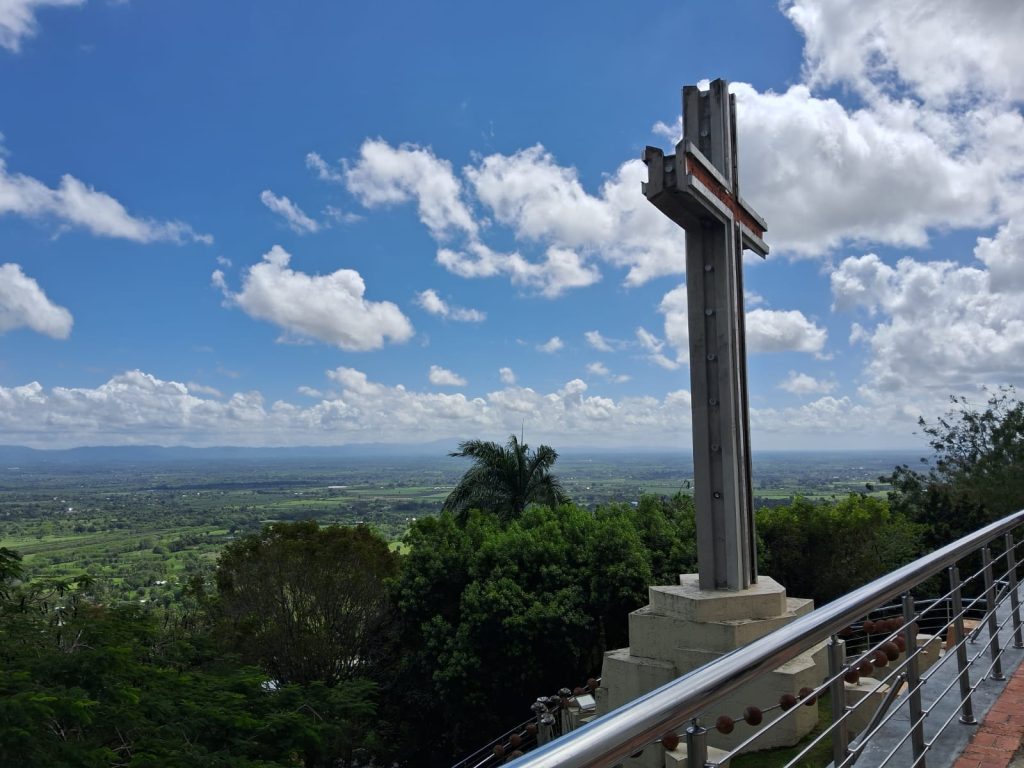
The winding and gradual ascent is not designed as a tourist walk, but as a lived experience: bougainvillea, cayenne and flamboyant trees appear among stretches of spontaneous vegetation, while small stops allow pilgrims and visitors, many of them on foot, to stop, breathe or pray before reaching approximately 550 meters in height.
Upon reaching the summit, an esplanade opens up with a wide view of the valley, a sober temple, spaces for prayer and a constant presence of promises, candles and shared silences.
But above all, there's an atmosphere difficult to describe: a blend of debated history and unquestionable faith.
Liturgical activity is constant, especially on weekends. But every September 24th, the feast day of Our Lady of Mercy, the place becomes one of the country's main pilgrimage centers. On that day, faith ceases to be private and becomes a mass phenomenon.
After Mass
If you attend the Eucharist, you can follow the thread of history with a visit to La Vega Vieja, where the foundations of the city founded in 1494 by Christopher Columbus remain.
It was a prosperous city, fueled by the region's gold, until the 1562 earthquake almost completely wiped it off the map. Today, all that remains is silence and stone: the ruins of the Concepción Fort, urban layouts, and traces of churches. Walking through it is like experiencing emotional archaeology: it doesn't impress you with what you see, but with what it compels you to imagine.
Recommendations for the traveler
Go early, for the weather and peace and quiet; confirm Mass times; wear comfortable shoes; respect the atmosphere of contemplation. Understand where you are: not just at a viewpoint, but in a place full of meaning.
Below, the country continues; above, something is suspended. Perhaps that is why this place continues to draw people: because here, between a documented cross and a disputed apparition, Dominican faith found a place to remain.
You might climb out of faith, curiosity, habit, or even simple historical interest. The truth is, though, when you come down, your perspective is never the same.
Santo Cerro isn't a well-established culinary destination, so for lunch it's best to head down to the city of La Vega, where you'll find options like El Zaguán, Platanitos, El Naranjo, or La Carretera. These are authentic, unpretentious places where local cuisine maintains its everyday charm.
Santo Cerro is not just a sanctuary: it's a way of understanding how a country constructs its symbols. Between what the documents say and what tradition maintains, there remains an intermediate space. And it is precisely there that this place continues to hold meaning.
Because history isn't just about what happened, but about what we choose to believe... and the places we keep returning to.
Recommended readings:







