To continue the process, he will meet with Bandex this afternoon.
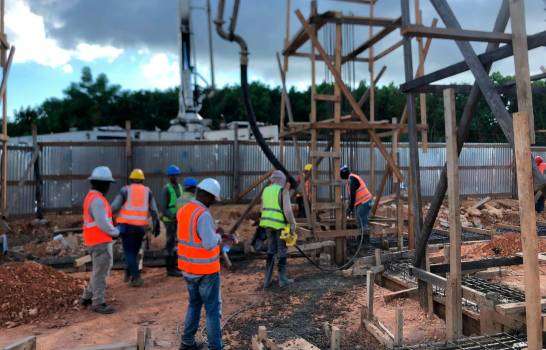
SANTO DOMINGO.- Like developed countries, the Dominican Republic's construction sector must move towards industrialization, where processes should depend less and less on manual labor.
President Luis Abinader believes this measure will prove more efficient and economical in the medium term. According to the president, tools such as prefabricated elements and other techniques that have emerged with technological advancements are becoming much more efficient over time.
“What’s more, it’s more efficient and more economical in the medium term. And in the case of construction, it’s industrialization with prefabricated elements and a series of other techniques that I’m sure will be more efficient, as is the case in other more developed countries where it’s much less artisanal and much more industrial,” Abinader explained, referring to the topic, during La Semanal con La Prensa, which takes place every Monday at the National Palace.
He announced that, to continue taking firm steps towards that goal, this Tuesday, March 8th at 3:00 pm, the agricultural and construction sectors will meet with representatives of the Development and Export Bank (Bandex), to further explore alternatives to support entrepreneurs in those sectors, in their evolving agenda.
“To continue financing the mechanization, equipment, and industrialization of construction, to gradually eliminate foreign workers. That's what we're working on, and we're also doing it in accordance with the Ministry of Labor's law,” he said.
In the measures announced last Sunday to curb illegal Haitian migration to the country, Luis Abinader said, “We will expand the fund administered by the National Development and Export Bank (Bandex) to provide producers' associations and cooperatives with the resources for their technological transformation. The private construction and agricultural sectors must reach an agreement with the government on their industrialization and mechanization within a reasonable timeframe.”.
The Dominican president highlighted yesterday cases such as the rice sector, where there is a success story, financed through Bandex for mechanization. "And many products have reduced labor by 80%.".
He pointed out that this is a measure that will not be implemented in the short term, but that he understands that the workforce will have to be gradually reduced.
He specified that he has held several meetings with the stakeholders involved, seeking a solution to the issue. He cited the case of the Dominican Association of Housing Builders and Developers (Acoprovi), which has organized conferences and meetings on the importance of mechanization in that sector. “In other words, everyone is already making progress, and what we want is for them to move forward even faster,” he emphasized.
Salary increase to boost
Abinader reiterated that he will promote an increase in the minimum wage in the free trade zone and tourism, as part of a strategy to promote the "Dominicanization of work".
"In the speech I gave to the country yesterday, we are going to propose at the tripartite table a 25% increase in the minimum wage in the free trade zone and a 30% increase in the tourism sector ," the president said, referring to the measures announced during his address on Sunday, April 6.
The head of state explained that these proposals are part of a set of actions aimed at responding to the concerns of Dominican citizens about job losses due to irregular migration, a problem that, in his words, "cannot be ignored or minimized.