



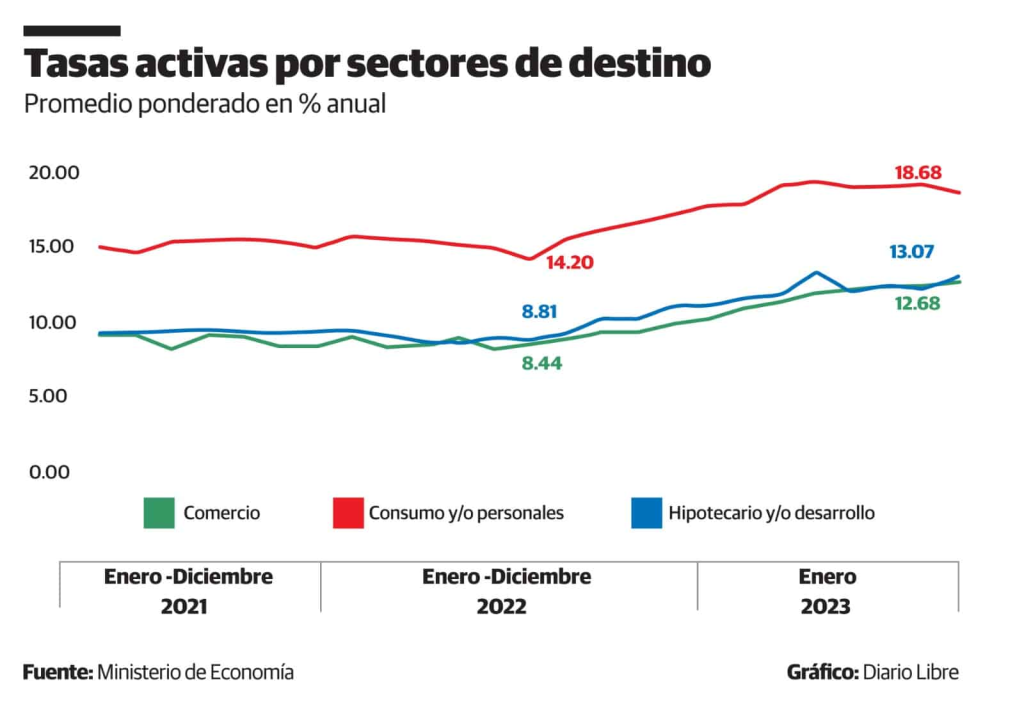
SANTO DOMINGO- Mortgage loans are the second on the list of loans that have increased in the last twelve months, going from 8.81% in January of last year to 13.07% currently, for an increase of 4.25 percentage points.
A year ago, in January 2022, the weighted average interest rate for a consumer or personal loan was 14.20%. Twelve months later, in January 2023, it rose to 18.68%, an increase of 4.49 percentage points. According to the Ministry of Economy, this is a result of the restrictive monetary policy adopted by the Central Bank, as reported today by the newspaper Diario Libre.
According to the ministry's most recent Macroeconomic Situation Report, the interest rate on consumer or personal loans has been the one that has varied the most.
Meanwhile, the rate of loans for commerce varied by 4.24 percentage points, going from 8.44 to 12.68%.
According to the media review, the weighted average rates are higher than those recorded in 2021, when in November of that year the Central Bank began to increase its monetary policy interest rate to contain inflation, taking it from 3.00% to the current annual rate of 8.50%, impacting the purchasing power of individuals and companies to reduce pressure and bring about a balance between supply and demand.
Variations
Interest rates by destination
January 2023 vs. January 2022
4.49 percentage points
Consumer loans
4.25 percentage points
Mortgage loans
4.24 percentage points
Trade loans
Although the restrictive monetary policy – which other countries have also applied in the current context – managed to moderate the rise in prices, bringing the year-on-year inflation rate down to 7.24% in January, it has also led to a gradual increase in interest rates for different types of credit and deposit products in the financial system, depending on whether they are contracted at a fixed or variable rate.
This gradual increase was experienced by a customer of a commercial bank. From the time she took out a mortgage loan in November 2016 until November 2021, she was paying the bank 24,737 pesos per month, even though the rate was fixed for a year.
By February 2022, the monthly payment had risen to 25,156 pesos, and in November of that same year - when the bank notified him again of a new rate increase - it increased to the 26,634 pesos he currently pays.
In summary, in one year he went from paying 1,897 pesos more per month for his mortgage loan.
Market rates
Last January, the active interest rate (the one the customer pays to the bank when taking out a loan) stood at 14.96%, above the annual average of the last seven years (12.67%), the Ministry of Economy indicates in its report.
The passive rate (the rate the bank pays the customer for deposits) remained above the historical average since 2013, reaching 10.02%. However, the ministry notes that it registered a slight reduction of 0.17 percentage points compared to December 2022, when it stood at 10.19%.
Economist Jaime Aristy Escuder analyzes on his blog that between March 2020 and November 2021, the weighted average lending rate was 10.13% and the deposit rate was 3.39%. The spread between the two rates was 6.73%.
It indicates that between January and February of this year, the active interest rate began to rise much faster than the passive rate, placing the margin at 6.05%, "a level that is below the historical average of 7.68%.".
It concludes by projecting that the active interest rate will continue to rise faster than the passive rate in the coming months.
Source: Diario Libre







