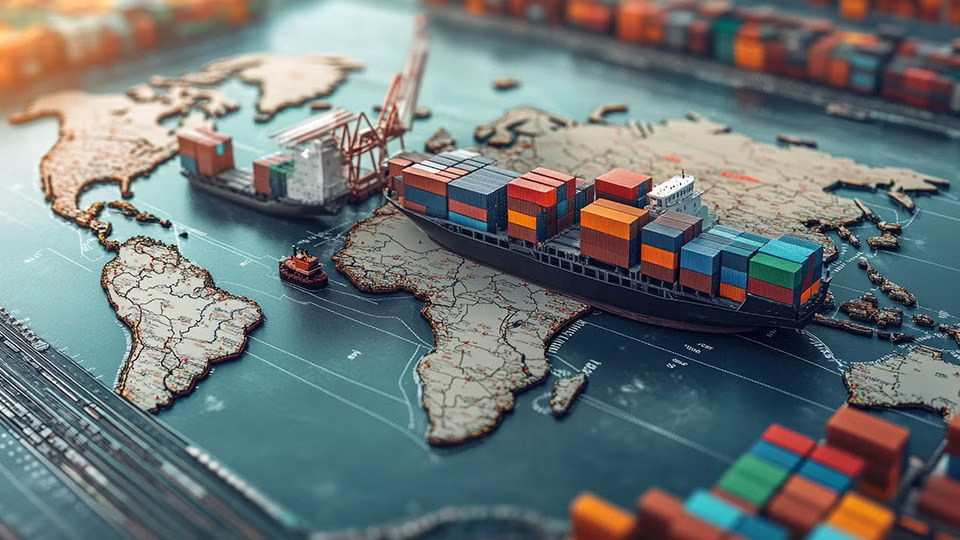
Over the past few years, nearshoring has ceased to be a trend and has become a global strategy for survival and competitiveness.
The pandemic, geopolitical tensions, supply chain problems, and rising operating costs in Asia forced many international companies to rethink where to produce, operate, and expand.
And amid this global reorganization, the Dominican Republic began to feature more and more prominently in the conversation. The country's strategic location, its air and sea connectivity, its free trade zones, macroeconomic stability, and the growth of its services sector have made it one of the most closely watched markets in the Caribbean and Latin America.
But here's where the real question arises:
Are we really ready for the next nearshoring cycle?
Because attracting investment doesn't depend solely on tax incentives or low labor costs. International companies today evaluate entire ecosystems. And that includes:
– logistics infrastructure,
– energy availability,
– talent,
– transportation,
– corporate offices,
– industrial facilities,
– telecommunications,
– sustainability,
– legal certainty,
– and speed of execution.
I've seen international companies arrive in the country excited about market opportunities… and then be surprised by certain operational limitations that we still need to improve.
In some cases, the challenge isn't finding space. It's finding the right space.
Warehouses with adequate heights.
Prepared industrial floors.
Efficient logistics access.
Ample parking.
Robust electrical infrastructure.
Offices capable of accommodating high-density operations.
Because modern nearshoring is no longer just about "cheap square meters." It's about operational efficiency. And that completely changes the real estate conversation. Today, many international companies compare the Dominican Republic not only to other Caribbean markets, but also to cities and industrial hubs in
Mexico,
Costa Rica,
Colombia
, and Panama.
Time is a factor.
Infrastructure is a factor.
Talent is a factor.
Response speed is a factor.
And that's where the real estate sector plays a much more strategic role than is often realized. A country can have an excellent geographic location, but if it lacks a corporate and industrial inventory prepared to absorb large-scale operations, it loses competitiveness. This applies to offices, logistics, and industry alike. Interestingly, the Dominican market has already begun to react. We are increasingly seeing:
– more institutional developers,
– more modern industrial projects,
– improved technical specifications,
– an ESG (Environmental, Social, and Governance) vision,
– more sophisticated logistics parks,
– and corporate buildings more aligned with international standards.
But there is still enormous room for growth. Especially since many international companies are no longer simply looking for a place to operate. They are looking for markets where they can grow over the next 10 or 15 years. And that requires a different way of thinking.
It forces us to plan infrastructure before we need it.
It forces us to develop more efficient assets.
It forces us to raise standards.
It forces us to further professionalize the market.
Because the next nearshoring cycle will probably not be captured by the cheapest country. It will be captured by the best-prepared country.
Conclusion
The Dominican Republic has a historic opportunity before it.
Global demand exists.
International interest exists.
The strategic location exists.
Now the big challenge is building the infrastructure, inventory, and operational capacity to transform that opportunity into long-term, sustainable growth. Because nearshoring doesn't just reward geography. It rewards preparation.
Recommended readings: