


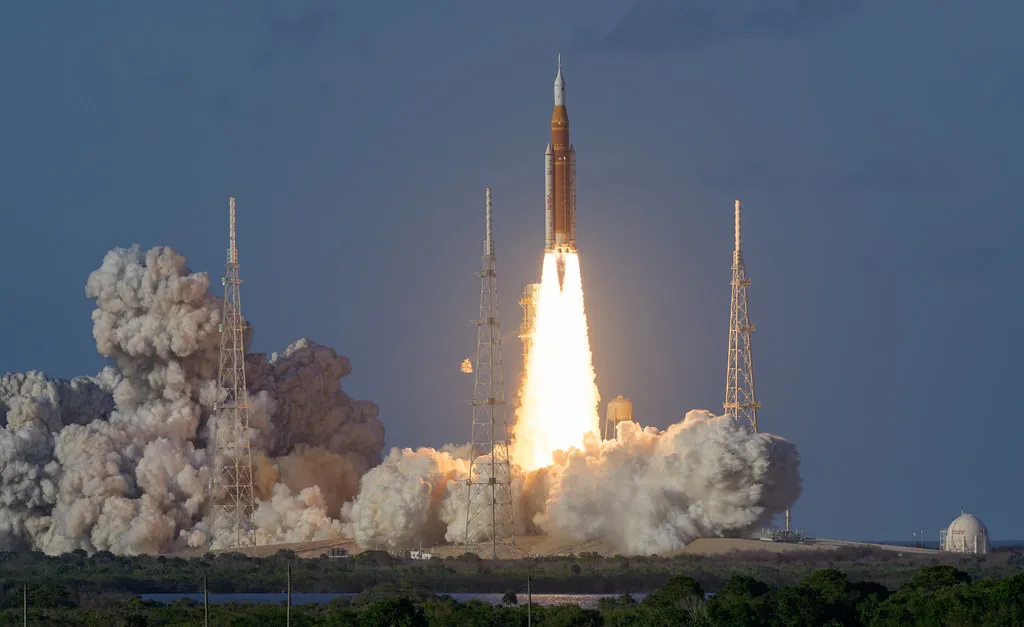
NASA the green light this Thursday to the astronauts of the Artemis II to head towards the Moon and carry out the first manned lunar flyby in more than 50 years.
NASA Administrator Jared Isaacman confirms that the translunar injection maneuver has been completed and the Orion spacecraft is now on its way to the Moon. “The Artemis 2 crew is officially on its way to the Moon. The United States is sending astronauts back to the Moon. This time, farther than ever before,” he wrote on social media.
NASA's SLS (Space Launch System) rocket lifted off from launch pad 39B at the agency's Kennedy Space Center in Florida at 6:35 p.m. EDT yesterday, Wednesday, April 1, sending four astronauts aboard the Orion spacecraft on a planned test flight around the Moon and back.
The spacecraft remained in high Earth orbit for a day, where the crew conducted a manual piloting demonstration to test Orion's handling capabilities. The astronauts, along with teams at Mission Control at NASA's Johnson Space Center in Houston, will continue to check the spacecraft's systems.
"If all systems are functioning correctly, mission controllers will give the command to the European-built Orion service module to perform the translunar injection maneuver on Thursday, April 2. This maneuver, which lasts approximately six minutes, will send the spacecraft on a trajectory that will carry the crew around the Moon and, at the same time, use lunar gravity to propel it back to Earth," said the initial NASA statement.
More than 50 years
“Today’s launch marks a watershed moment for our nation and for all who believe in exploration. Artemis II builds on President Donald J. Trump’s vision, bringing humanity back to the Moon for the first time in more than 50 years and opening the next chapter of lunar exploration beyond the Apollo program. Aboard Orion are four exceptional explorers preparing for the first crewed flight of this rocket and spacecraft, a true test mission that will take them farther and faster than any other human being in a generation,” NASA Administrator Jared Isaacman said Wednesday.
He added that Artemis II is the beginning of something bigger than any single mission. “It marks our return to the Moon, not just to visit it, but to eventually establish our lunar base, and lays the foundation for the next great advances,” the NASA statement emphasizes.
The launch marks the start of an approximately 10-day mission for NASA astronauts Reid Wiseman, Victor Glover and Christina Koch, and CSA (Canadian Space Agency) astronaut Jeremy Hansen.
Flight Objectives
As the first crewed mission of NASA's Artemis program , among its objectives, the flight will demonstrate for the first time crewed life support systems and lay the groundwork for a permanent presence on the Moon in preparation for future missions to Mars, according to official information.
After reaching space, Orion deployed its solar panels, allowing the spacecraft to receive power from the Sun, while the crew and engineers on the ground immediately began transitioning the spacecraft from launch operations to flight operations to begin checking key systems.
“Artemis II is a test flight, and the test has just begun. The team that built, repaired, and prepared this vehicle for flight has given our crew the machine they need to demonstrate what it is capable of,” said NASA Associate Administrator Amit Kshatriya.
“Over the next 10 days, Reid, Victor, Christina, and Jeremy will be testing Orion so that future crews can confidently go to the lunar surface. We are on the first mission of a long campaign, and the work ahead is greater than what we have already accomplished,” the executive noted.
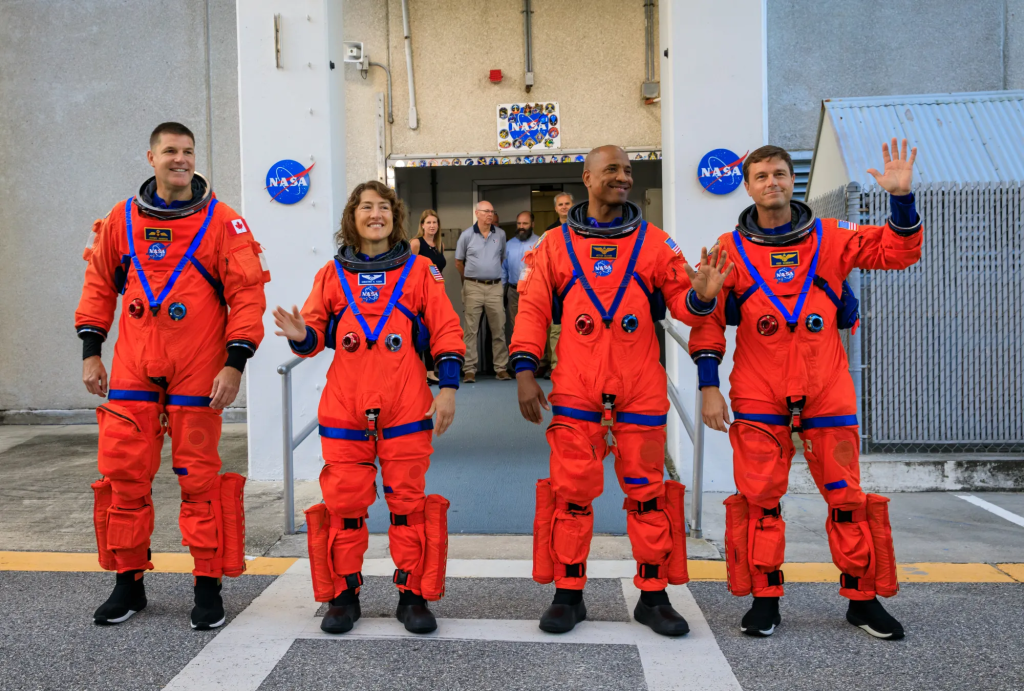
The Artemis II crew members (from left to right), CSA (Canadian Space Agency) astronaut Jeremy Hansen and NASA astronauts Christina Koch, Victor Glover, and Reid Wiseman, leave the astronaut crew quarters inside the Neil Armstrong Operations and Verification Building and board the Artemis crew transport vehicles before traveling to Launch Pad 39B as part of an integrated ground systems test at Kennedy Space Center in Florida on September 20, 2023, to test the crew schedule for launch day. NASA/Kim Shiflett.
Who are the astronauts?
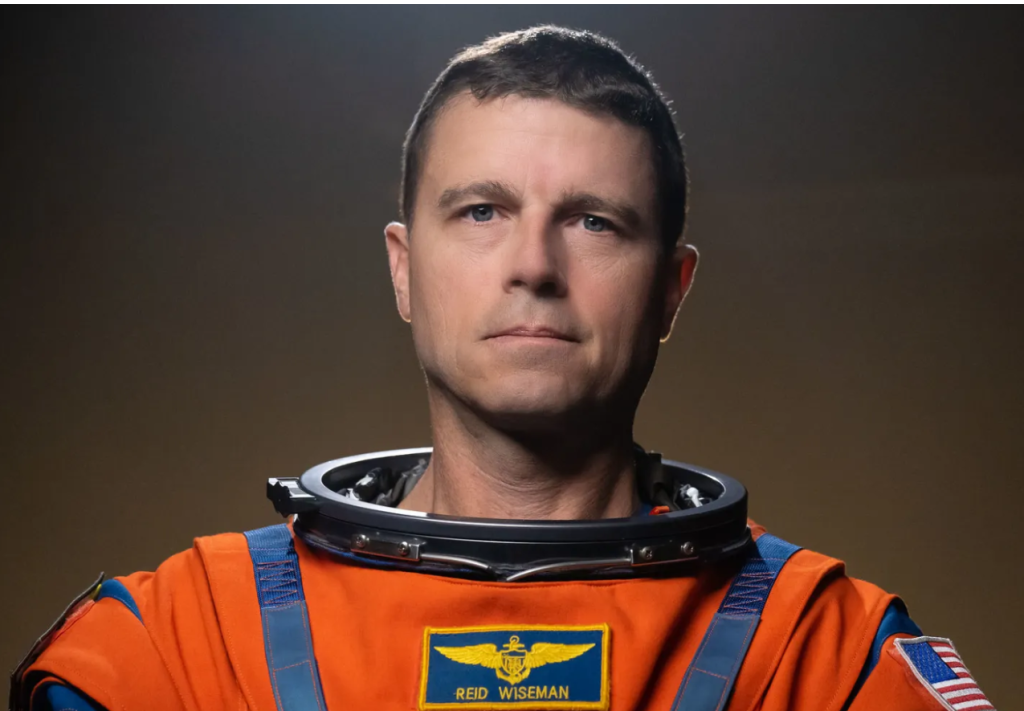
Reid Wiseman (Credit: NASA).
He was selected as a NASA astronaut in 2009. He is the commander of the Artemis II mission. This Baltimore native earned a Bachelor of Science degree from Rensselaer Polytechnic Institute in Troy, New York, and a Master of Science degree in Systems Engineering from Johns Hopkins University in Baltimore. He commanded the NEEMO21 mission to the Aquarius Reef Habitat off the coast of Islamorada, Florida. A 27-year Navy veteran, his late wife, Carroll, dedicated her life to helping others as a registered nurse in the neonatal intensive care unit. He is survived by his two children. Despite his long list of professional accolades, Reid considers his experience as a single father to have been both his greatest challenge and the most rewarding period of his life. Among his awards and distinctions are: Legion of Merit, Defense Superior Service Medal, Air Medal with combat distinction (five decorations), Navy and Marine Corps Commendation Medal with combat distinction (four decorations), Navy and Marine Corps Merit Medal, and other campaign and service decorations.
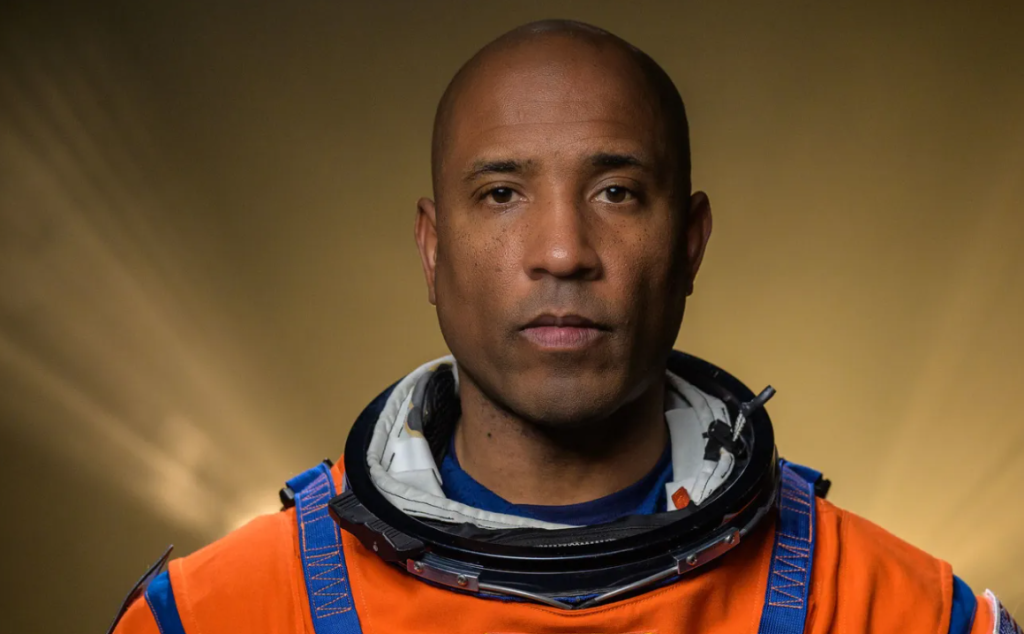
Victor J. Glover, Jr. (Credit: NASA).
A NASA astronaut since 2013, he served as a legislative intern in the U.S. Senate. This California native earned a bachelor's degree in engineering while playing two sports and serving his community. Glover is a naval aviator and was a test pilot for the F/A-18 Hornet, Super Hornet, and EA-18G Growler aircraft. He and his family have been stationed in numerous locations across the United States and Japan, and he has participated in both combat and peacetime missions. He was born in Pomona, California. He is married to Dionna Odom, a native of Berkeley, California. They have four children. His awards include the Defense Superior Service Medal, the Navy Commendation Medal, two Navy and Marine Corps Merit Medals, the NASA Distinguished Service Medal, and the NASA Space Exploration Medal; he was named Ontario High School Athlete of the Year in 1994, among others.
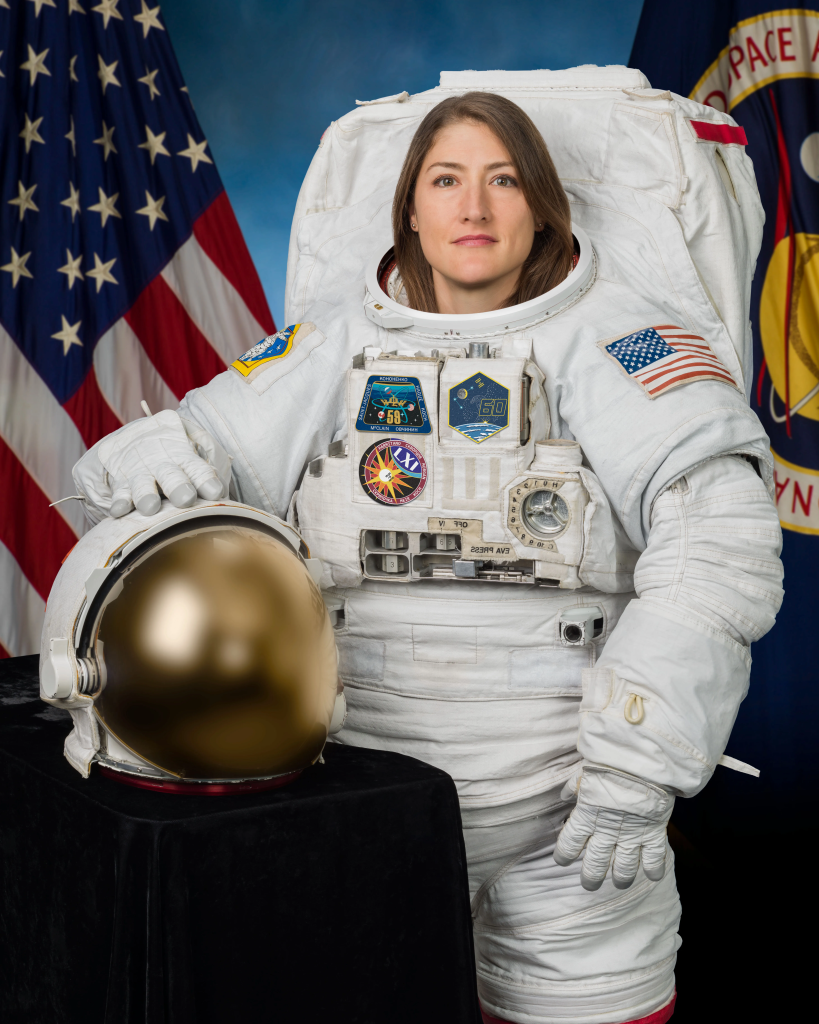
Christina Koch (Credit: NASA).
She was selected as a NASA astronaut in 2013. She served as a flight engineer on the International Space Station (ISS) for Expeditions 59, 60, and 61. Koch set a record for the longest solo spaceflight by a woman with a total of 328 days in space and participated in the first all-female spacewalk. A native of Grand Rapids, Michigan, she grew up in Jacksonville, North Carolina. Among her awards are the Neil Armstrong Award for Excellence, Astronaut Scholarship Foundation, 2020; Astronautical Engineering Award, National Space Club & Foundation, 2020; ATHENA Global Leadership Award, ATHENA International, 2020; and the NASA Group Achievement Award for the Jupiter Energetic Particle Detector Instrument on NASA's Juno Mission, 2012, among others.
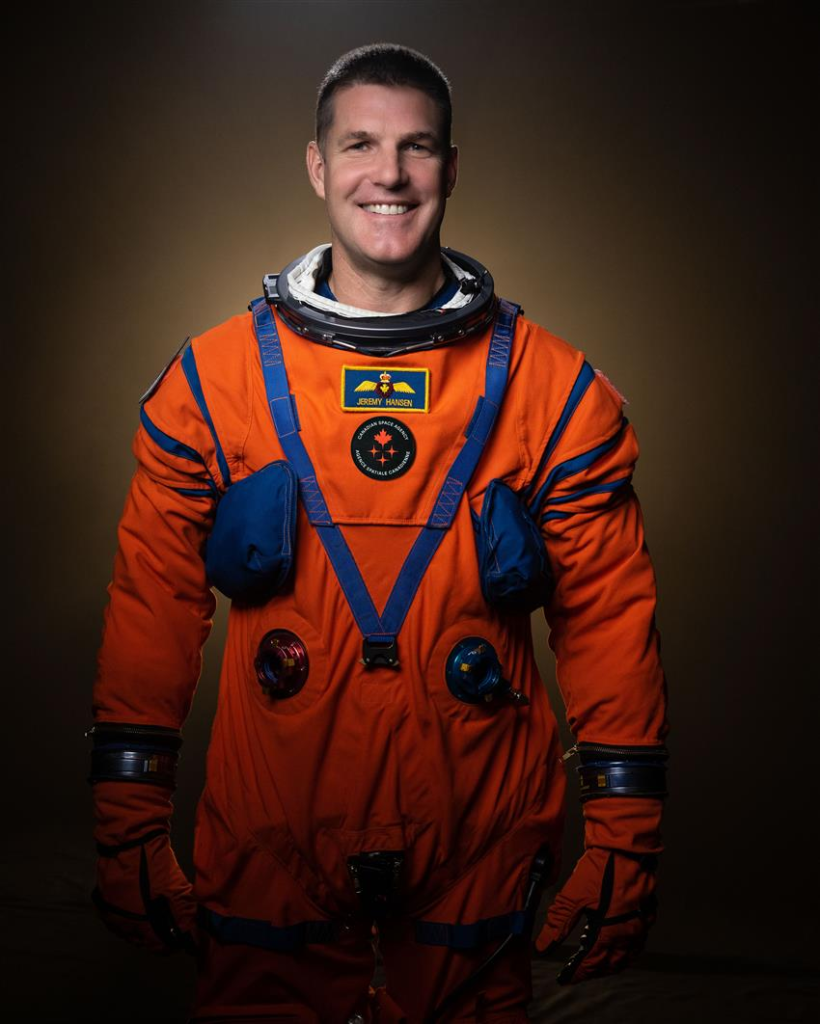
Jeremy Hansen (Credit: NASA).
He was born in London, Ontario, and raised on a farm near Ailsa Craig, Ontario, until he moved to Ingersoll for high school. He is married and has three children. He graduated with honors in space science from the Royal Military College of Canada in Kingston, Ontario. His awards include: the Air Cadet League of Canada Award: Top Air Force Graduate of the Royal Military College of Canada (May 1999), the Clancy Scheldrup Memorial Trophy – Outstanding Graduate of the Basic Flight Course (
2001), the Canadian Air Force Pilot's Wings (May 2002), the Canadian Armed Forces Decoration – 12 Years of Good Service (October 2006), the Queen Elizabeth II Diamond Jubilee Medal (2012), and the Royal Canadian Geographical Society Gold Medal (2014).
After a successful lunar flyby, the astronauts will return to Earth and splash down in the Pacific Ocean.
As part of the Golden Age of Innovation and Exploration, NASA will send Artemis program astronauts on increasingly difficult missions to further explore the Moon in search of scientific discoveries, economic benefits, and to lay the groundwork for the first crewed missions to Mars.







