


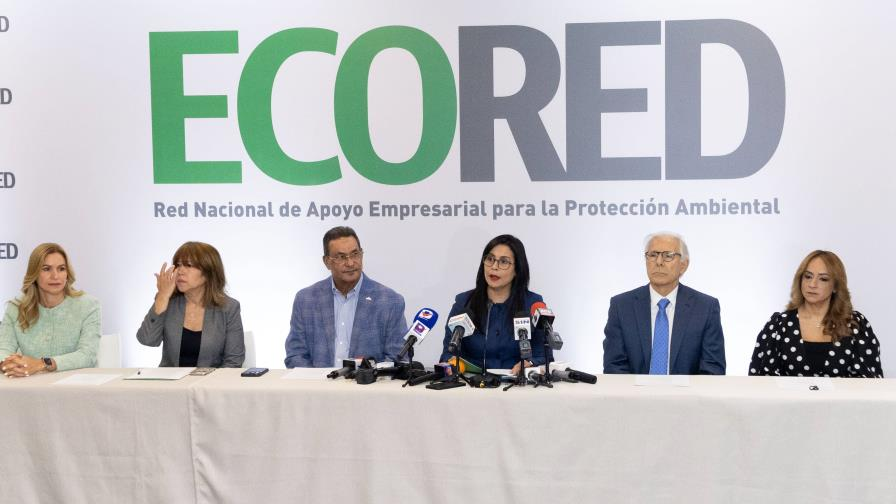
SANTO DOMINGO– Various business associations and representatives of the national productive sector warned that the new Law on Comprehensive Management and Co-processing of Waste represents a serious financial sustainability problem for the country, by establishing a financing model that would commit more than 75% of the resources collected without ensuring the capacity for investment in recycling, infrastructure or environmental education.
According to representatives from Ecored, Adocem, and the tourism sector, the reform, approved in a single reading on July 23 and awaiting promulgation by the Executive Branch, creates a contribution scheme based on the gross income of companies, without considering the amount of waste generated or the efforts made in recovery and recycling.
This, they pointed out, particularly penalizes sized enterprises (MSMEs) with reduced margins and could push many into informality or underreporting income in order to survive.
“Regarding the amount, we continue to believe that those who pollute more should pay more, and that the amount should be related to the quantity of waste you generate, because that is what will lead us to reduce, as an incentive, the amount of waste we bring in,” said Aguie Lendor, executive vice president of the Dominican Republic Hotel and Tourism Association ( Asonahores ).
However, Christy Luciano , the interim president of Ecored , warned that the form and design of the law represents a serious problem for the business sector of the Dominican Republic.
“We are deeply concerned that this reform was approved in a single reading on July 23 and sent to the Executive Branch for its enactment, without incorporating fundamental technical adjustments or opening a space for real dialogue with the sectors involved,” he said.
He also highlighted that annual revenue is estimated at over 8 billion pesos, of which approximately 4 billion would be allocated to increasing the rates of the collection companies, which currently receive less than 3 billion pesos, and about 2 billion pesos would be transferred directly to the municipalities.
He said the reform weakens principles of good governance and poses risks of discretion by allowing the inclusion of actors with particular interests in decision-making roles.
Furthermore, he indicated that it hinders the fair participation of MSMEs, threatens the progress of the circular economy model that “has cost us so much to build and would lead us to regress in the guarantees of effective traceability of waste or in the integration of managers into the chain, which would limit transparency, environmental control and compliance monitoring .”
Ecored Recommendations
- That the special contribution be supported by fiscal or financial studies and be determined based on net income and not gross income.
- That open and competitive contracting mechanisms be applied, in accordance with the Law on Purchases and Contracts; and that the operating contracts between the Sustainable DO Trust and the authorized managers of transfer stations, sanitary landfills and valorization plants, have a validity of three (3) to five (5) years, and not 10 years, as is currently the case.
- That mandatory oversight bodies be established with the participation of academia, NGOs and the private sector, to guarantee transparency in the allocation of permits and contracts through the municipalities.
- Promote the valorization, recycling and utilization of waste as drivers of sustainable development and industrial transformation.
- That a representative from Codopyme be included on the Sustainable DO Trust Council, as a way to balance decision-making.
"Our position is not one of confrontation, but of responsible warning, because to move forward with the necessary reform we all need to be on board," Luciano explained.







