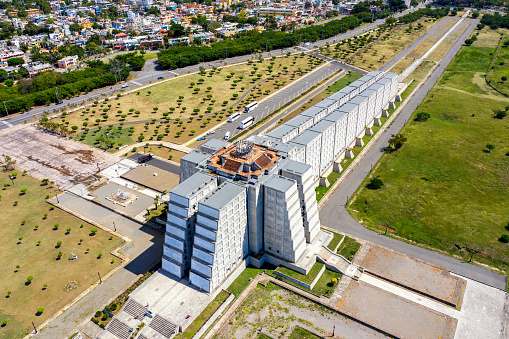
SANTO DOMINGO.- There is something that almost all Dominicans have seen at some point: the enormous gray silhouette of the Columbus Lighthouse rising above Santo Domingo East.
Many remember it for school visits, others for the endless discussions about whether Christopher Columbus's remains truly rest there. And some, simply, for those nights when a gigantic cross of light seemed to appear in the city's sky.
But there is one detail that often goes unnoticed: the entire monument was designed precisely for that purpose, to become a monumental cross seen from above.
And it wasn't by chance.
A monument that wanted to be seen from the sky
Although the Columbus Lighthouse was inaugurated in 1992, during the commemoration of the 500th anniversary of Christopher Columbus' arrival in America, the idea of building a great tribute to the navigator has a much longer history.
According to the historical records preserved by the National Network of Museums of the Dominican Republic, the first proposal arose in 1852, when the historian Antonio Delmonte y Tejada proposed erecting a monument in honor of the discoverer.
However, it took nearly 140 years for that project to become a reality.
When an international architecture competition was finally organized, 455 proposals from 48 countries were submitted. The winner was a young English architect named Joseph Lea Gleave, who was just 24 years old when he presented the design.
His idea was simple, but full of symbolism.
The phrase from Columbus that inspired the entire work
According to the educational portal EducanDo and the museum's own institutional history, Gleave took as a reference a phrase attributed to Christopher Columbus:
"Place crosses on all the roads so that God may bless this land.".
That is why the building was conceived as an immense cross lying on its side. Seen from the air, the structure reveals an almost perfect shape, a representation of the evangelization and the encounter between Europe and America that the monument sought to commemorate.
The architect himself explained that he did not intend to build a building with a fleeting style, but a symbol capable of belonging "to all times," an idea that still forms part of the Lighthouse's identity today.
The cross of light that could be seen for miles around
But the symbolism did not end with architecture.
According to the National Museum Network, the monument was equipped with 156 lights and a special system that projected a gigantic luminous cross into the night sky.
During its early years, that beam of light could be seen from tens of kilometers away and became one of the most recognizable images of Santo Domingo. The institution itself notes that the projection could be seen from up to 64 kilometers away.
Over the years, the system ceased to be used permanently due to the enormous energy consumption it involved, so today it is only switched on on special occasions.
Even so, many Dominicans still remember those nights when it seemed as if a cross was floating over the city.
Much more than a mausoleum
There is another interesting fact that few people know about.
Although popularly known as the Columbus Lighthouse, the building also functions as a museum. Inside, it houses dozens of rooms where different countries exhibit part of their cultural heritage.
The Colonial Zone website explains that currently more than forty nations have their own spaces, along with archaeological collections, exhibitions on historical shipwrecks and areas dedicated to the history of America.
Furthermore, there is a mausoleum there that, according to Dominican authorities, holds the remains of Christopher Columbus, a claim that has been the subject of historical debate for decades because Spain maintains that the authentic remains are in the Cathedral of Seville.
A symbol that continues to look to the future
Perhaps that's why the Columbus Lighthouse has never been just a building. It's a monument built to be viewed from above, a gigantic cross erected over the Caribbean and designed to tell a story of discovery, faith, and the encounter between cultures.
And although today its powerful lights no longer illuminate the Dominican sky as before, the idea with which it was conceived remains intact.
Because, in the end, the Columbus Lighthouse never sought to point the way at sea.
His true intention was to become, literally, a permanent mark on the history of the Dominican Republic.
Recommended readings: