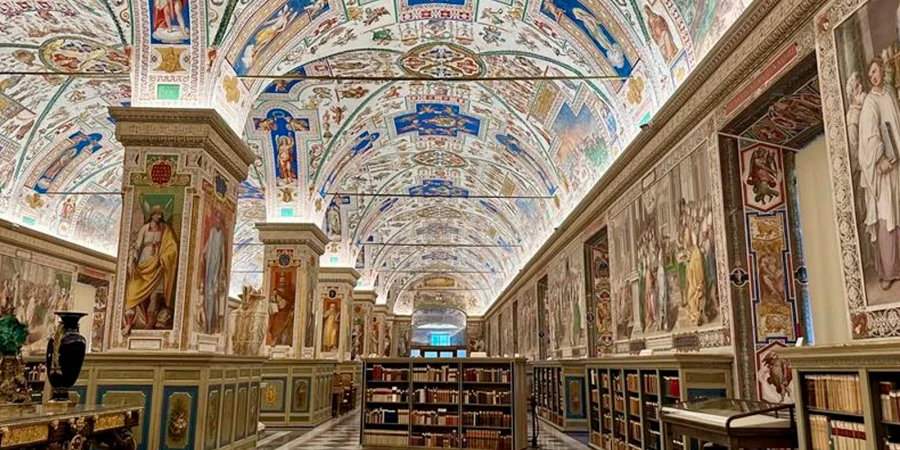
SANTO DOMINGO – There are libraries around the world so ancient and valuable that, in some cases, protecting the books has become more important than allowing people to touch them. Medieval manuscripts, unique maps, centuries-old religious texts, and historic first editions now rest behind special glass cases, in climate-controlled rooms, and under strict conservation standards that make reading them an almost untouchable experience.
Although it may seem exaggerated, the reason is simple: many of these books are so fragile that a single incorrect handling could damage them forever.
One of the best-known examples is the Vatican Apostolic Library, considered one of the oldest and most prestigious libraries in the world. Officially founded in the 15th century, it houses more than 1.5 million printed books, as well as thousands of historical manuscripts and priceless, unique documents.
According to the Vatican Library's official website, many ancient manuscripts and books are not freely accessible due to conservation reasons. Some are temporarily out of circulation for restoration, while others are restricted because constant exposure to light, dust, or human contact would accelerate their deterioration.
Old books are far more delicate than they appear. The paper used centuries ago contains organic materials that react to humidity, temperature, and even the natural oils from human hands. Over time, the pages become brittle and the ink can slowly begin to fade.
According to academic research on book preservation, dust, fungi, and bacteria pose real threats to historical collections. A study published on the scientific platform arXiv warns that certain microorganisms found in old books can seriously deteriorate the paper and affect unique documents.
For this reason, many historical libraries have created stringent protocols to protect their collections. In some places, researchers must wear special gloves, obtain prior permission, and work under constant supervision. In others, touching the original book is simply prohibited, and only digital copies are offered.
The Vatican Library itself has spearheaded major digitization projects in recent years to enable researchers worldwide to study manuscripts without endangering the originals. According to Vatican News, the institution modernized its digital platform precisely to facilitate remote access to extremely delicate historical materials.
Not just anyone can access those books. According to the library's official rules, access is primarily reserved for researchers, university academics, and authorized specialists. Even within the building, consulting manuscripts requires additional permission.
The obsession with preserving these texts makes sense when you understand what they represent. Many of these works are irreplaceable: manuscripts handwritten centuries ago, maps predating the great geographical discoveries, or books printed during the early years of printing.
Among the most famous pieces preserved by the Vatican Library are medieval codices, illuminated manuscripts, and historical texts related to figures such as Galileo Galilei and Dante Alighieri. In addition, the library houses thousands of incunabula, the name given to books printed before 1501, considered some of the most valuable bibliographic objects in the world.
But the Vatican isn't the only place where this is happening. Several heritage libraries around the world have had to make parts of their collections virtually untouchable. The online newspaper Britannica recently highlighted some of the most impressive historic libraries on the planet, many of them located within UNESCO World Heritage sites and protected by strict conservation measures.
In some cases, books aren't even stored on ordinary shelves. There are specially designed rooms to control temperature, humidity, and light levels. Some manuscripts are kept in special acid-free boxes to prevent further deterioration.
Paradoxically, the goal of a library, which is to allow access to knowledge, has led to certain books having to be kept out of human hands in order to survive.
Today, digitization has become the primary solution to this dilemma. Thanks to high-resolution cameras and digital archives, thousands of historical documents can be studied without physically opening the originals. Recent research on bibliographic digitization indicates that this process has become essential to prevent the permanent loss of unique historical works.
Even so, for many historians and book lovers, nothing replaces the experience of standing in front of a real manuscript that has survived for centuries.
Because beyond the display cases, the restrictions, and the white gloves, these libraries exist for a powerful reason: to protect irreplaceable fragments of human history before they disappear forever.
Recommended readings: