


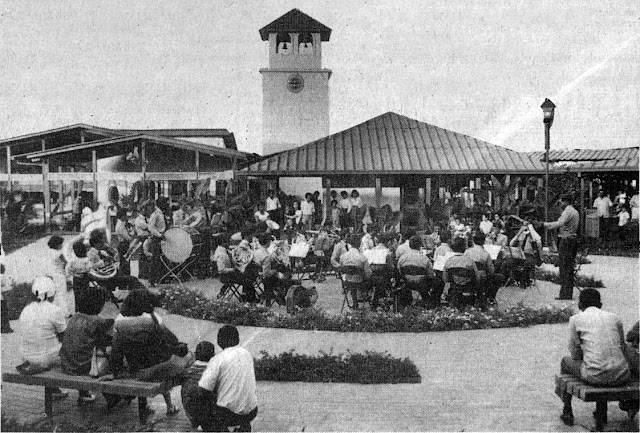
SANTO DOMINGO –For nearly two decades, at the corner of Avenida 27 de Febrero and César Dargam, where memories now intertwine, there thrived a small plaza that felt more like a train station than a shopping center. A leisure space that was a landmark in the 80s and 90s. A unique, single-story shopping plaza with gardens, a fresh design, craft shops, food and drinks, and a public transportation service that made history.
We are talking about Plaza Criolla, located next to the headquarters of the Popular Association of Savings and Loans (APAP) and adjacent to the University of Action for Education and Culture (UNAPEC), which in some publications is said to have opened in the late 70s and closed its operations towards the end of the 90s.
With its iconic bell tower and tiled roofs, Plaza Criolla was an oasis in the capital city, with wide walkways and wooden railings perfect for strolling while shop windows offered amber, larimar, and other handcrafted gifts. Its atmosphere was welcoming, with ambient music that fostered a calm that was a far cry from the bustle outside.
Among the most remembered places is La Ceniza, a brewery that attracted attention with its offering of "dressed up as a bride" drinks and simple cocktails, which was frequented by university students, families and couples who took advantage of its indoor tables to share laughter and informal Sunday lunches.
“My enrollment in English classes at APEC lasted until my dad, back in Higüey, found out that I was going to the Plaza Criolla parking lot to celebrate with the basketball fans and players after the games at the Sports Palace,” recalls journalist Wellington Carpio , laughing and without remorse
In the online archives, the opening of Plaza Criolla is placed between the late 1980s and early 1980s, and the name of its owners is equally shrouded in mystery. The residents of the capital already had the vibrant and luxurious Plaza Naco , so this plaza, with its adjacent Terra Bus station (which traveled all the way to Port-au-Prince), became a meeting point and a place for saying goodbye. In fact, people rarely visited the plaza for shopping, but rather to kill time, waiting for their bus to depart or the next one to arrive.
Another popular shop, especially among travelers, was Joyas Dominicanas, with a wide selection of jewelry made from amber, larimar, and coral, as well as pieces carved from mahogany; La Tamara, where photocopies could be made. Some names have faded over time: the shop selling baseball caps and jerseys, the barbershop, the shoe store, the small bookstore, and the shop selling unique gifts.
“There was a restaurant that made a really good stew, I always went there with one of my sisters but I don’t remember the name. Look, now you’ve stirred up some stomach nostalgia,” says Penelope Arias, a bank executive, amused.
Every space was filled with people getting off the buses and scattering through the corridors, shopping, eating, waiting. Plaza Criolla wasn't a sophisticated place, but it had a different, warm energy. It was as if the city itself converged there; it was a place to pass through and also to linger.
And of course, the crowd was equally diverse. People from the provinces and the capital mingled with suitcases, bundles, boxes, and backpacks. Students, employees, teachers, executives. People alone and in groups, all respecting each other's weariness and always greeting each other with eye contact.
“I remember traveling to Santiago on Terrabus. Those buses looked like airplanes on land, and I remember that at the end of each trip they raffled off bottles of Bermúdez rum, if my memory serves me right. They offered peanuts and coffee, hahaha, just like on airplanes,” says Maritza Chevalier, a teacher from Santiago.
The twilight of an era
The opening of Plaza Central in 1988, the first large-scale multi-floor mall, at the intersection of Avenida 27 de Febrero and Winston Churchill, with more than 300 establishments and 1,100 parking spaces, marked the beginning of the end for Plaza Criolla.
As intercity transportation moved to more modern terminals and the concept of a "plaza" transformed into an air-conditioned shopping mall, that little plaza faded away without ceremony, without farewells, without a press release or official closure. Until one day it was simply gone. The Popular Savings and Loan Association acquired the land and expanded its property before the turn of the millennium.
Many people still have memories, and perhaps photographs, of a stroll, a trip, or a Sunday visit to listen to a band concert in the courtyard parking lot. The truth is that this visitor-centric model of commercial development has disappeared, leaving behind the pleasant memory of a bygone era.
Plaza Criolla was more than a place: it was a station of humanity in a city that, like the travelers who crossed it, was always passing through, although at a more relaxed pace and with a desire to stay.







