


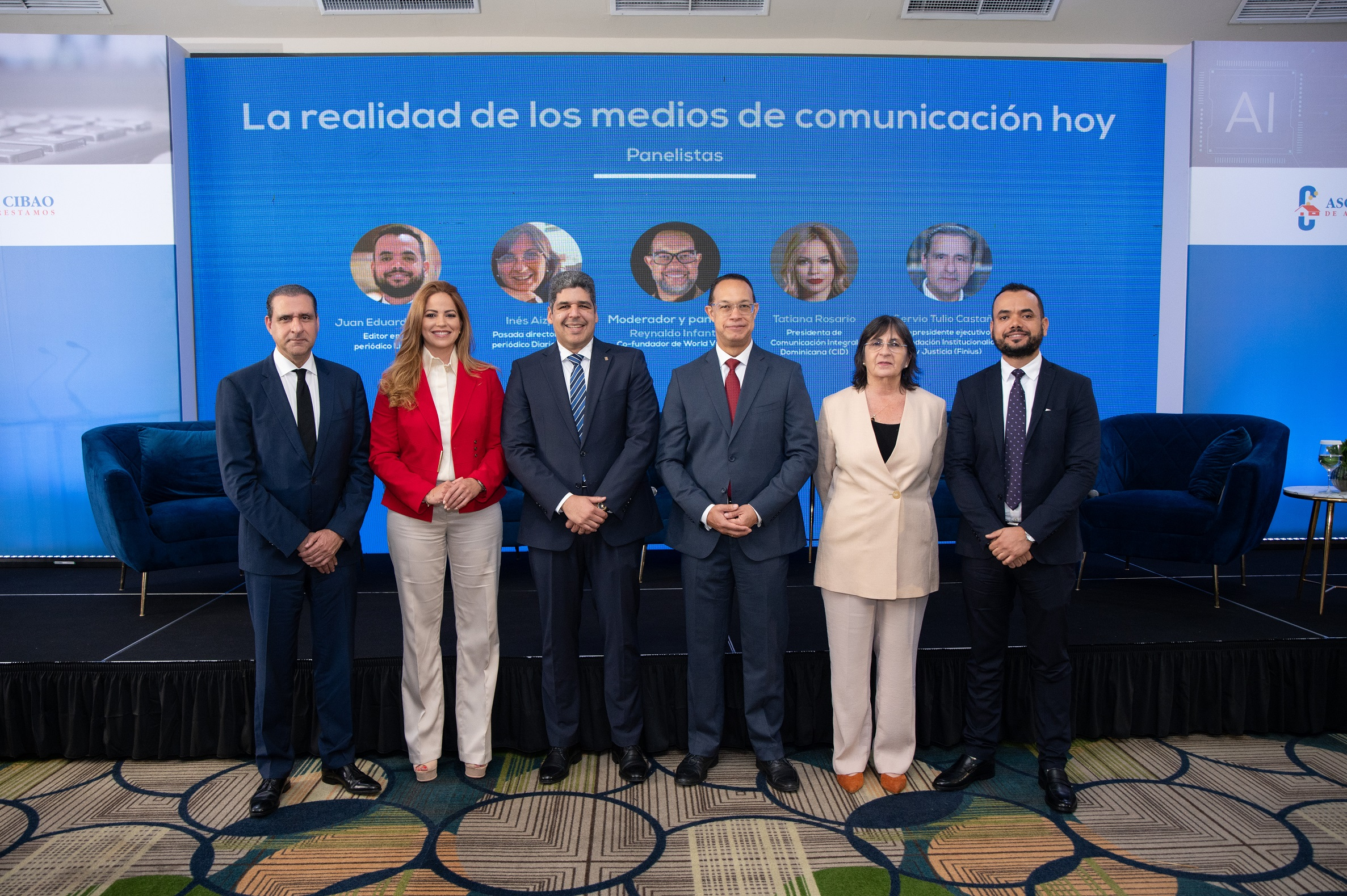
The Cibao Savings and Loan Association held the panel "The Reality of the Media Today," with the participation of personalities from different areas of communication and law, who addressed crucial issues that impact journalistic work today.
In his welcoming remarks, José Luis Ventura, executive president of the Cibao Association, emphasized the importance of responsible and ethical journalism, as well as the fundamental role that the media has played throughout the 60-year history of the financial institution.
Similarly, Yara Hernández, Vice President of Communications and Sustainability, valued this traditional meeting as a training and networking space, which allows journalists, opinion leaders and media outlets in the Cibao region to exchange ideas and strengthen ties.
The panel consisted of journalists Inés Aizpún and Juan Eduardo Thomas, communications specialist Tatiana Rosario, and lawyer Servio Tulio Castaños. Reynaldo Infante, a prominent radio announcer and voice producer, moderated the discussion.
During the activity, topics such as ethics, changes in the audience and readers' habits, adaptation to different types of content, the legal framework and the proposed modification of Law 61-32 on Expression and Dissemination of Thought, as well as the business model of the media and technological evolution were highlighted.
In detail, Inés Aizpún emphasized that ethics in journalism is a non-negotiable value and is what makes this profession respected, both personally and for the media outlet. The former director of Diario Libre asserted that: “As a professional, you can choose between integrity and respect for the profession and the audience, or decide that selling or renting out information will be more profitable and that seriousness doesn't pay. That's not true. Ethics and integrity pay.”.
Along the same lines, Tatiana Rosario emphasized the importance of communication that is "honest, clear, respectful, pluralistic, and fair." She posited ethics as the central axis of communication and fundamental principles such as truth, independence, equity, impartiality, and, above all, respect for human dignity.
Rosario encouraged those working in communications to start their own media outlets, researching and addressing whatever topic interests them. "In this way, voices are diversified and amplified, guaranteeing more democratic and inclusive communication.".
Speaking about the legal framework governing this profession, Servio Tulio Castaños, vice president of the Institutionalism and Justice Foundation (Finjus), highlighted that with the rise of social media platforms, the reproduction of misleading information has become easier, "where conflicts of interest and the professional conduct of journalists and their relationship with the media and the government can be influenced by government control; therefore, legal measures are needed that can provide solutions to this situation without restricting legitimate expression.".
He also addressed the right to be forgotten, habeas data, and how newspapers can handle requests or complaints when an individual asks for their information to be removed from their websites. Castaños explained: “This happens when a person has been involved in a media situation and the media covers that story. Then we see those people asking the media to remove their information. There is a ruling from the Constitutional Court that states that newspapers should not delete that news from their websites.”.
In contrast to the "pessimistic" predictions commonly found regarding the future of journalism, Juan Eduardo Thomas, current editor-in-chief of Listín Diario, believes that this profession presents exciting opportunities that can guarantee a sustainable and useful future for the public. He pointed out that it is essential to carefully analyze data, study and better understand the audience, and base projects on diverse sources of funding, including the active engagement of readers.
He also explained the migration of audiences to different platforms like TikTok. He said that the media hasn't understood that the trend is for users to use that app, which has become a news search engine. "They're already looking for information on TikTok while we in the media continue creating content for X, formerly Twitter.".
In his closing remarks, Reynaldo Infante noted that today there are challenges that require a responsible balancing act, on the one hand, the purpose of the media and its actors and, on the other hand, excessive profit regardless of the means or consequences.







