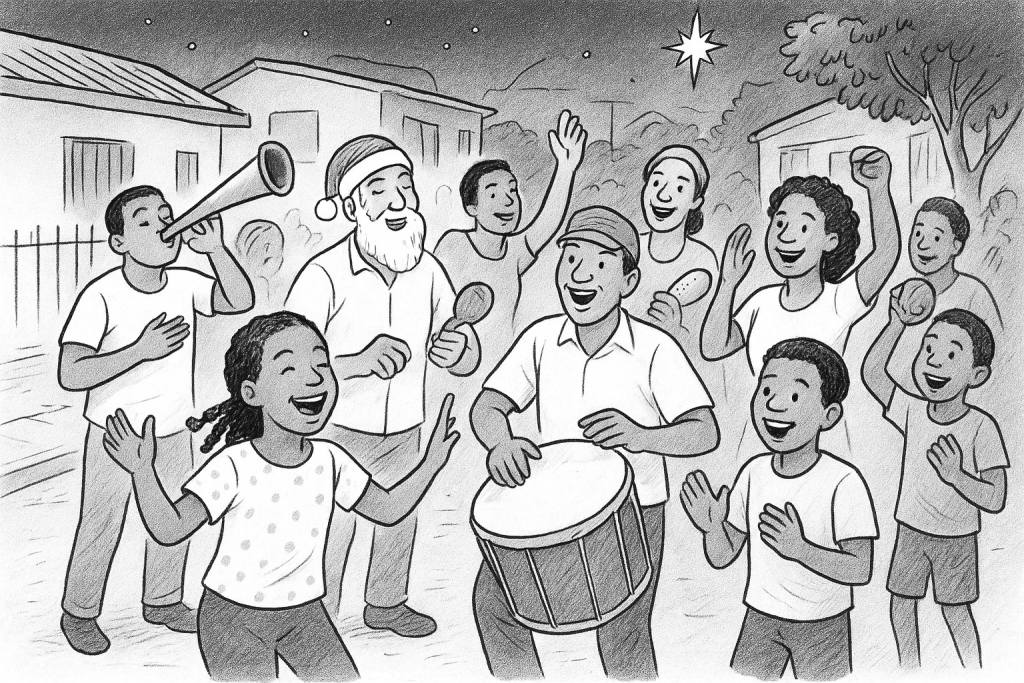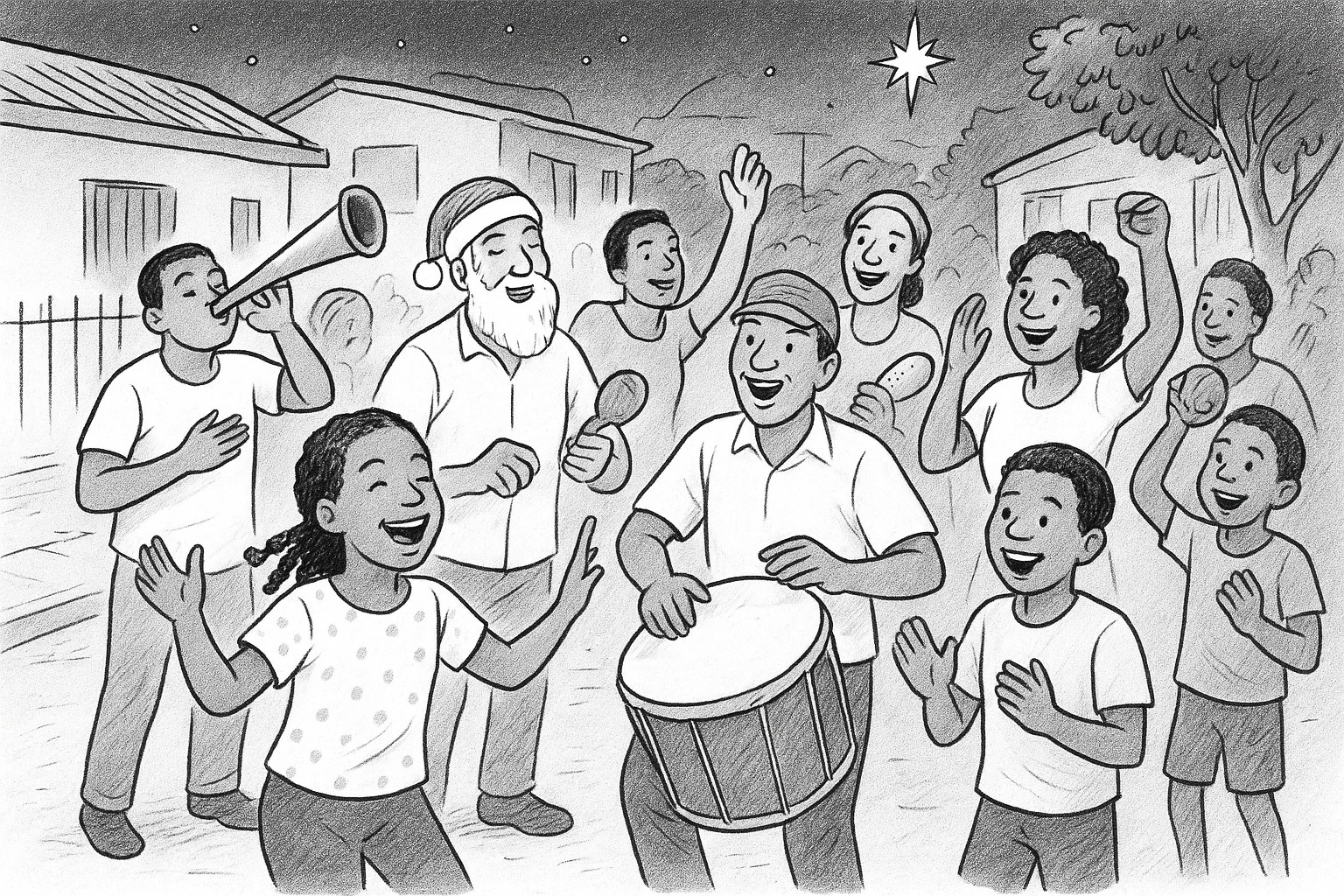
The term Aguinaldo has a parallel meaning: the song that was sung and the collective joy. In popular memory, both ideas remain linked: an aguinaldo was a song that was shared, traveled, and spread with the morning dew.
SANTO DOMINGO. – Open the door, open the door, I'm in the street… This song, sung in chorus by the neighbors, in the early morning, in front of your door, to the rhythm of güira, tambourine, guitar, tambora, accordion if there was one and if not, with whatever appeared that made “music”, was the call to get up and heat the water for ginger tea or chocolate and the rest was brought by the group: the laughter, the hugs, the chairs, the punch and the bread.
To the washers, to the washers, to the washers of my heart…
Every house in the neighborhood was somewhat prepared for this "raid," since you never knew if it would be your turn. The group would meet stealthily at the agreed-upon spot and move through the streets, knocking on doors and inviting people to join them, until they reached the chosen house. Only two knew where the final stop would be, and with half the neighborhood awake and on its feet, the party would begin.
the aguinaldo began to gain public visibility between the end of the 19th century and the first decades of the 20th century.
These street patrols, deeply communal, sometimes with religious undertones and very territorial, became popular and took root in towns and neighborhoods, thanks to their mix of religiosity and Creole revelry, with high levels of citizen security.
And so it was until the 1980s and 1990s, when cities began to change due to accelerated urbanization, and the countryside also began to change, due to waves of migration abroad and thanks to the contributions of the diaspora.
These late-night gatherings that brought joy to most people and defined a tradition, gradually disappeared when low houses grew taller, when eight families began to live where one family lived (now there are dozens), and when security became a luxury.
Due to the change in social dynamics, with the reduction of social proximity and the common use of public space, the pace of life and neighborhoods that resemble beehives, tradition has become a memory, surviving only in some rural areas, a few neighborhoods or in activities organized by companies.
Christmas bonus: song or activity?
In the Dominican Republic, the term "aguinaldo" is used interchangeably to refer to the song (villancico) or the activity itself, although the concept was much more than just the song: it was a community ritual in which the whole family participated. Above all, it was a musical procession that fostered community.
Over time, the term also came to name the musical pieces that accompanied it, and on the radio, records, and the first typical groups that established a Christmas repertoire, people began to simply call them "aguinaldos".
Thus, songs like “De la montaña venimos” (We Come From the Mountain), a piece that crossed the pond from Puerto Rico, authored by Bobby Capó, or “Las Arandelas” (The Washers), adapted from a poem by the Dominican Juan Antonio Alix, were passed down from generation to generation through oral tradition, although with the lack of practice they are being forgotten, saved by “Cima Sabor Navideño” (Christmas Flavor, the nostalgic radio program that rescues the popular music of this time of year.
The song that walked
The repertoire of the Christmas carols was hybrid: adapted carols, improvised lyrics, verses taken from oral tradition and well-known songs, such as "Las Arandelas", or "De la montaña venimos", which functioned as a collective starting point because of their easy-to-repeat structure or the charm of their story.
Although today radio delivers festive merengues and studio-recorded productions, the country had for more than a century a solid tradition of rural Christmas carols, thanks to villancicos inherited from the Hispanic tradition, some popular religiosity and improvised poetry; testimonies, scores and lyrics still survive that allow us to reconstruct that soundscape.
One of the few Christmas carols with proven Dominican authorship is “Cánticos”, better known as “A las Arandelas”, whose lyrics were written in 1908 by the Cibao poet and decimero Juan Antonio Alix, whose work is an essential part of the country's popular literature.
Its melody is anonymous and was transmitted orally, although its interpretation was consolidated in the Cibao and, by the 20th century, it achieved national dissemination thanks to the recording of the Conjunto Típico Cibaeño in the 50s and later Tatico Henríquez and Fefita la Grande.
Most of the repertoire performed today as “Dominican Christmas carols” actually originates from Hispanic carols adopted locally since colonial times. Songs like “Los pastores a Belén” (The Shepherds to Bethlehem), “A Belén pastores” (To Bethlehem Shepherds), “La cuna e' Belén” (The Cradle of Bethlehem), and “Ay José, José” (Oh Joseph, Joseph) circulated throughout the Hispanic Caribbean before taking root in the Dominican Republic, although the verses of the rural tradition shaped them with new rhythmic variations.
Although its origin is not Dominican, its interpretation is part of the musical memory.
The boundary between aguinaldo and modern Christmas song became even more blurred in the 1970s, when groups like Conjunto Quisqueya, Johnny Ventura or Wilfrido Vargas transformed Christmas with festive merengues, with productions inspired by Puerto Rican or Pan-American Christmas motifs, as is the case of "De la montaña venimos", which was enthusiastically adopted by the local public, especially in the version of the Félix del Rosario orchestra.
Community life: the lost stage
"Oh, Doña María, oh, Compai José, open the door, I want to see you..." Resisting this invitation was frowned upon by the community. You had to get up and open it. If you didn't join the revelry, you had to contribute something for those who would be enjoying themselves "until dawn." It could be coffee, and contributions of alcoholic beverages, such as rum or punch, were especially welcome. And until that gift appeared, the group would be singing outside your door.
For that magic to happen, neighborhoods were needed where people knew each other by name and their history, and the custom of opening doors and having the table ready for the visitor with coffee, ginger, bread, hot chocolate, or whatever was available.
It was a practice that depended on a vibrant community, not a scheduled event, and that's why it flourished in a country of low-rise houses, quiet streets, wide sidewalks, and constant neighborly interaction. In that context, "Las Arandelas" was more than a song: it was the announcement that Christmas had arrived on the block.
The community life that sustained this practice was transformed.Reality changed, and the tradition lost its natural space with mass migration to cities, the growth of urbanized neighborhoods, the privatization of public space, the increase in motorized traffic, and, although it has been mentioned in this report, it must be repeated: insecurity played a leading role as a deterrent.
The growth of urbanization in the Dominican Republic profoundly changed daily life. Houses with shared yards and sidewalks were replaced by apartment buildings, gated communities, and residential areas with strict regulations on noise and access.
In these areas, most residents are strangers to one another. Security limits free access at any time. Rules of coexistence prohibit loud music during traditional Christmas carol celebrations. What was once a natural stroll through a neighborhood has become impassable.
It changed the way Christmas is celebrated
The transformation is not solely due to urban planning. Modernity introduced habits that reduced participation in community activities, and it is clear that the accelerated pace of work and extended hours left less time for spontaneity.
Technology replaced physical gatherings: today Christmas music arrives through playlists, not from neighbors playing instruments, and the culture of private entertainment (shopping malls, concerts, closed parties) displaced street celebrations, relegating them to those controlled spaces.
The perception of noise has changed: many now see a Christmas bonus as a nuisance, an invasion of privacy, and not as a festive gesture.
From living tradition to scheduled activity
Faced with the impossibility of sustaining spontaneous Christmas bonuses, public institutions, schools, churches and companies began to organize "controlled" Christmas bonuses: Christmas caravans, parish choirs, cultural activities and outdoor concerts.
Although they seek to preserve the tradition, their planned nature and their distance from daily life create a clear difference with the Christmas gifts that arose naturally in the neighborhoods
With the decline of Christmas gifts, the culture of unconditional sharing fades away, as does traditional Christmas music, displaced by modern genres, the sense of community belonging that defined Dominican Christmas, and the intergenerational experience of seeing children, young people, and adults united in an enjoyment that would be memorable for the youngest.
Is there any hope of rescue?
Not all is lost, and with an official effort, it can probably be revived, especially with security guarantees. Few communities, particularly rural ones, are reported to still celebrate Christmas carols in the traditional style. In urban areas, cultural movements and community organizers are trying to revive them through organized tours of historic neighborhoods like Ciudad Nueva in the capital, or with activities that promote the use of public space, such as the one in Plaza España.
The challenge is great: to revive a tradition born from human connection in a society that has grown accustomed to living behind walls and screens. However, its memory lives on in those who awoke to the sound of a drum at 5 a.m. and hold onto the hope that new generations will also be able to experience that magic.
“Las Arandelas” is that familiar, melodic song that evokes immediate recognition, connects generations, and simply humming its melody is enough to get someone singing along, even if many people haven't experienced a traditional Christmas carol tradition. It's a reminder of a collective practice formed in a country that no longer exists.
“The washers/Song”
Open the door for me, open the door
for me, I'm out in the street,
and people will say this is rude,
people will say this is rude.
In there I see, in there I see
a covered bundle.
I don't know if it's a roasted suckling pig.
I don't know if it's a roasted suckling pig.
Chorus:
To the washers, to the washers,
to the washers of my heart.
To the washers, to the washers,
to the washers of my heart.
Author: Juan Antonio Alix
Other Christmas bonuses
These are traditional Christmas carols cited in Dominican folklore research by Fradique Lizardo, Dagoberto Tejeda, and Xiomarita Pérez, and in songbooks compiled between the 1960s and 1990s. We encourage our readers to seek them out, enjoy them, and give a new opportunity to a tradition that unites us in the joy of the extended family that is our community
- “We come from the mountains”
- “The cradle of Bethlehem”
- “Here comes Juan”
- “The Twelve Pairs” (Christmas version)
- “Oh, José, José”
- “The shepherds to Bethlehem” (Creole version)
- “To Bethlehem shepherds” (Cibao adaptation)
- “Christmas has arrived”
- “Sing, sing”
- “La saya” (when it was performed during Christmas carol time)
- “New Year’s Eve”
- “The grinding” (it was used as a Christmas meringue in some rural areas)
Rescuing Christmas carols is not just about preserving music: it's about recovering trust, the family spirit in the community, shared memory, and the magic of waking up together to the sound of the drum.