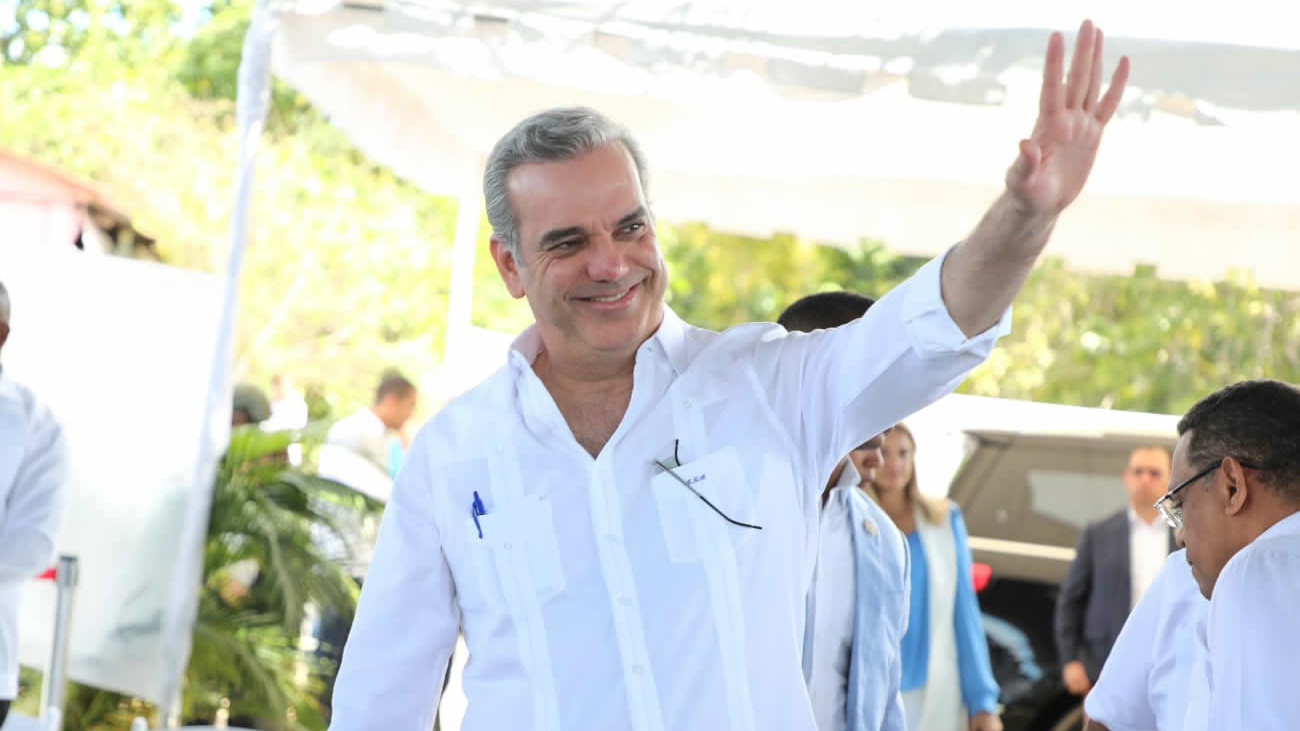
The Executive Branch, through decree 642-26, ordered the temporary change of the official residence of the Head of State from Santo Domingo to Santiago de los Caballeros, where his workplace will also be located
SANTO DOMINGO.– President Luis Abinader will carry out a working agenda from this Monday until Wednesday, September 16, starting in Santiago, which will take him through the provinces of Espaillat and Valverde, as well as various points in the "Heart City" (Santiago).
During these three days, the president will lead inaugurations, supervise works and hold meetings with authorities, representatives of the productive sectors and other actors in the region.
In the same order, the Executive Branch ordered through decree 642-26 the temporary change of the official residence of the Head of State from Santo Domingo to Santiago de los Caballeros, where his workplace will also operate.
The provision, which came into effect at the beginning of this week, also establishes that ministers, deputy ministers, directors general and other officials directly dependent on the Executive Branch must remain in charge of their respective offices and make the necessary arrangements to guarantee the continuity of administrative work.
The president's move to the Cibao region raises questions about how the presidency functions outside the National Palace. Does the Constitution allow the head of the executive branch to temporarily relocate their office to another province?
In that context, Article 122 of the Constitution establishes that the Executive branch is headed by the President of the Republic, in his capacity as Head of State and Government. Article 128, in turn, lists his powers and responsibilities. But there is one provision particularly relevant to Abinader's case.
Article 128, paragraph 2, subparagraph c, establishes as a power of the president, in his capacity as head of government, "to change the place of his official residence when he deems it necessary".
This means that the Constitution does not stipulate that the president must physically remain in the National Palace or in the National District to perform his duties.
In fact, the Magna Carta itself recognizes the National District as the capital of the Republic and seat of the national government, but that condition does not prevent the president from temporarily moving his office or official residence to another point in the territory.
Leonel Fernández had already formally moved the headquarters to Santiago
The temporary relocation of presidential activities outside of Santo Domingo is not a new precedent in the country.
During Leonel Fernández's second term, a more explicit case occurred. Through Decree 160-07, the then-president ordered the transfer of the official residence of the Presidency of the Republic to Santiago de los Caballeros on March 30 and 31, 2007.
The measure also convened the Governing Council in Santiago, where Fernández led official activities and meetings with representatives from various sectors of the region. On that occasion, Santiago formally served as the presidential seat for two days.
Three days of work in the Cibao
Abinader will begin his tour this Monday, September 14, in Moca, Espaillat province, where he will inaugurate the Las Espinas highway, a 5.8-kilometer road, and meet with mayors and local authorities to learn about the municipalities' priorities. He will then travel to Santiago, where he will hold private meetings.
Also, on Tuesday the 15th, he will focus his agenda on meetings with representatives from the public, private, business, academic and social sectors of Santiago.
Infrastructure projects will mark the final day
Finally, on Wednesday the 16th, the president will begin his activities with a private meeting and then inaugurate the El Guano school.
He will also oversee the expansion work at Cibao International Airport, one of the main connectivity infrastructures in the northern region. From Santiago, he will continue to Licey al Medio, where he will inspect the construction of the sewage system and the treatment plant.
The day will continue in Mao, Valverde province, where he will supervise sanitation works and the construction work of the Mao Traumatological Hospital.
The tour will conclude with a meeting with mayors and authorities from Valverde to follow up on the priorities and development projects of the municipalities.
Abinader will repeat the scheme, although with an extra day
The main difference with the precedent of 2007 is the duration and the way in which the displacement has been announced.
In the case of Fernández, a decree expressly ordered the transfer of the official residence of the Presidency for two days.
In Abinader's case, the Presidency reported that Santiago will be the center of his work agenda for three days, from September 14 to 16, with trips to Espaillat and Valverde.
Therefore, Abinader's journey extends one day longer than that formal transfer carried out by Fernández in 2007.
It does not imply a replacement of the president
The temporary relocation of the presidential office does not mean that Abinader will cease to hold office, nor that the vice president should assume executive power.
The Constitution provides for the replacement of the president in the event of a temporary or permanent absence. In the case of a temporary absence, Article 129 stipulates that the vice president assumes executive power.
An official three-day agenda outside the National Palace does not, in itself, constitute a temporary absence of the president, because the president continues to perform his duties and make decisions from another part of the national territory.
The Constitution itself also stipulates that the president may change the location of his official residence when he deems it necessary.
A practice compatible with presidential functions
Abinader's transfer to Cibao falls within the scope of his constitutional duties and does not, in itself, constitute a violation of the Constitution.
Rather than abandoning the seat of government, the president will temporarily move his workplace to Santiago to carry out an agenda that combines supervision of works, inaugurations and meetings with authorities and productive sectors.
The precedent set by Leonel Fernández also demonstrates that back in 2007 the Presidency had formally arranged for a transfer of his official residence to Santiago for two days.
The event will last three days and will cover Santiago, Espaillat and Valverde, with an agenda focused mainly on infrastructure, sanitation, health, education and regional development.
The Weekly Agenda moves to Santiago
The representative of the Executive Branch will carry out part of his work agenda this week from Santiago, where he will also lead LA Semanal con la Prensa, as part of the temporary transfer of the activities of the Executive Branch to that province.
During his stay, the president will hold meetings with representatives from various sectors and will address issues of national interest during the meeting with the media
Recommended reading: