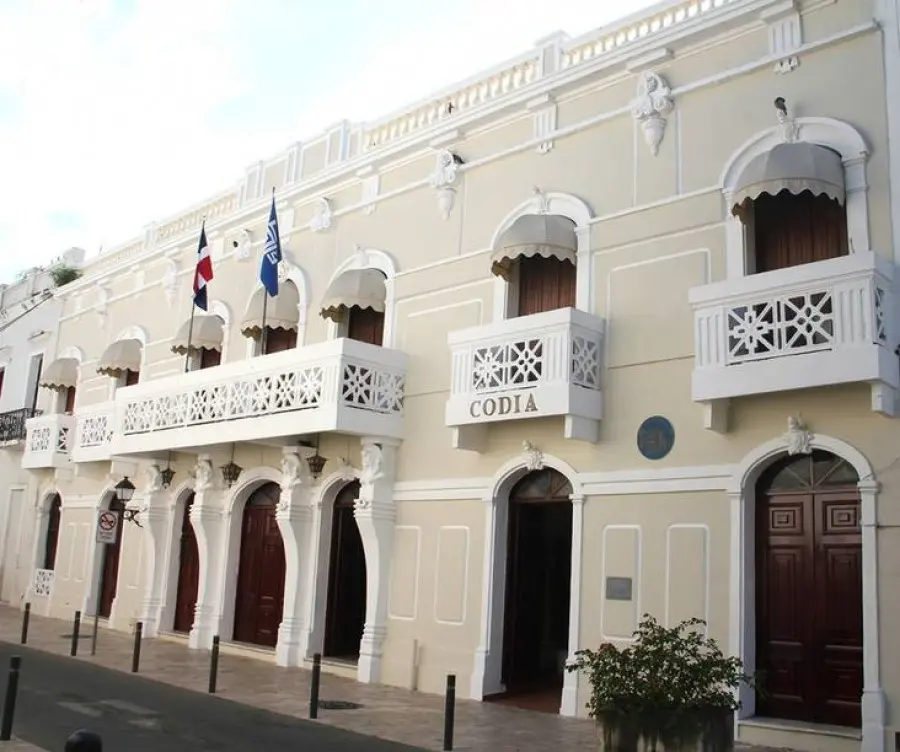
SANTO DOMINGO.- The Dominican College of Engineers, Architects and Surveyors (CODIA), is the body that according to law 6160 of the creation of the body, must look after the public interest by advising the State in infrastructure works.
“To serve as guardian of the public interest and act as advisor to the State in matters within its competence.” “To advocate for the establishment of legal technical standards, specifications and laws that must govern any of the phases of project development and execution of works and their contracting,” says one of its articles.
However, the current situation has made it clear that the role of the union remains merely on paper before the country's governments, since an investigation carried out on the recently collapsed overpass at the intersection of 27 de Febrero Avenue and Máximo Gómez in 1999 was ignored by the then president Leonel Fernández, findings with which preventive measures could have been taken and avoided the regrettable event in which 9 people died.
Two former presidents of the association agree that governments have historically insisted on "excluding" the technical opinions of the organization, despite the fact that they point out that among its members there are professionals with sufficient competence to be taken into account.
“Apparently, governments are not interested in the opinion of Codia because many times it has to be a criterion favorable to their interests, and since we are just technicians, they are not interested in anything from the guild, that is why you see that Codia is not leading that commission,” Cristian Rojas, former president, told El Inmobiliario .
This refers to the newly created commission, announced by President Luis Abinader this week and which will be headed by geologist Osiris de León, to conduct a survey on the state of the country's infrastructure, following the collapse that occurred on Saturday, November 18, at the overpass of 27 de Febrero Avenue with Máximo Gómez.
“At Codia, we are regularly sidelined, we are left out, forgetting the role that should be played in the law, and it is a shame because Codia can make great contributions to anticipating situations,” said Martín Concepción, former president of the organization, this week while participating in an interview on the program El Día on Telesistema.
He acknowledged, however, that after he left, the governments have been very keen to control the profession and that he would like to see a more active role for an institutional Codia, on the side of the citizens and not on the side of the government in power.
Cristian Rojas stated that governments are not interested in oversight or transparency, and that for years governments have not used Codia to fulfill its functions as an advisor to the State as established by law.
“Codia brings together in its membership all professionals from the different branches of engineering, with master's degrees and studies in their various areas, from engineering, surveying and architecture, chemistry, environment and experts from all engineering fields,” he said.
He said, “We don’t know why the government isn’t using that tool, which would bring transparency to any project.”.
He stated that the Codia (Dominican College of Engineers, Architects, and Surveyors) typically provides technical opinions in situations involving large-scale projects. "The opinions that are appropriate from both a feasibility and a technical standpoint, which is our area of expertise.".
He recalled that when the Metro was being built, they demanded the construction plans and studies from the government in power, which was that of Leonel Fernández, "because these are works that are done without studies and without construction plans, just like the Santiago monorail and other works that are being built.".
He added that the Codia's role is being completely excluded from the procurement and contracting committees, despite its important function as an overseer of procurement and contracting, "and we have also been excluded from these committees, meaning that Codia does not participate in the bidding processes carried out in this country either.".
Concepción, for her part, stated that the college is a guardian of the public interest, “we have full freedom to conduct our expertise and provide the State, the Dominican people, with the results of any study we conduct, without any intention of causing harm, but based on the truth, and the further removed from politics, the better,” she explained.
During the interview on Telesistema, he recalled that the aforementioned study, which revealed the weaknesses of the overpass that collapsed on Saturday the 18th, was taken by them to the National Palace itself, but that then-President Leonel Fernández sent his assistant to receive them and not personally as they requested, to explain the revelations of the investigation and the measures that should be taken.