



British aerospace company Droneliner aims to change the aviation landscape with its unmanned aircraft, specifically designed for cargo transport.
Behind this initiative is not an inexperienced startup, but a team with some of the most respected and experienced executives and engineers in the aerospace world, such as John Roberts, who worked for decades at Airbus and is behind projects like the A380, or Nicholas Cumpsty, former chief engineer of Rolls-Royce and professor emeritus at Imperial College London or MIT.
Currently, the vast majority of cargo planes have cylindrical bodies and concave interior walls, similar to the passenger planes we are used to flying on. This results in the waste of many cubic meters of space on each journey, since cargo containers are rectangular.
The central body of the Droneliner, designed by the company's engineers, is shaped like a large rectangular box with virtually smooth edges. Furthermore, instead of traditional side loading, this aircraft features ramps at the front and rear, allowing containers to be loaded and unloaded with minimal sacrifice of interior space.
In conventional aircraft, this space is also limited by the need to accommodate the crew and the cockpit from which the pilots operate. In the case of the Droneliner, it is planned that it can be piloted remotely (though not autonomously at the moment), so it wouldn't need to sacrifice its operational capacity.
Regarding propulsion, Droneliner's engineers are opting for two turbofan engines. These would be capable of using SAF (Sustainable Aviation Fuel) biofuel, which is much less polluting than current hydrocarbons, and would also be prepared for future use of hydrogen. To minimize fuel consumption, regardless of the fuel used, the hybrid propulsion system has the capacity to power operations such as taxiing, takeoff, and landing with electric energy.
Two versions
The British company's engineers are already working on two different versions of the aircraft. One is the DL200, a single-engine aircraft capable of carrying between 36 and 40 containers, distributed over two decks and equivalent to a maximum cargo of 181 tons.
The twin-engine DL350, meanwhile, will double that capacity, transporting between 70 and 80 containers on three levels with a maximum weight of 318 tons. But the most surprising aspect is its range, which in both cases should reach up to 6,500 nautical miles, the equivalent of more than 12,000 kilometers.
This is due to its efficiency, with an 83% reduction in fuel consumption compared to conventional cargo planes. This distinguishing feature is due, among other things, to the fuselage's lightness, which makes it "at least 40% lighter than any equivalent aircraft," according to their website.
This means that, while current aircraft need 200 tons of fuel to transport 50 tons of cargo, the Droneliner reverses that ratio and is capable of transporting 200 tons of cargo with only 50 tons of fuel.
To achieve this record-breaking efficiency, redesigning the containers is also crucial. That's why Droneliner plans to supply lightweight versions of the current containers, measuring 6 meters in length. They don't need to be stacked in large quantities, so they don't have to be made of steel. Nor do they require the use of cranes, as they can be moved with a simple forklift or pallet jack. In fact, there will be several versions of the container, including flatbed versions to maximize the aircraft's capacity.
Waiting time at each stop is reduced to the 30 minutes required for refueling, as the loading and unloading process is streamlined thanks to rails embedded in the ramps and fuselage floor. Containers are towed on board at one end and lowered at the other smoothly and with minimal personnel.
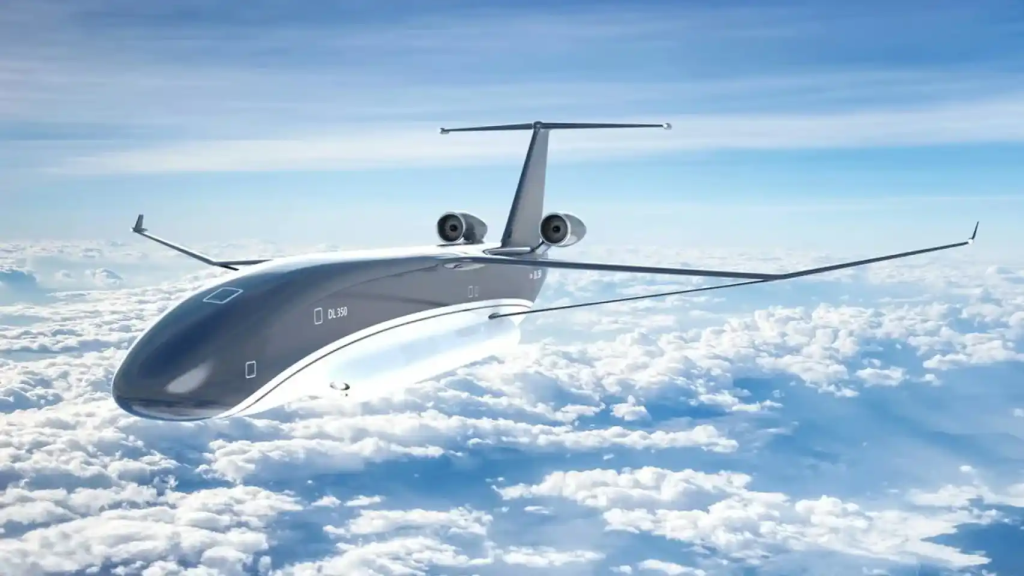
Droneliner's unmanned aircraft, in its twin-engine version Droneliner Omicrono.
Cargo drone
For now, the company isn't giving a timeline for the first operations, but everything suggests that a first prototype could be ready by the end of this decade. Droneliner thus joins other initiatives, such as UPS and its 'flying vans', or Natilus's unmanned cargo drone.
"The Natilus N3.8T [as it has been commercially named] is the first in a family of next-generation cargo aircraft," the company announced. Its representatives indicated that this drone is focused on drastically reducing the operating costs and environmental impact of current aircraft.
In terms of specifications, it features a pair of turboprop engines that propel the drone's maximum takeoff weight of 8,618 kilograms. According to the company's website, its range reaches up to 1,667 kilometers with a payload capacity of 3,855 kilograms.
Unlike Droneliner, this drone model is expected to be operational in the coming years, having successfully passed wind tunnel testing in 2021 and anticipating becoming a reality by 2025. Natilus' plans for this aircraft line include creating a larger model capable of carrying 130 tons and with a range of 8,200 kilometers.
The company announced in 2022 that it already had over $6 billion in initial orders from the world's leading airlines, with an initial backlog of 400 aircraft. "If they replace their Boeing and Airbus fleets with our solutions, cargo airlines could increase their margin to 33%" from the current 4%, according to Aleksey Matyushev, CEO and co-founder of Natilus.
Source: https://www.elespanol.com/omicrono/.







