


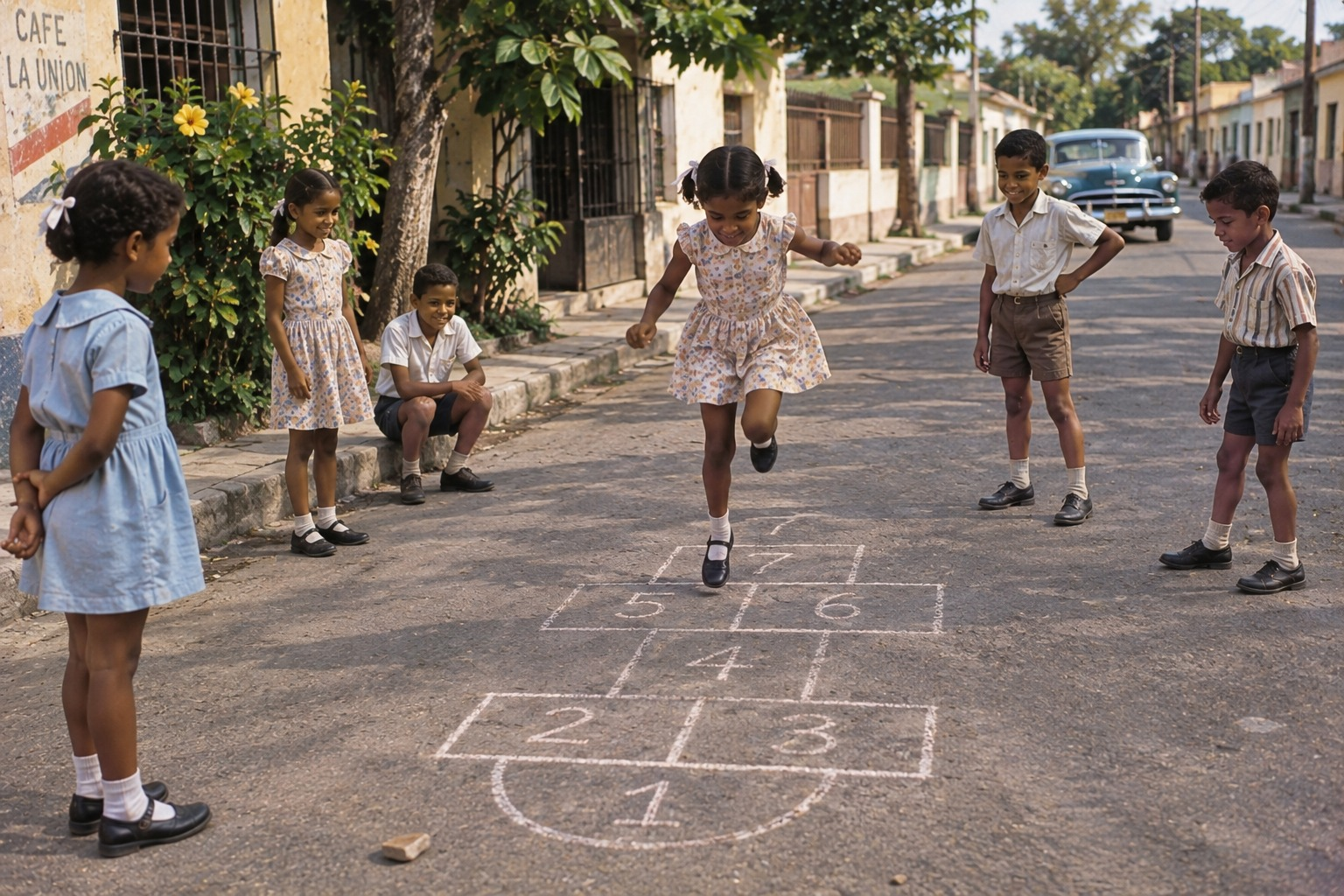
Street games taught Dominican boys and girls to run, compete, obey, cheat, invent rules, and come back tomorrow
SANTO DOMINGO – A while back, a ball could be anything, a base could be a can, and a stadium could be any open space in the neighborhood. It was the Independent Republic of the Street, and in those days, to start a game you didn't need to download anything, register, accept terms and conditions, or ask for the Wi-Fi password. All you needed was for some other kids to show up and for someone to say, "What are we going to play?"
The answer could be to topao. Or trúcano. Or the handkerchief. Or the little plaque. Or a little taco. Or that game whose name seems to have been invented by a group of children with too much free time and no intention of consulting an adult: Flowers and convent.
Flowers and convent.
Convents and flowers.
Let them come and go.
And don't stop…
And that's how a government was formed in that imaginary country, limited by the road, the bushes of jabilla or rubber trees, and the imaginary border, the most powerful of all: "Don't step off the sidewalk or you'll have problems." And boy, did they have problems! But it didn't matter, they were happy, and now they know it.
There was no president, but there was always a leader. There was no written law, but there were rules. There was no referee, but there was always someone who knew exactly why you were cheating, and if you protested too much, someone would probably tell you, "You know how the game is played!"
That "you know" was the rule.
The unwritten law
One of the most extraordinary things about traditional Dominican games is that much of their rulebook was nowhere to be found. There was no book that said how many steps a player could take, what distance should exist between the bases of the game board, or how long someone could hide before the others shouted that they were cheating.
The children learned by watching. And by playing. And by losing. And by coming back the next day.
Edna Garrido de Boggs understood the importance of this world very early on. Her book, *Folklore infantil de Santo Domingo* (Children's Folklore of Santo Domingo), published in 1955, stemmed from research begun in 1944. The compiler visited elderly people and even transcribed texts that were no longer circulating among the population. The book brought together games, songs, rhymes, formulas, and other expressions of children's folklore.
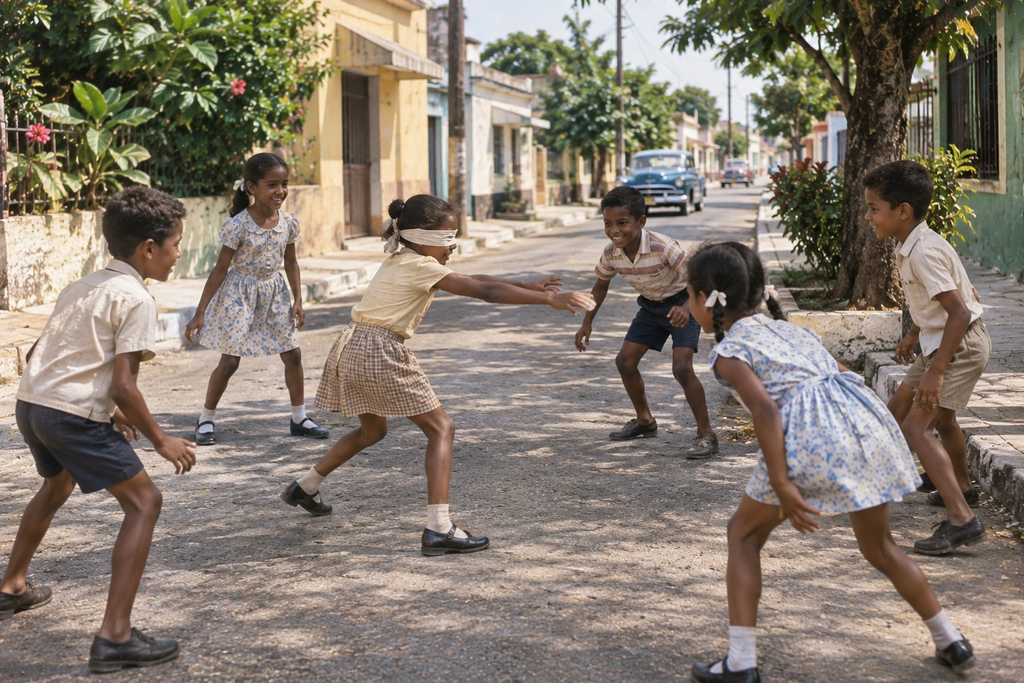
Image generated by digital means.
Garrido was not photographing a static childhood, but rather trying to capture a childhood that was already slipping away.
Nearly seventy years later, Xiomarita Pérez did something similar from a different angle. Her Brinca la tablita: canciones y juegos tradicionales dominicanos (Jump the Little Board: Traditional Dominican Songs and Games) compiled and annotated song-games and is one of the contemporary references for the transmission of that fun repertoire.
And Xiomarita was not content with just writing them down, but she put them to use in workshops called "Jumping the Little Board," which she took to communities like Río Limpio, in Elías Piña, to exchange with the children and observe what they played.
That's important because a traditional game doesn't survive just because someone puts it in a display case.
It survived if someone said, "Let's play!", and then it would start right there.
Flowers and convent: the power to send someone running
Of all the games, "Flowers and Convent" seems to have been designed by a small children's bureaucracy: a leader is chosen. The leader sings: "Flowers and convent" and the chorus responds: "convents and flowers"
"Let them go back and forth"... "and not stop..." And then the leader asks for something: a leaf, a stone, a ball. Any object that's lying around, and the first one to find it and bring it back becomes the leader.
It's a very simple game, and at the same time, it's a mini-lesson in society: one person gives the orders, the others obey. Everyone runs.
Whoever runs fastest gains power. Whoever knows the terrain best has the advantage. And the object being sought is of no real importance. The important thing is to go and get it and return first. A leaf becomes a trophy. A pebble becomes a prize. A piece of street becomes territory.
A child who five minutes ago was sitting on a sidewalk suddenly becomes the leader of an expedition, and the street ceases to be merely a place to walk. It becomes a place to run, live, and learn.
The topao and the invented border
In the topao, civilization becomes even simpler: one pursues, the others flee. Someone touches someone else, and now that someone is the pursuer. Leadership is earned, not inherited, not bought.
But a crucial question arises: – Where am I safe?
And then the tanibol, the tani, emerges . That improvised refuge could be a tree, a wall, a lamppost, a column, an old cart, or anything the group accepted as safe territory. With its imaginary lions at the entrance, like in ancient Babylon: once inside the tani , you were immune.
This means that play needs architecture, but not architecture designed for children, rather architecture appropriated by children. A tree can become a fortress. A wall, a border. A post, a refuge. A car, neutral territory.
Urban planners build one city. A child builds another, and the two don't necessarily coincide. In the 21st century, they necessarily don't coincide.
The plaque: when poverty played baseball
The license plate is perhaps one of the most Dominican examples of how a child can look at an abandoned object, pick it up, and transform it into something else: two abandoned license plates, a bat, a ball, and a street. But it could be an open can of ketchup, a piece of a broom handle, a ball of rags, and the street remains the street. The Independent Republic of the Street.
This game replicates the logic of baseball: teams, batting, running, defense, makeshift bases, and there's no need to buy or rent a field. No adult needs to say it's okay to play there because the neighborhood itself provides the infrastructure.
The plaque also tells a material story. It's an industrial object that leaves the adult world and enters the children's universe, transformed into a play tool. Poverty, instead of hindering fun, forces children to invent, making it all the more enjoyable.
That doesn't mean romanticizing poverty; it means recognizing a capacity for appropriation that children's culture had then and that today is often limited by other conditions.
The plaque also shows how much baseball must have been in the air and demonstrates that Dominican baseball didn't just live in the stadiums: it lived in the vacant lots, on the street corners. In the stick that served as a bat and in the argument about whether it was a home run. In the kid who swore he caught the ball and the other who swore he didn't. The country's sporting history also has its chapter in the streets.
Losing at the taco stand: learning through pain
There are games that seem designed to show that our grandparents had a rather less delicate relationship with pain, and marbles is one of them. Marcio Veloz Maggiolo documented the game and described a system of physical punishment for the loser: their knuckles ended up paying the price for defeat. In other words, not only did they lose, they left with the painful, physical evidence of having lost.
This brings to mind something that often disappears when we talk about traditional games as if they were all idyllic snapshots of a happy childhood. Some games involved violence, punishments, and teasing. They had hierarchies and exclusions. Just like life itself.
And that's precisely why they were children's social institutions. The children learned that losing had consequences. They learned to defend themselves. To negotiate. To endure. To protest. To recognize when protesting wouldn't change the outcome, and to manage that frustration.
The game was fun, yes, but it was also social training in exchange.
The one who stops, bats
Then there was the batting contest. All you needed was a ball, size didn't matter, a wall to bounce it really hard against, and a group ready to catch it. Some played with a bat or a stick. But everyone was eager to prove they knew how to hit and bet that no one would catch it, because the idea was to maintain their hitting power.
One person bats, the others try to catch. Whoever catches it, bats. And that's how they took turns.
This game encapsulates, in miniature, the Dominican obsession with baseball and also taught hundreds of thousands of children the possibility of playing without owning anything: you didn't have to own a field, because there was always the street, the vacant lot, or the big backyard. The rules were often invented, and the kids provided the energy.
And if an adult appeared and told them to leave, they probably just had to move twenty meters further and keep going. Childhood was about mobility.
Trucano: the name also plays a role
There is something beautiful about the fact that in the Dominican Republic many people know as trúcano or trúcamelo what in other countries is called rayuela or has other names.
The game basically consists of jumping, often on one foot, following a path drawn on the ground, but the name changes according to geography and tradition.
And that matters because when a game disappears, it's not just a physical activity that disappears. A word can disappear too. A way of referring to the world: "trúcano" was a term that children of several generations understood without needing an explanation. In the 80s, the "yun" version appeared.
Studies in comparative folklore have already shown that children's traditions travel, transform, change names, alter their verses, and acquire local nuances. Xiomarita Pérez has emphasized precisely this changing nature of folklore.
That's why we shouldn't just ask: "Do they still play hopscotch?" We should ask:
“Do they still say trucano?”
The handkerchief and the body as a map
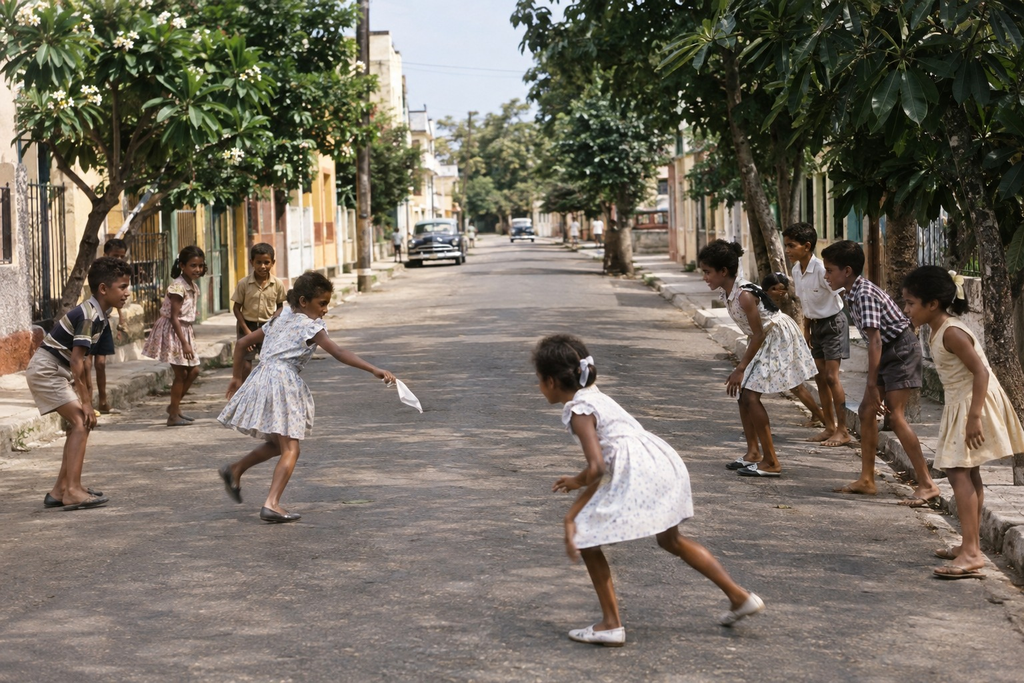
Image generated by digital means.
The game requires two opposing groups and someone to hold the handkerchief. Each player has a number. A number is called out, and two children run off. The first one to grab the handkerchief must return safely to their group. If the other player touches it first, they lose.
A tiny scrap of fabric becomes the center of a battle, the prized object of the moment. Here, the game requires considerable space and, above all, other bodies.
You can't play alone. It doesn't work if each child is in their corner staring at their own screen because the logic depends on there being someone in front of them. An opponent. A teammate. An audience and two groups shouting at each other.
Flowers, rules and power
There is one question that runs through all these games: Who invented the rules? Because these games didn't have a manual, but Veloz Maggiolo observed that the rules were an oral tradition passed down from child to child, and that means that each neighborhood could be a small republic, with its own laws.
A child might say, "This is how we play here," and the others would negotiate whether that rule was valid in this territory.
Therefore, it would be a mistake to study games solely as entertainment. In those years, they were also mechanisms of socialization, teaching territory, cooperation, rivalry, memory, speed, calculation, obedience, leadership, and negotiation.
Some also taught violence and punishment, others reproduced gender differences, while still others mixed boys and girls. But all of them said something about the society that produced them.
Childhood as a factory of culture
For a long time, it has been thought that culture is produced from above and created by writers, musicians, institutions, artists, and intellectuals. But children's games show otherwise.
A group of children had the power to create an entire culture without writing a book: they invented rules, modified them according to the circumstances, gave them names, and passed them on. They mixed them with songs, took them to another neighborhood, and changed them. And a generation later, someone remembers them differently.
That's folklore, not a relic. A living, ancient social technology. A technology that didn't need electricity.
The question that remains
So why did they disappear? Was it because of television? Nintendo? Cell phones? Because kids these days don't want to run anymore? But perhaps the question is misguided. Perhaps we should first ask:
Where would they play? Because to play tag you need places to run. To play hide-and-seek, space. To paint a trucano, a ground where someone will let you draw. To play plaquequita, a street with few cars. To play Flores y convento, a group of children who can dash off to find a stone without anyone thinking that something terrible is about to happen.
The story of these games, then, does not end with the cell phone, but goes through a much greater transformation: the transformation of the Independent Republic of the Street, and that is the story that still remains to be told.
Recommended readings:






