


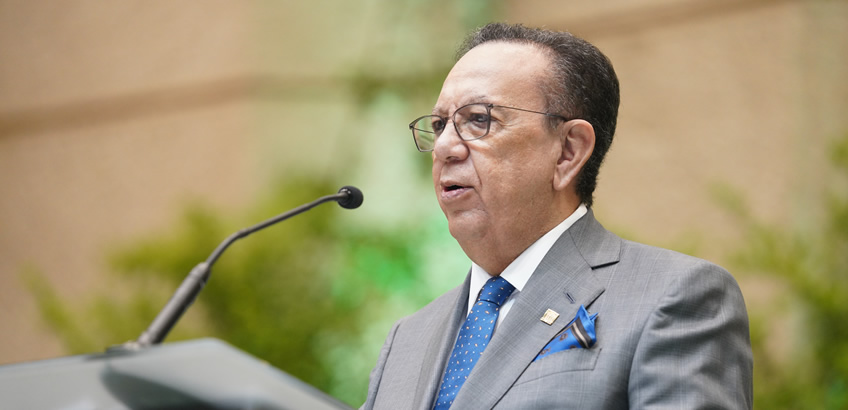
SANTO DOMINGO- The Dominican economy has expanded 5.6% year-on-year through August of this year, driven by a context of price stability, lower inflation and a reduction in interest rates, reported yesterday the governor of the Central Bank of the Dominican Republic, (BCTD), Héctor Valdez Albizu.
The construction sector (4.9%) and free trade zones (6.5%) were the two sectors that contributed most to the aforementioned growth during the first eight months of 2023, according to the agency's data.
Valdez Albizu indicated that the economy shows an accumulated growth of 5.1% between January and August of this year, as shown by the Monthly Indicator of Economic Activity (IMAE).
He said that this result places the country "as the fastest growing economy in Latin America to date.".
The governor's statements were made within the framework of the seventy-seventh anniversary of the Central Bank of the Dominican Republic (BCRD), where the professional valued the resilience of the national productive apparatus, in the face of a global scenario in which, although it has overcome the COVID-19 pandemic, it still faces geopolitical crises that impact the prices of raw materials and oil, generating uncertainty throughout the world.
Valdez Albizu explained that year-on-year inflation stood at 3.29% in September 2024, while core inflation, which reflects the monetary conditions of the economy, reached 4.01%.
Valdez Albizu argued that inflation rates have been kept in check thanks to the proper implementation of monetary policy.
International perspective
Despite the "uncertain outlook" internationally, the US economy grew 2.6%, while its inflation fell to 2%, a scenario that allowed for a 50 basis point reduction in federal funds rates.
This outlook influenced the Central Bank's decision to reduce the monetary policy rate from 7% to 6.75% in August, and then lower it by 25 basis points in September, bringing it to 6.50%. This represents a cumulative reduction of 200 basis points since May 2023.
Meanwhile, the services sector experienced a rise of 5.4%, according to data from the monetary entity, supported by financial services (8.1%), hotels, bars and restaurants (7.1%), transport and storage (5.9%), real estate and rental activities (5.8%) and communications (5.3%).
Projection for the year
The governor highlighted that the behavior of the Dominican economy indicates that it will end 2024 with a growth of 5.0%, with a range of between 4.5% and 5.0% for 2025.
However, he stressed that this is a percentage that the Central Bank maintains "to be conservative and have some security", since international organizations such as the International Monetary Fund (IMF) estimate an expansion between 5.1% and 5.2%.
Meanwhile, inflation is expected to reach 3.5% by the end of 2024, converging to 4.0% by next year.
"We are fully complying with our constitutional commitment to guarantee stability through inflation," he assured.
He also stated that the current account deficit would be 3% of the gross domestic product (GDP), which would be covered by foreign direct investment, exceeding $4.5 billion by the end of this year.







