


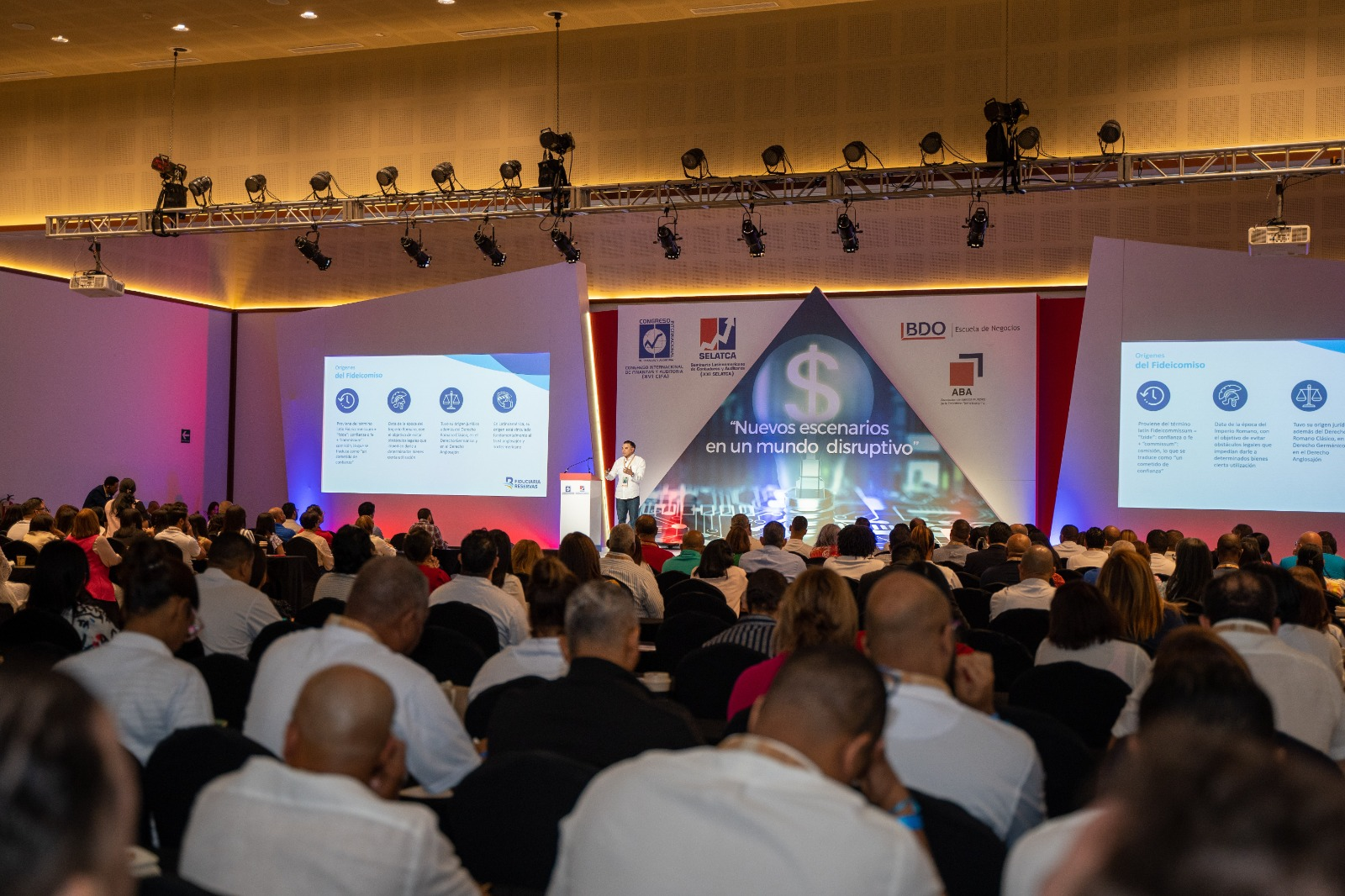
SANTO DOMINGO.- Unlike other countries, the Dominican Republic has the unique characteristic of having linked the trust to real estate development through Law 189-11, which has allowed the development of projects with a great social impact for the country.
The general manager of Fiduciaria Reservas, Andrés Vander Horst Álvarez, assured yesterday that the public trust has enabled large-scale projects with significant social impact in the Dominican Republic using resources outside the National Budget, with a high level of transparency and efficient operation.
In his lecture "Public Trusts as a National Investment: Perspectives for Good Practices in Transparency and Auditing," delivered during the closing of the XVI International Congress of Finance and Auditing (CIFA) and the XXI Latin American Seminar of Accountants and Auditors (SELATCA), Vander Horst Álvarez pointed out that, consequently, 90% of the country's transactions are real estate trusts, and most are low-cost, which has led to more housing of this type being built in the last 10 years than in the entire history of the nation.

Andrés Vander Horst Álvarez, during his speech. (External source).
However, he stated that the public trust, regulated by Law 28-23, constitutes a specialized financing alternative outside of normal public debt, in order to develop infrastructure works, transportation and other areas of public interest.
Among the public trusts he detailed and described as having a significant social and economic impact in the Dominican Republic are: RD Vial, which has issued securities of up to RD$50 billion; VBC RD, comprised of more than 25,000 homes and including Ciudad Juan Bosch; Mi Vivienda, which has already delivered 3,900 housing units; and Pro-Pedernales, an initiative that has already raised more than RD$12 billion through investments from various private market funds.
"The public trust is here to stay, and it is up to us to defend this instrument to give the Dominican economy a sense of trust, something it needs to continue growing," Vander Horst stated.
Artificial intelligence will not replace human beings
Artificial intelligence will not replace humans, although it does pose significant adaptation challenges for professionals, including those in auditing, risk management, marketing, and other business areas that can use this technological tool to streamline their functions, concluded specialists in digital transformation and technology at the XVI International Congress of Finance and Auditing (CIFA) and the XXI Latin American Seminar of Accountants and Auditors (SELATCA).
For three days, more than 300 professionals from the financial sector, public and private institutions, met at the simultaneous events organized by the Association of Multiple Banks of the Dominican Republic (ABA) and BDO Business School.
Ángela Nieto, Senior Vice President of Digital Transformation and Information Technology at Banco BHD, commented that Artificial Intelligence (AI) is very useful for the banking sector, as it allows the creation of models to satisfy users in a specialized and individual way.
"We will always need human personnel to manage these tools," Nieto pointed out, noting that empathy, creativity, love, compassion, flexibility, intuition, and other qualities cannot be artificially replaced. He added that professionals should focus on developing tasks that require value-added input when using AI.
In light of the digital transformation, Edwin Reyes, Vice President of Information Technology Audit at Banco Santa Cruz, highlighted the importance of changing how organizations operate, make decisions, and provide value-added services, in order to positively impact users.
He noted that AI presents challenges for various organizational areas. When outlining the challenges for auditors, he pointed out that they can leverage AI to optimize controls and assess risks, thereby improving the effectiveness of internal processes.
AI can also be useful in preventing money laundering and terrorist financing, as explained by independent consultant Juan Carlos Medina, who emphasized the importance of the quality of the data supplied to this tool. He stressed that the sound judgment of compliance officers and entities subject to Law 155-17 is vital for the effective use of this tool.







