


SANTO DOMINGO.- In response to the damage caused by heavy rains on November 18th in Santo Domingo, President Luis Abinader announced yesterday that the Santo Domingo Water and Sewerage Corporation (CAASD) will present a program for integrated stormwater and sanitary drainage in Greater Santo Domingo within the next 15 days.
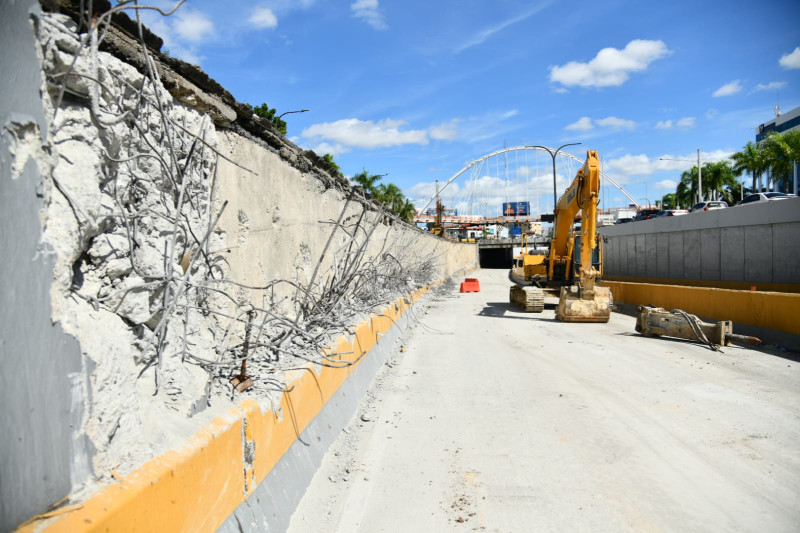
Experts have highlighted, following the torrential downpours that have fallen in the country recently, that this problem requires urgent action from the Dominican State, after the collapse of several slabs of the underpass at the intersection of 27 de Febrero Avenue and Máximo Gómez Avenue, which left 9 people dead.
“It is a project that a government cannot do in four years, and it is a project that, due to the scale of the investment, I think should be done between eight and 12 years, but I would like it to be approved by the entire society and the political leadership,” Abinader said.
Experts speak
In yesterday's edition, El Inmobiliario highlighted the arguments of architect Edgar Martínez, who considered that "Flooding resulting from an inadequate stormwater drainage system represents a direct threat to urban infrastructure and the safety of its residents.".
Meanwhile, engineer and former Secretary of Public Works, Pedro Delgado Malagón, emphasized the complexity of rainwater drainage in Santo Domingo due to the porous nature of the limestone subsoil, which makes it difficult to control water in the face of the city's disproportionate growth. "What happens with that rock, which is a very permeable reef limestone, full of holes and irregularities?".
The engineer pointed out that, although the structures are not designed to withstand rainfall of such magnitude, the incidence of extreme weather events, coupled with climate change, is challenging the usual standards of urban planning.
Referring to historical infrastructure projects, such as the drainage system implemented by the Spanish in the 6th century, Delgado Malagón spoke of the economic and structural differences between that era and the present, ironically suggesting that moving the city might be more viable than emulating projects of that magnitude: "It is impossible to make a large investment in this aspect; I think it would be cheaper to move the city.".
Regarding infrastructure
Delgado Malagón describes the infrastructure situation in the Dominican Republic, particularly in Santo Domingo, as complex, after outlining a series of worrying problems, focusing on the destructive influence of water as an aggressive agent that wreaks havoc on transportation structures and homes. "Water, once a benefactor, has become a destroyer and a source of pollution, affecting the quality of life of thousands of low-income families living near rivers like the Ozama and the Isabela," he stated.
Meanwhile, Martínez argued that the exponential growth of urban areas, driven by population growth and infrastructure expansion, poses significant challenges for stormwater management in urban environments.
Addressing the concerns of Dominicans regarding the country's infrastructure following certain events, Delgado emphasized that it was not a problem of design flaws or poor practices, but rather the unpredictability of nature, and made a clear appeal: "The critical state of infrastructure in Santo Domingo demands urgent and coordinated action to address current challenges before they worsen," he said.
Pedro Delgado Malagón's vision highlights the need for a deep and strategic review of urban infrastructure to face climate challenges and ensure resilience against extreme natural phenomena, while also urging Dominicans not to be afraid to pass through tunnels and overpasses after the events of November 16th.
“Finding definitive solutions requires a comprehensive, technical, and coordinated approach. The challenges related to stormwater drainage are multifaceted and demand effective coordination among the various competent government entities and civil society actors. Inter-institutional collaboration is essential to overcome administrative barriers and ensure the successful implementation of comprehensive solutions,” Martínez explained.







