


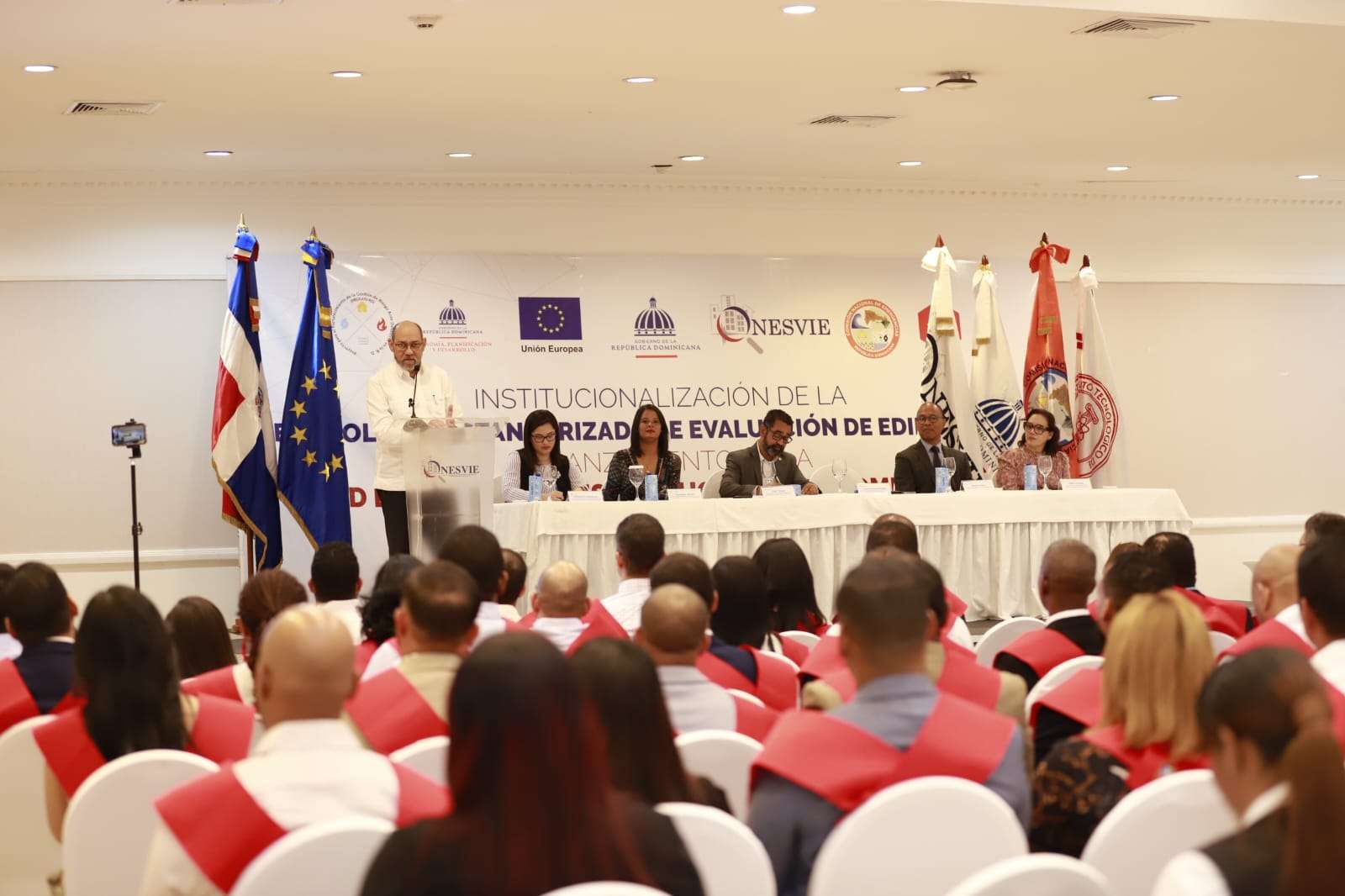
The initiative seeks to optimize the building assessment process at the national level and had the support of the European Union and the participation of 20 institutions
SANTO DOMINGO. The National Office for Seismic Evaluation and Vulnerability of Infrastructure and Buildings (Onesvie), through the Strengthening of Disaster Risk Management in the Dominican Republic (Progeri-RD) project of the National Emergency Commission (CNE), financed by the European Union, delivered to the country the first class of the Dominican Network of Structural Evaluators (REED), made up of a total of 47 professionals who graduated from the "Diploma in Building Evaluation".
The training was given at the Technological Institute of Santo Domingo (Intec), with the purpose of certifying technicians from different areas to contribute to the safety of buildings, infrastructure and lifelines at the national level in the face of any disaster.
During the event, the "Standardized Building Evaluation Methodology" was also institutionalized, which will be used by evaluators and is focused on streamlining the evaluation and data collection processes before and after an event.
Onesvie and the 20 public and private institutions participating in the training reaffirm their commitment to making the building assessment process in the country more efficient.
After thanking the European Union and involved institutions for their support, Leonardo Reyes Madera, Director General of Onesvie, expressed his satisfaction with this achievement, which, in his view, sets a precedent and demonstrates the responsibility that the institution he leads has assumed to address the problem of seismic vulnerability.
“Earthquakes don’t give warning, and their consequences can be irreparable. I still believe we have time to reduce vulnerabilities in our buildings,” he pointed out.
Addressing the first group of evaluators, the head of Onesvie stated: “You will be a voice of warning; you are formally authorized to spread this message of prevention, which represents true resilience. For the first time in the Dominican Republic, we will no longer have to guess what might happen in any of our buildings, both in the public and private sectors,” the official said, according to a press release.
Meanwhile, Juan Salas, president of the CNE and executive director of Civil Defense, indicated that from the institutions he leads, he continues to coordinate actions that contribute to a preventive culture of risk, from the local level, a work that is demonstrated with this graduation of specialized technicians.
Meanwhile, Yanelba Abreu, administrator of the Progeri-RD project, praised the efforts of all the institutions involved in each stage of the training program.
He also highlighted the delivery of an evaluation kit for each evaluator and the provision to Onesvie of a state-of-the-art 350 matrix drone, as well as all the necessary technological equipment for the evaluations to be carried out thanks to European Union funds.
Also participating in the event were Patricia Céspedes, Director of Regional Cooperation Monitoring at the Ministry of Economy, Planning and Development, and Alliet Ortega, Vice-Rector of Administration at the Technological Institute of Santo Domingo.
The agreement for the institutionalization of the building evaluation methodology was signed by Onesvie, Civil Defense, the Ministry of Public Works and Communications (MOPC), the Puerto Plata Water and Sewerage Corporation (Coraaplata), the Santo Domingo Water and Sewerage Corporation (CAASD), the Dominican Red Cross and the Ministry of Education of the Dominican Republic (Minerd), to which others will be added.
Also participating in the training were members of the College of Engineers, Architects and Surveyors (Codia), Ministry of Defense (MIDE), National Police (PN), as well as the National Institute of Hydraulic Resources (Indrhi), the National Institute of Drinking Water and Sewerage (Inapa), Women in Engineering of the Dominican Republic (MIRD), Autonomous University of Santo Domingo (UASD) and Pontifical Catholic University Madre y Maestra (PUCMM).
Data on REED members will be in the so-called Evaluators Bank, which will be available to the Dominican State, through governmental and non-governmental institutions involved in actions of prevention, mitigation, response, rehabilitation and recovery in the face of natural events.
About the Program
The Progeri-rd program, within the framework of the Regional Indicative Program (PIR), under the 11th EDF, aims to continue strengthening the Integrated National Information System (SINI) and the National School of Risk Management and promote its projection at the regional level.







