


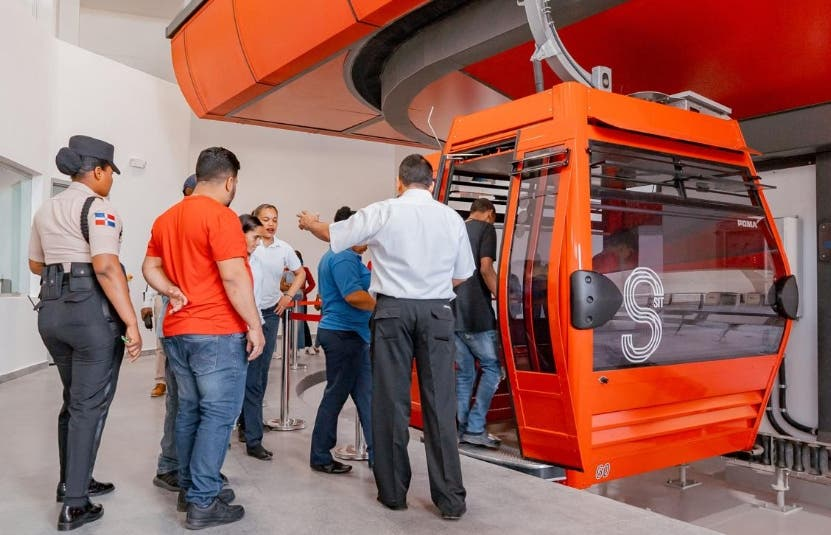
SANTO DOMINGO.- In just 9 days and two hours of daily use, the Santiago cable car has transported more than ten thousand people who are going to experience the cable mobility system, inaugurated on March 17 by President Luis Abinader.
Long lines of users from various sectors of the Heart City have formed during the operation of this service which, due to the inauguration, circulates free of charge, and along whose route the user population shows enthusiasm and empathy with the important work that marks a new era in the Cibao transport system.
The first section of the mass transit project that was launched in that province involved an investment of RD$6,544 million pesos and will directly impact some 73,968 inhabitants of 9 of the most populous sectors of the demarcation.
Julio Ramírez, in charge of cable cars for the Trust for the Development of the Mass Transit System of the Dominican Republic (Fitram), explained that the four-kilometer route, in 83 cabins for 12 users, is carried out at a height of 7 meters per second at a speed and takes 12 to 15 minutes.
“The first terminal, which is the central one, goes from the Central Electoral Board, the second one, Padre Emiliano Tardif, then you cross the bridge through René Clan de Guzmán until you reach the Yolanda Santana station,” he explained.
He highlighted the security of the system in the country, which has been in service for more than 42,000 hours.
The Santiago Cable Car is a cable transport system, made up of 129 cabins with detachable clamps, with the capacity to transport 4,000 passengers per hour and in each direction, with a daily transport capacity of 64,000 people.
This first section of the system covers 4 kilometers, running from the La Yagüita del Pastor sector to the Las Carreras Central Terminal in Pueblo Nuevo, with 4 stations: E1: Central Station, E2: Emiliano Tardif Station, E3: Renée Klang de Guzmán Station, and E4: Yolanda Santana Station. The entire journey takes 10 minutes.
With information modified from El Día.







