The bill could be definitively approved after August 16.
SANTO DOMINGO.– After receiving a flood of criticisms and proposals from various sectors involved in the issue, to be incorporated into the draft Law on Real Estate Rentals and Evictions, the special commission studying the project accepted more than 90% of the proposals made by the various organizations, which advocated for strengthening the legislation.
The proposal was approved in June in its first reading in the Lower House , while public hearings were subsequently held , where various representatives of the business community connected to the industry expressed their opinions on the draft bill, highlighting aspects that needed to be adjusted to strengthen legal certainty in the country's rental market.
Deputy Amado Díaz, president of the commission, reported yesterday that the legislators would be modifying the bill in aspects such as less rigid sanctions for owners and more freedom in the rental contract, after noting that more than 90% of the suggestions received in public hearings were accepted, considered and incorporated into the project.
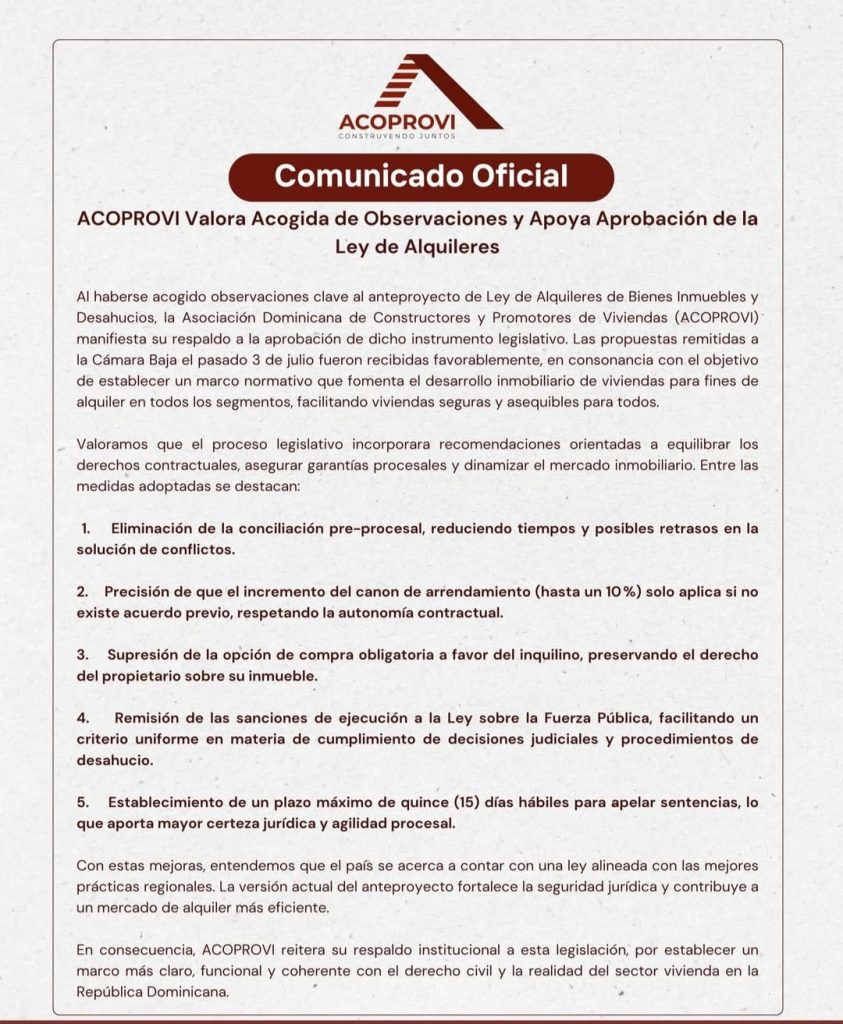
The Dominican Association of Housing Builders and Developers (Acoprovi) immediately applauded the approval, indicating that the observations submitted to the Lower House on the 3rd of this month were well received , in accordance with the interest in contributing to a robust real estate sector that positively impacts citizens and providers of these services.
“We welcome the fact that the legislative review process has taken into account our recommendations regarding the balance between contractual rights, procedural guarantees and the dynamism of the real estate market,” the entity said in a document.
Deputy Díaz explained that one of the central aspects of the legislative proposal is to establish a "prompt handling" for cases of lawsuits for non-payment and, therefore, the modifications to the project would propose that within a period of between 45 and 60 days the eviction of the delinquent tenant .
The legislator defended this measure, pointing out that, although housing has a social component, this must be guaranteed by the State and "not by private individuals who make great efforts to build a home and live off its rent."
Some points observed and taken into account
The changes to the project include a distinction between residential and commercial properties. For residential properties, a more streamlined eviction procedure is envisaged, while for commercial properties, due to the multi-million dollar investments they often require, the process will be referred to a regular court.
Regarding the observations of the Dominican Republic's Multiple Banking Association, which warned that the initiative could imply an additional burden for financial entities by allowing rental deposits to be made in any bank, Díaz clarified that the project does not impose any obligation in this regard.
In that order, he specified that it is an option given to the tenant so that, if they do not want the Agricultural Bank to keep their deposits, they can request that the money be kept in any bank near the rented property.
Díaz explained that this provision seeks to give guarantees to the tenant, but without imposing on the owner the duty to use that route.
Furthermore, the deputy stressed that the changes also encompass maintaining the private nature of the rental agreement, understanding it as an agreement between two parties, in which the State should only intervene in case of disagreement.
He assured that the content of the law is geared towards respecting the will of the parties involved and that state intervention will be limited to the punitive sphere when necessary.
He acknowledged that, given the few days remaining in the current legislative session, it is very likely the bill will be presented during the next session, which begins on August 16. He estimated that, during the first or second week of the new session, the Lower House will resume its review and move toward its final approval.
Acoprovi welcomes the measure
We share Acoprovi's statement, welcoming the decision of the Chamber of Deputies: