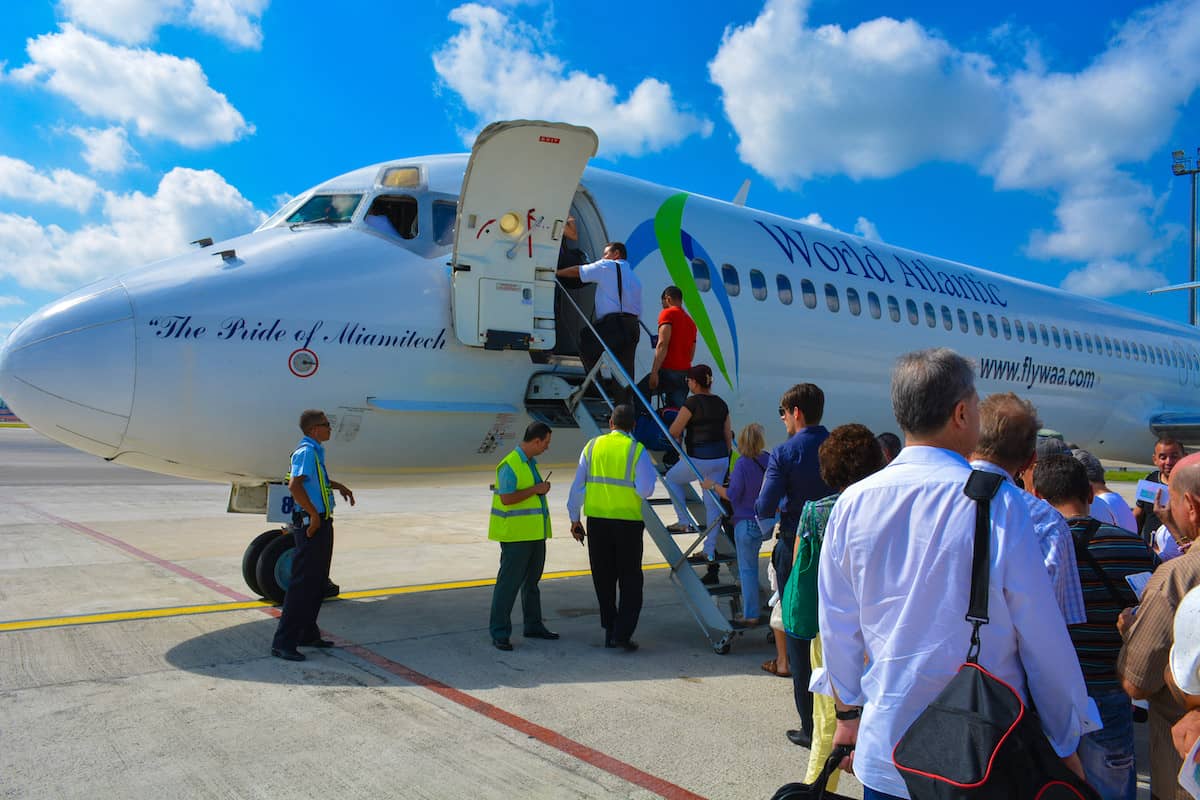
The announced fuel shortage for commercial aviation in Cuba could impact flights operated by the Dominican airline Air Century, which serves the Santo Domingo–Havana route. Currently, the company is the only one maintaining regular service between the two countries, with two weekly flights from Dr. Joaquín Balaguer International Airport (El Higüero)in Santo Domingo North, a terminal operated by Aeropuertos Dominicanos XXI (Aerodom).
No airline operates flights to the Caribbean island from Las Américas International Airport (AILA), José Francisco Peña Gómez, which concentrates connectivity in this single alternative.
The potential impact comes after the Cuban government informed international airlines operating on the island that, starting this Monday, the country will run out of aviation fuel. The warning was confirmed by the EFE, which cited two industry sources and detailed that the official message was directed to pilots and air traffic controllers due to the kerosene shortage, which is affecting all Cuban international airports.
US executive order and the drop in oil supply
The shortage of aviation fuel is linked to the executive order signed on January 29 by US President Donald Trump, titled “Addressing Threats from the Government of Cuba to the United States.” The decree includes additional tariffs for countries that supply oil to the Caribbean nation and grants the Department of Commerce the authority to identify the countries involved, while the Department of State would determine the amount of the tariffs.
Washington maintains that Cuba poses a threat to its national security and accuses the government of Miguel Díaz-Canel of aligning itself with Russia, China, and Iran, providing intelligence infrastructure to foreign powers, and harboring organizations such as Hezbollah and Hamas. These measures come on top of a structural crisis: local production barely covers 40% of energy needs, while the island imported around 60,000 barrels per day until recently from countries such as Venezuela, Mexico, Russia, and Algeria.
The situation worsened in December, when Venezuelan shipments ceased following the capture of former President Nicolás Maduro in a US military operation on January 3. Mexico, which in 2025 supplied approximately 44% of Cuba's oil imports, some 17,200 barrels per day, also virtually eliminated its shipments in January under pressure from Washington.
Emergency plan and effects on tourism and services
Faced with a shortage of imported fuel, the Díaz-Canel government announced an emergency plan that takes effect this week. The measures include halting diesel sales to the public, reducing the state workweek to four days, cutting hours at hospitals and offices, suspending non-urgent surgeries, severely restricting interprovincial transportation, and closing tourist hotels in the northern keys due to power outages.
Tourism, historically protected as an economic engine, was already showing signs of weakening. Official data indicates that in 2025 the island received 18% fewer visitors than the previous year and 62% fewer than the record 4.7 million reached in 2018. The closure of hotel complexes due to fuel shortages is an unusual occurrence in the country, where these facilities typically remained operational even during natural disasters.
The emergency is not entirely new. In December, the Cuban Aviation Company had warned about the “unavailability” of JET-A1 fuel at national airports, although the situation was temporarily alleviated at that time with the arrival of a tanker ship.
International warnings and seeking support
Experts like Jorge Piñón, from the University of Texas Energy Institute, have indicated that without new oil shipments, Cuba could face a total economic collapse in March. The country produces about 40,000 barrels of heavy crude oil per day—primarily for thermoelectric power plants—but needs to import at least an additional 60,000 barrels to sustain electricity generation and essential services.
From Moscow, Kremlin spokesman Dmitry Peskovstated on Monday that “the situation in Cuba is truly critical” and that Russia is maintaining diplomatic contacts to discuss possible solutions and provide assistance. Meanwhile, US Secretary of State Marco Rubiorecently declared that his government “would love to see” regime change on the island, though without specifying any concrete actions.
At the end of January, Cuba declared an “international emergency” following the announcement of US tariffs. Meanwhile, Mexico sent more than 800 tons of humanitarian aid on two military vessels, according to President Claudia Sheinbaum, who affirmed that diplomatic channels remain open with Washington to try to resume crude oil supplies.
The Cuban ambassador to Mexico, Eugenio Martínez, stated that the aid would help mitigate the consequences of what he described as an “economic war” and publicly thanked the Mexican government for its support. However, the warning to airlines highlights the magnitude of a crisis that has already reached the airport system and could affect regional air connectivity, including the only regular route between the Dominican Republic and Cuba.
Recommended readings: