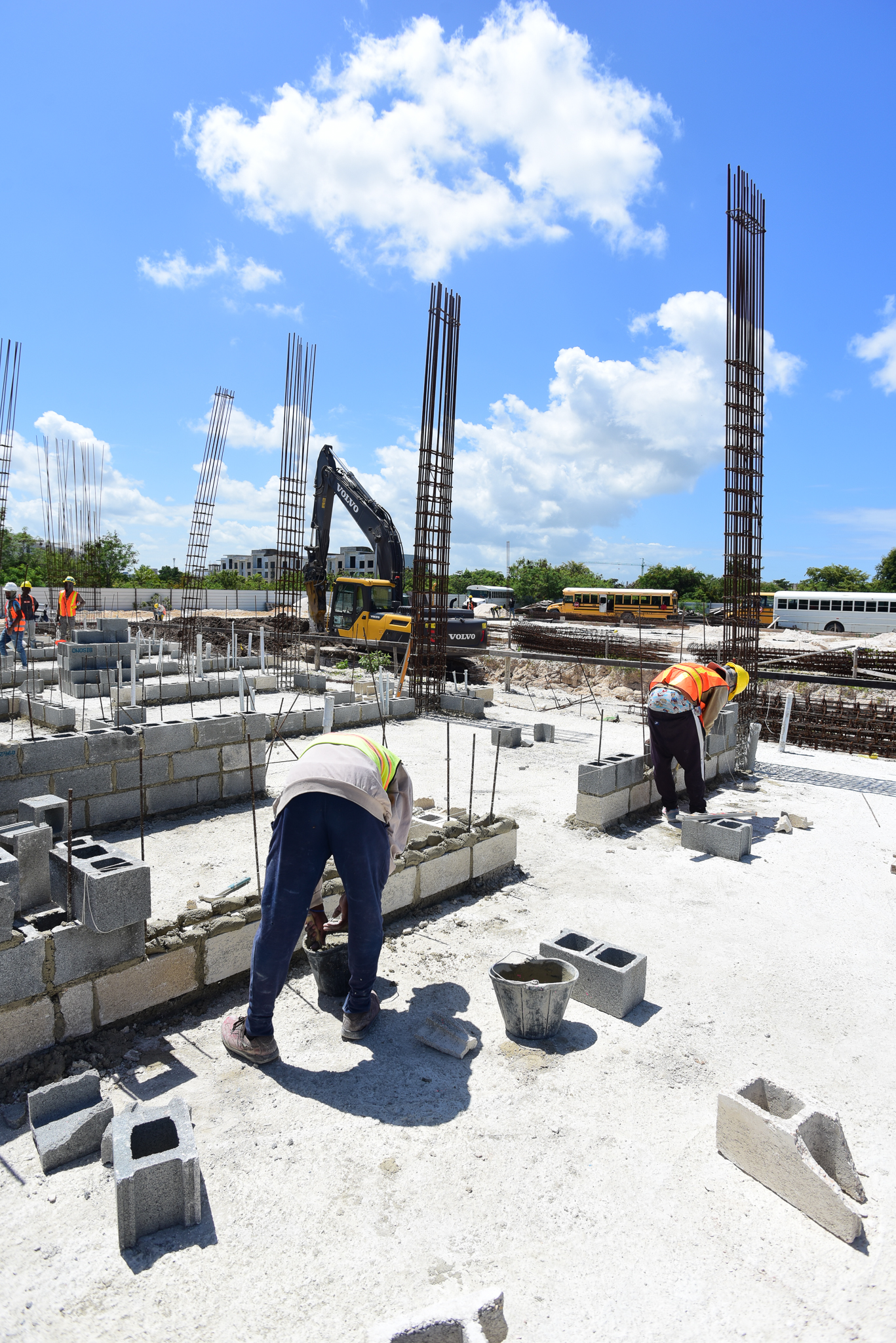
The sector grew by nearly 8% in March, according to the Central Bank's IMAE, confirming a change in the cycle after the slowdown of recent years, supported by better financing conditions and greater construction activity
SANTO DOMINGO. – The construction sector registered a year-on-year expansion of nearly 8% in March 2026, one of the highest in recent months, with a direct impact on the 5.1% growth of the economy in that month and an accumulated 4.1% in the first quarter.
According to the results of the Monthly Indicator of Economic Activity (IMAE) published this April by the Central Bank, construction was among the activities that contributed most to the aggregate result, along with free zones, commerce and tourism.
The entity links this performance to the increase in investment in works, both private and public, as well as to relatively more favorable financial conditions, in a context of reduced active interest rates and liquidity measures adopted since 2024, as detailed in the Monetary Policy Report (MPR) and in its current reports.
These conditions have impacted the execution of residential, commercial and tourism projects, which is reflected in the recent trajectory of the IMAE for the sector and the evolution observed in the first quarter of 2026 continues a trend of improvement that began previously.
Indeed, the IMAE series shows that construction maintained a more dynamic performance from the end of 2025, when it began to register positive year-on-year variations after a period of weakness.
The IPM documents that this recovery was associated with greater availability of financing and the gradual normalization of macroeconomic conditions, with inflation within the target range and more stable expectations.
Three years of ups and downs
In perspective, the behavior of the last three years shows a change in trajectory that is clearly identifiable in the Central Bank's own statistics.
During 2023, the sector operated under the effects of the monetary tightening applied since 2022, which resulted in limited growth and episodes of contraction in construction, according to the monthly evolution of the IMAE.
The IPM for that period explains that the increase in interest rates and the higher cost of credit influenced the postponement of projects and the slowdown in construction activity.
Around 2024, the sector began a gradual reactivation process, according to the evolution of the IMAE and this change was associated, according to the IPM, with the progressive easing of monetary policy, the implementation of liquidity provision measures and a gradual recovery of credit to the private sector.
The Central Bank notes that these conditions coincided with an improvement in the pace of construction work and a stabilization of the sector's growth, although still at moderate levels compared to previous cycles.
By 2025, the IMAE data shows a more defined recovery towards the second half of the year, with positive year-on-year rates in construction, while the IPM attributes this behavior to the continuation of monetary stimulus, the expansion of credit and the increase in investment, both public and private.
Impact on el inmobiliario
In that context, the real estate sector, closely linked to construction, benefited from the flow of financing and the demand for housing and tourism projects, according to the Central Bank's sector reports.
Reports published in El Inmobiliario agree that construction remained among the main drivers of economic growth at the beginning of the year, in line with official IMAE data, reinforcing the consistency between the Central Bank's statistics and their interpretation in the specialized journalistic field.
Taken together, the data from the IMAE, the IPM and the Central Bank's press releases allow us to establish a clear sequence: a slowdown phase in 2023, a gradual reactivation in 2024, a more sustained recovery in 2025 and a more dynamic start to 2026.
This overview shows that construction and real estate activity have regained their ability to influence economic growth, although their evolution continues to be subject to factors such as financing conditions, public investment and the external environment, as the monetary authority itself warns in its reports.
Recommended readings: