

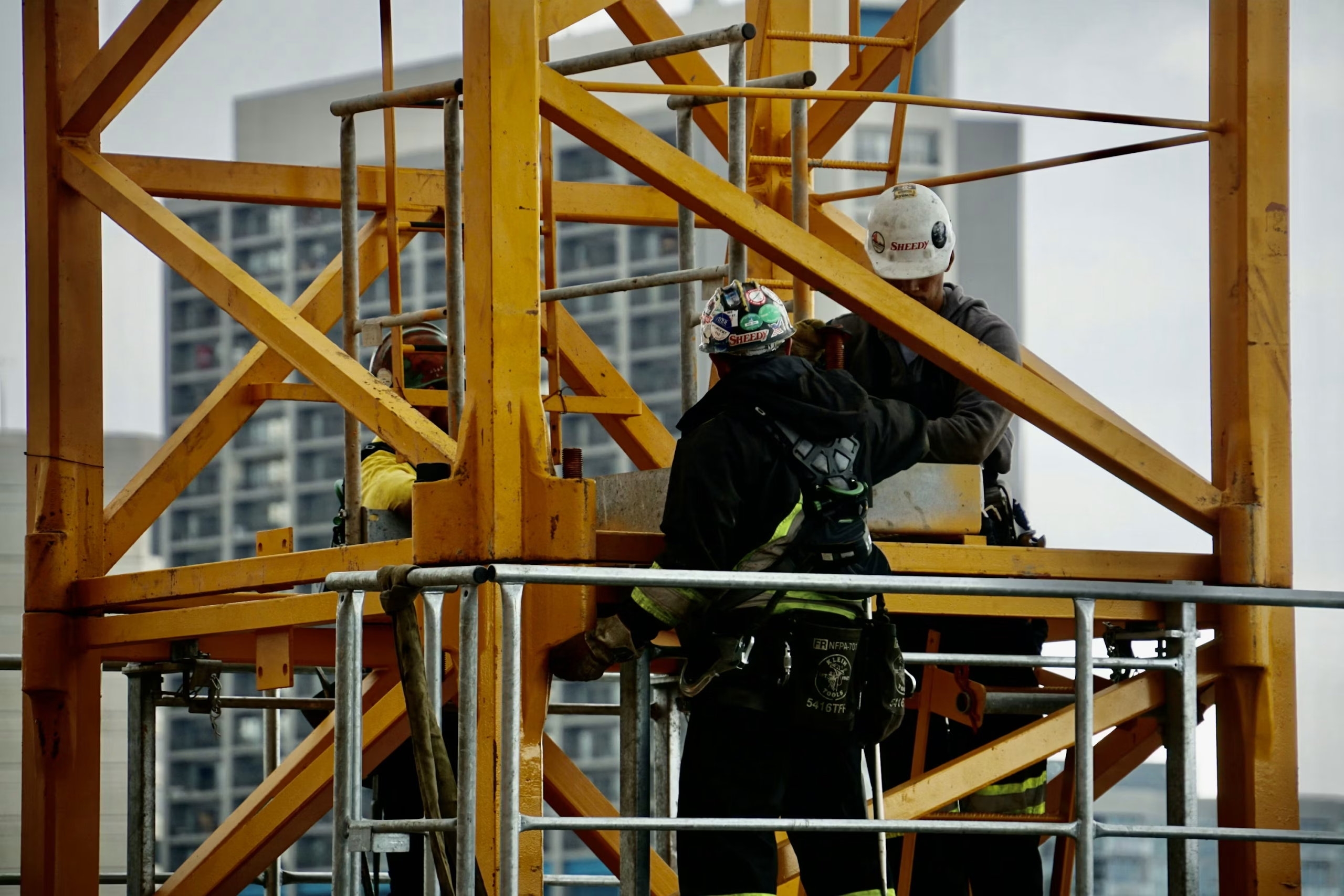
SANTO DOMINGO – The death of a construction worker in the Piantini district has brought to the forefront an issue that often fades into the background until tragedy strikes: workplace safety in construction. This incident comes at a time when official statistics highlight the magnitude of the challenge.
Between 2007 and October 2025, the Dominican Institute for Prevention and Protection of Occupational Risks registered 647,933 work accidents and occupational diseases, of which 83.08% corresponded to the private sector and 16.92% to the public sector, according to the National Social Security Council (CNSS).
Between January and October 2025 alone, 43,249 workplace accidents were recorded, and 60.7% of these involved men. Beyond the cold statistic, this figure reveals a daily reality: thousands of workers are exposed to risks while erecting the structures that transform the urban landscape.
Building the country also involves risks
Construction is one of the sectors that most drives the Dominican economy and, at the same time, one of the largest job creators, both formal and informal. Each tower, building, or project involves a chain of work that connects hundreds of people. However, this same operational intensity entails a level of exposure that is not always visible from the street.
Globally, the International Labour Organization estimates that at least 60,000 fatal accidents occur annually in the construction industry, representing approximately 17% of all workplace deaths. In the Dominican Republic, this industry ranks second in terms of accident-related fatalities, and along with the industrial sector, it continues to experience a progressive increase in workplace risk.
Industry experts agree that most accidents are not accidental. Studies indicate that 80% are linked to failures in organization, planning, and control, while the remaining 20% are related to execution errors. In other words, many of these situations can be prevented.
Prevention as the first line of defense
Given this scenario, prevention becomes as important a tool as a helmet or harness. A report by SURA Insurance outlines some basic—yet crucial—measures, such as properly storing materials, keeping transit areas clear, checking cables and scaffolding, using personal protective equipment, and training workers, which can make the difference between a normal workday and an accident.
Even the insurance market has begun to respond to this reality with solutions aimed at construction workers. Personal accident insurance, for example, includes medical coverage, disability benefits, financial support in case of death and funeral expenses, as well as assistance in situations of hospitalization or emergency transport.
More than just an add-on, these tools reflect how risk management has become an increasingly prevalent conversation within the sector.
When supervision becomes necessary
The debate also extends to compliance with regulations. The Ministry of Labor reported that, following special operations in the National District, 15 towers were shut down out of a total of 33 inspected for presenting conditions that endangered the safety of workers.
The workshops —conducted in 41 companies— resulted in 380 reports: 304 warnings for non-compliance and 76 infractions related to the lack of safety committees, signage, personal protective equipment, first aid kits and fire extinguishers, among other irregularities.
The Minister of Labor, Eddy Olivares, has stated that both workers and the environment where buildings are erected must have the necessary conditions to prevent any type of accident. He explained that the inspections aim to raise awareness and encourage builders to strictly comply with health and safety regulations.
During one of these inspections, a worker fell—without serious consequences—because he did not have the proper protective equipment, an incident that highlighted the importance of applying Regulation 522-06, which obliges the employer to protect the worker against occupational risks and allows for the suspension of activities when there is an imminent danger.
The risk doesn't end when you leave the construction site
Workplace safety is not limited to the perimeter of a project. Between 2020 and 2024, IDOPPRIL reported 48,293 commuting accidents, meaning accidents that occurred while workers were traveling to or from their workplace. The system has disbursed more than RD$5.121 billion to its members for these incidents.
This data broadens the conversation: protecting the worker involves looking not only at the space where construction takes place, but at everything surrounding the workday.
Beyond the tragedy
The death of the construction worker in Piantini comes at a time when urban growth is accelerating and construction remains a pillar of economic activity. But it also serves as a reminder that behind every structure are people whose safety depends on planning, supervision, and compliance with regulations.
The figures, inspections, and technical recommendations all point in the same direction: reducing accidents is not only a regulatory goal, but a necessary condition for truly sustainable development.
Because while the country continues to build its future in concrete and steel, the great challenge remains ensuring that every worker can return home at the end of the day.
Recommended readings: