SANTO DOMINGO – The roof is one of the most important elements in the design of a home. The report published by the National Statistics Office (ONE), in its "Booklet I on Structural Characteristics of Housing," breaks down the data from the 2022 National Population and Housing Census.
This document examines the structural characteristics of the Dominican housing stock, including the materials used in roofs, walls and floors, as well as the internal distribution of the houses, based on the construction conditions recorded in the national territory.
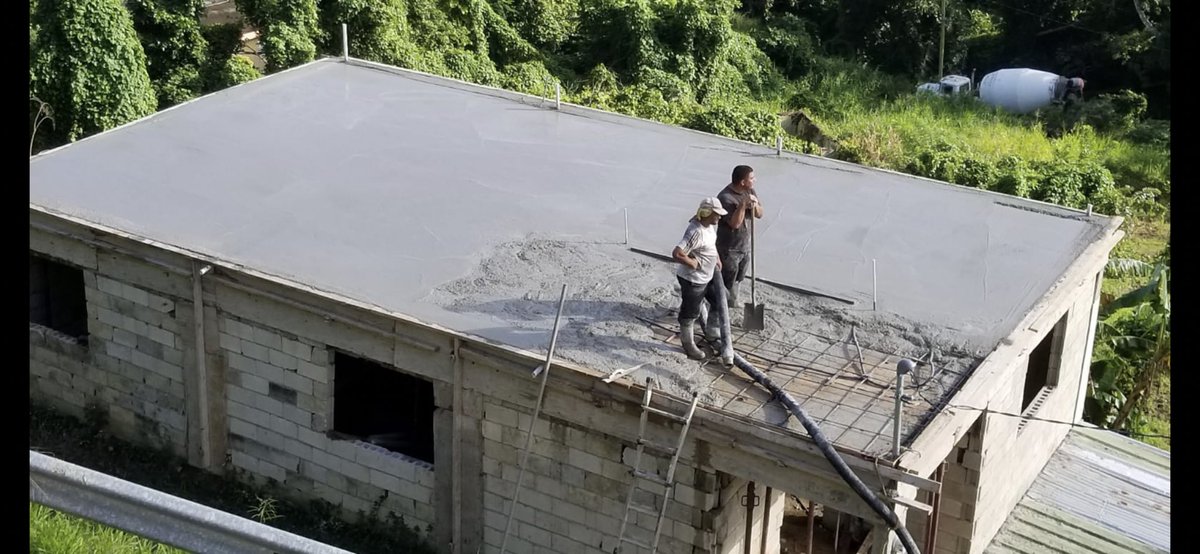
According to the report's findings, concrete and zinc are the predominant materials in the roofs of occupied private homes in the Dominican Republic, accounting for 50.9% and 47.5% of the national total, respectively
Concrete leads the way in roofing structures nationwide
The results show that concrete is the most used material in roofs, present in 1,881,428 homes, which is equivalent to 50.9% of the national total.
Zinc is a close second, used in 1,755,486 homes, representing 47.5%, which shows an almost balanced distribution between both materials within the housing stock.
Other materials appear in smaller proportions, such as asbestos cement, with 38,553 homes (1.0%), cane with 1,970 (0.1%), and palm thatch with 1,656 (0.0%). The category “other” is added, encompassing 14,967 homes (0.4%), reflecting a limited presence within the total.
Marked differences between urban and rural areas
When observing the territorial distribution, the pattern of material use shows significant variations.
In urban areas, where 2,677,318 homes are concentrated, concrete dominates with 1,614,588 units, equivalent to 60.3%, followed by zinc with 1,022,615 homes (38.2%). The remaining materials maintain a marginal share, with values equal to or less than 1%.
In contrast, in rural areas, with 1,016,742 homes, the trend is reversed. Zinc is the predominant roofing material, covering 732,871 homes (72.1%), while concrete is less common, appearing in 266,840 homes (26.2%), a significant difference compared to urban areas.
Detailed composition of roofing materials
The census survey establishes that the total number of occupied private dwellings in the country amounts to 3,694,060, of which 2,677,318 correspond to urban areas and 1,016,742 to rural areas.
Within this group, concrete is distributed in 1,614,588 urban dwellings (60.3%) and 266,840 rural dwellings (26.2%), consolidating its predominance at the national level with 1,881,428 units (50.9%).
Zinc, for its part, has a strong presence in both contexts, with 1,022,615 homes in urban areas (38.2%) and 732,871 in rural areas (72.1%), for a total of 1,755,486 homes (47.5%).
Regarding other materials, asbestos cement was found in 30,536 urban dwellings (1.1%) and 8,017 rural dwellings (0.8%), totaling 38,553 (1.0%). Cane appeared in 580 urban dwellings and 1,390 rural dwellings, reaching a total of 1,970 (0.1%).
Likewise, palm thatch was identified in 292 homes in urban areas and 1,364 in rural areas, for a total of 1,656 (0.0%). Finally, the “other” category includes 8,707 urban homes (0.3%) and 6,260 rural homes (0.6%), totaling 14,967 (0.4%).
Recommended readings: