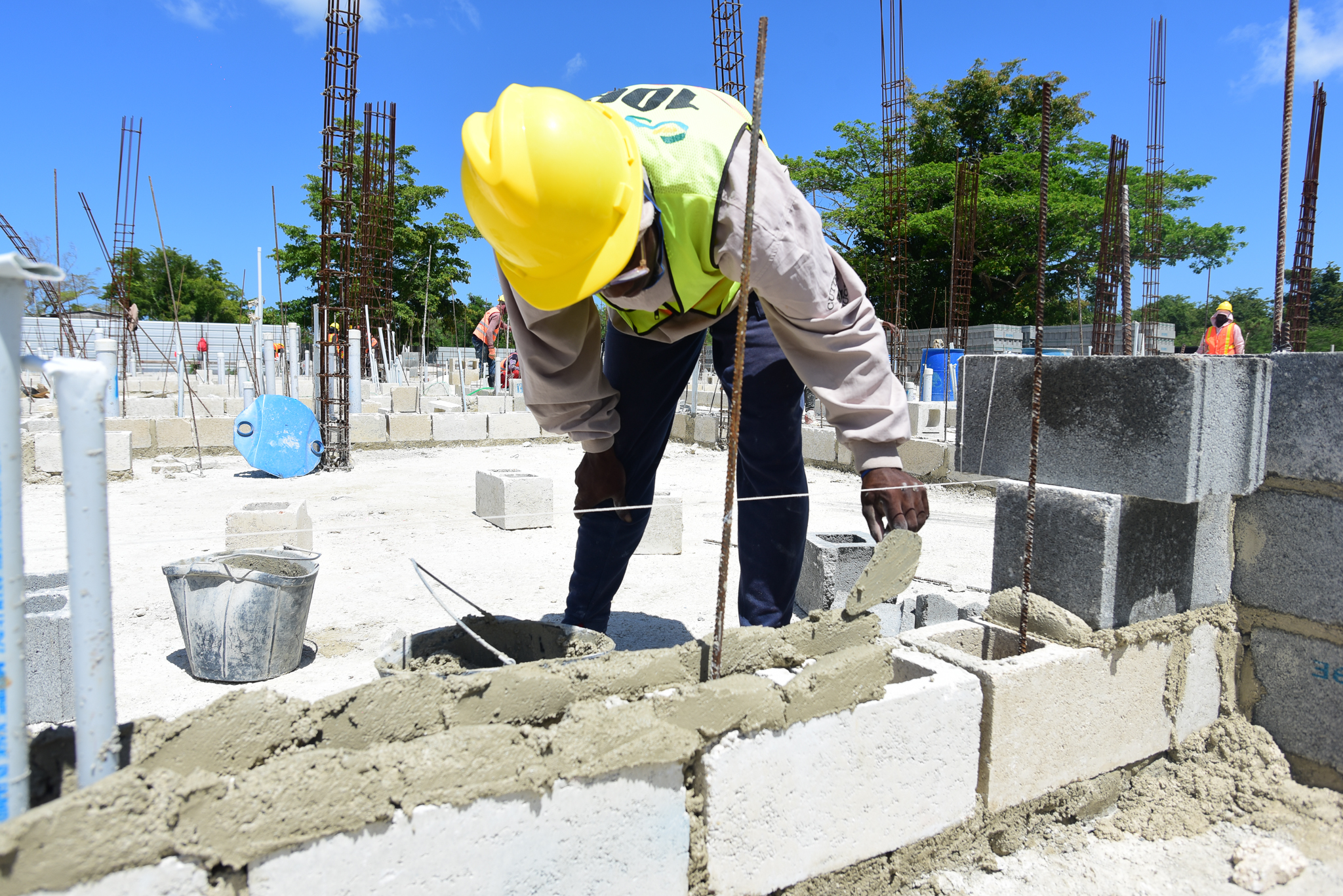
SANTO DOMINGO- The majority of private homes occupied in the Dominican Republic are built of block or concrete, a material that accounts for 82.2% nationwide, according to the results of Booklet I on structural characteristics of housing.
The report released by the National Statistics Office (ONE) presents a breakdown of the data collected in the X National Population and Housing Census 2022 and examines the composition of the housing stock from its structural elements, encompassing materials of walls, roofs and floors, as well as the internal distribution of the houses in terms of rooms and spaces intended for food preparation.
Concrete sets the standard
According to the report, the Dominican Republic has a marked preference for the use of concrete blocks in the walls of homes, positioning it as the most widespread material in the national territory.
Far behind are other construction options: wood represents 13.1%, while zinc reaches 2.8% and palm board 1.6%, showing a considerable difference compared to the predominant material, according to the data.
Alternative materials with limited presence
The study also records a low incidence of materials such as tejamanil, yagua, cardboard, plywood or waste elements, which, together, do not exceed 0.2% in the composition of the walls of the houses.
Gap between urban and rural areas
Analyzing the data by residential area reveals differences in building material use. In urban areas, concrete blocks account for 88.5% of homes, solidifying their dominance in this environment. Wood (8.4%) and zinc (2.1%) follow, while the remaining materials are used at minimal levels.
In contrast, in rural areas, although concrete continues to be the main material, its proportion drops to 65.4%.
In this context, wood gains greater presence with 25.6%, accompanied by zinc (4.5%) and palm board (4.0%).
Composition of materials
According to data from the Dominican Republic, there are 3,694,060 occupied private dwellings, all of which (100%) are located in urban (2,677,318) and rural (1,016,742) areas. Within this total, concrete blocks are the predominant wall material, used in 3,035,365 dwellings, representing 82.2% of the national total. In urban areas, this material is used in 2,370,749 dwellings (88.5%), while in rural areas, it accounts for 664,616 (65.4%).
According to the report, wood is the second most used building material, found in 484,877 homes nationwide (13.1%). In urban areas, it accounts for 225,027 units (8.4%), while in rural areas, its presence increases to 259,850 homes (25.6%). Palm planks, meanwhile, are used in 57,816 homes (1.6%), distributed as follows: 17,056 in urban areas (0.6%) and 40,760 in rural areas (4.0%).
Zinc is also among the identified materials, found in 102,920 homes (2.8%). Of these, 57,058 are located in urban areas (2.1%) and 45,862 in rural areas (4.5%). Other materials have a considerably lower incidence, such as shingles, found in 1,361 homes nationwide, of which 248 are in urban areas and 1,113 in rural areas, both with proportions close to 0.0%.
Additionally, the use of palm thatch is recorded in 839 homes (0.0%), distributed as follows: 111 in urban areas and 728 in rural areas. Meanwhile, homes constructed with cardboard, plywood, or waste materials total 5,900 (0.2%), of which 4,292 are located in urban areas and 1,608 in rural areas.
Finally, the “other” category includes 4,982 homes (0.1%), with 2,777 located in urban areas and 2,205 in rural areas, which shows a small share within the national total.
Recommended readings: