


As the Dominican Republic increases its renewable energy generation capacity and the discussion about emissions gains ground in public policy, energy efficiency is beginning to emerge as a factor that could transform the way real estate is designed, built, and valued
SANTO DOMINGO – For decades, the Dominican real estate market has competed primarily on three fronts: location, size, and amenities. Projects have differentiated themselves through their social areas, accessibility, views, proximity to services, or appreciation potential.
However, energy efficiency is quietly beginning to make its way into the construction industry.
Environmental Statistics Bulletin No. 11, published by the ONE in June 2026, reports that the energy sector accounts for 62% of national greenhouse gas emissions, a share associated with increased energy demand, the expansion of the vehicle fleet, and the growth of productive and service activities.
This data places energy consumption at the center of any discussion about the future of Dominican urban development.
According to the World Report on the State of Buildings and Construction 2025-2026, prepared by the United Nations Environment Programme (UNEP) and the Global Alliance for Buildings and Construction (GlobalABC), presented at the World Urban Forum in Baku in May 2026, buildings and the construction sector are responsible for 37% of global carbon emissions.
Of that total, 28% comes from the operation of the buildings, the energy used for air conditioning, lighting and daily operation, while the remaining 11% is associated with construction materials and processes.
The same report warns that approximately 12.7 million square meters of new built area are constructed every day worldwide, equivalent to adding a city the size of Paris practically every week.
In other words, a significant part of the global climate discussion is no longer focused solely on heavy industry or transportation. It also involves looking inside buildings.
The building as an energy consumer
This reality is especially relevant for tropical countries like the Dominican Republic, where high temperatures for much of the year make air conditioning one of the main components of the electricity bill for homes, offices, shopping centers and hotels.
For this reason, international organizations and entities linked to sustainable construction promote design strategies capable of reducing energy consumption without affecting the comfort of the occupants.
These measures include proper building orientation, maximizing natural ventilation, protecting facades from the sun, using materials with better thermal performance, and incorporating more efficient energy systems. The logic behind these measures is simple: the cheapest energy is the energy that doesn't need to be consumed.
LEED certified buildings in the Dominican Republic
Although the conversation is often perceived as an international trend, there are signs that the topic is beginning to gain traction in the Dominican Republic. LEED certification, one of the leading international standards for sustainable buildings, already has several local precedents.
Agora Mall was the first shopping center in Central America and the Caribbean to obtain it, at the Silver level, in 2014, and the headquarters of the Inter-American Development Bank in Santo Domingo reached the Platinum level.
In 2021, Hayco obtained LEED Platinum for its plant in the Las Américas Free Zone, becoming the first company in the country's free zone sector to achieve that distinction, and in 2022, the Vista 311 Corporate Building added a Gold certification, according to the Green Building Information Gateway registry of the US Green Building Council.
In the tourism sector, the Four Seasons Resort and Residences República Dominicana at Tropicalia, a Cisneros Real Estate development in Playa Esmeralda, Miches, was designed with the goal of achieving LEED certification, incorporating passive cooling, water management, and emissions reduction strategies from the design stage. According to the project's sustainability website, the documentation process for this certification is still underway.
The presence of these initiatives reflects a gradual transformation in the demands of investors, hotel operators and international corporations, who are increasingly interested in reducing operating costs and meeting sustainability goals.
The push for renewable energy
The Dominican energy transition also contributes to this scenario, as evidenced by the Minister of Energy and Mines, Joel Santos, who stated that the more than 2,000 megawatts of non-conventional renewable energy are powered by 38 solar and wind projects in operation and that there are another 25 additional projects under development.
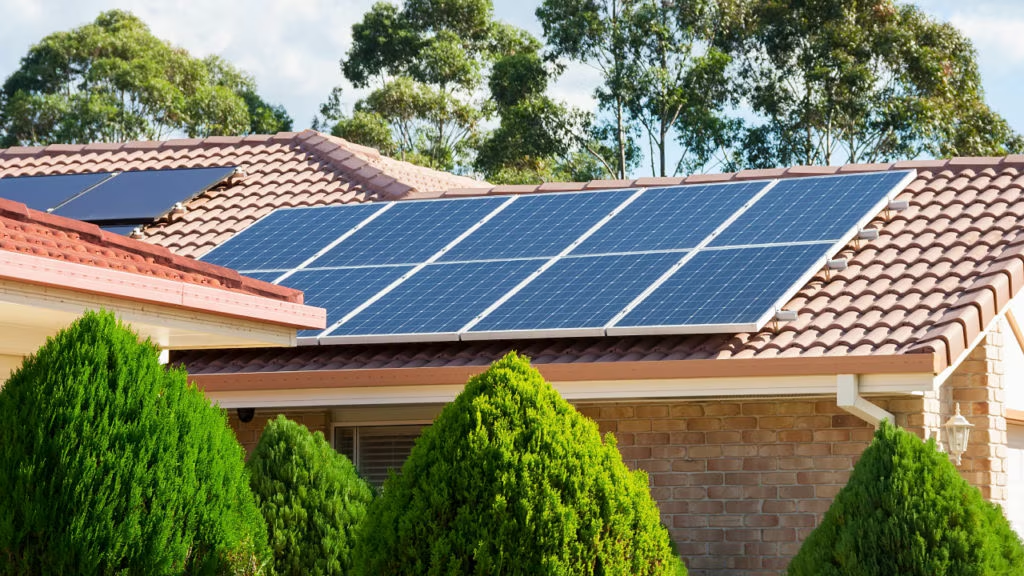
The growth of solar and wind power generation creates a more favorable context for the incorporation of energy solutions in real estate projects, from photovoltaic systems to self-consumption models and reduction of common expenses.
For developers and owners, sustainability is no longer just an environmental issue and is beginning to be related to the economic efficiency of properties.
The next added value
Factors such as location, price, financing, and accessibility continue to dominate the market, and it is still premature to say that energy efficiency determines purchasing decisions in the country.
However, international trends, the evolution of the national energy system, and the gradual growth of environmental certifications suggest that the conversation is changing.
For decades, the real estate sector sold square meters. Then it learned to sell amenities. Now it is beginning to explore a new value proposition: buildings capable of consuming less energy, reducing operating costs, and adapting to an environment where sustainability is playing an increasingly important role.
Recommended readings:




