Home Blog Page 325

A clogged drain was the cause of the wall collapse in Santiago, says a preliminary report

Authorities evacuated six families residing in apartments on Las Carreras Avenue. They are not ruling out relocating other residents as a precaution.

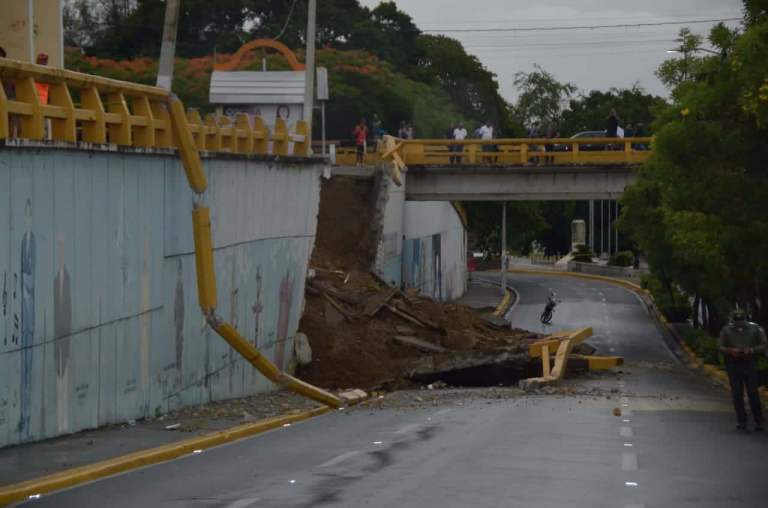
SANTIAGO.-Technicians investigating the causes of the collapse that occurred last Tuesday in a retaining wall on Las Carreras Avenue in this city, determined that it occurred because the drainage in the area was clogged.

Alexis Sosa, director of the Ministry of Public Works in Santiago, told Diario Libre yesterday that structural engineers are still investigating to determine if the other end of the structure also has damage.

The official explained that they are working full time to enable vehicular traffic through Las Carreras, one of the busiest land routes in the city, and that the goal is to decongest traffic in the Historic Center.

Employees of the contracting company in charge of repairing the collapsed retaining wall placed several supports yesterday, Thursday, to prevent the structure from continuing to collapse.

It consists of several steel pieces that support the affected area.

Cause of the collapse 

Preliminary findings by technicians indicate that the collapse occurred due to a water current, caused by rainfall, which had nowhere to escape because the area's drains were clogged.

Sosa believes that these systems became clogged due to a lack of maintenance.

The affected structure extends from the lower part of the city to the area of ​​the Monument to the Heroes of the Restoration (west-east direction).

As a result of the wall collapse, authorities evacuated six families residing in apartments on Las Carreras Avenue. They are not ruling out relocating other residents as a precaution.

Another wall collapses in Santiago

0

SANTIAGO.- Recent rains seem to be exposing the weakness of many of the structures in the "Heart City." A second wall collapse in less than 48 hours adds to the problem, this time at the José Mercedes Albino Polytechnic School in Canabacoa, a municipal district.

School authorities, led by director Zoilo Marrero, expressed their concern because the walls adjacent to the affected area have cracks, and they fear they could collapse if the rains continue.

The educator called on the Ministry of Education authorities to come and repair the damage.

Last Tuesday, the rainfall in the Cibao region caused the collapse of one of the retaining walls of several apartment buildings and shopping centers located on Las Carreras Avenue.

Yesterday, the Minister of Public Works and Communications (MOPC), Deligne Ascención, visited the site, along with technicians from his department, to assess the situation, where he made some recommendations, with the purpose of mitigating the risks in the area.

La Barranquita de Santiago celebrated the arrival of 50 homes for families in that community

0

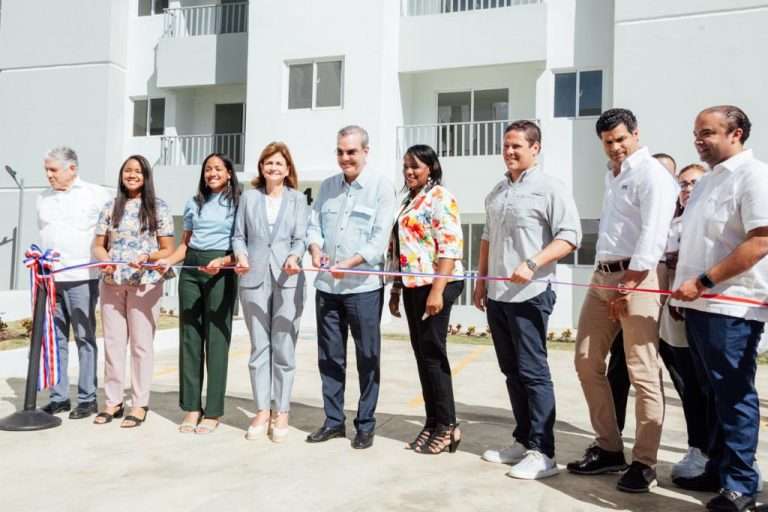
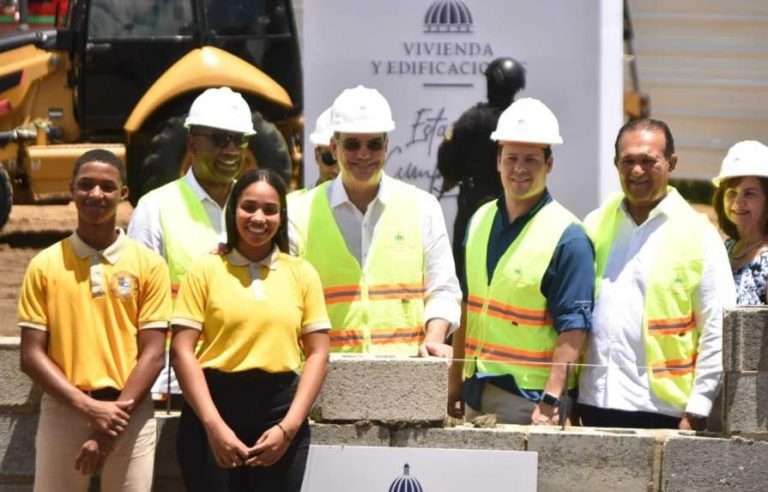
SANTIAGO- During his tour of this, the second most important province in the country, President Luis Abinader, along with the Minister of Housing and Buildings (MIVED), Carlos Bonilla, delivered 50 new apartment units of the Mi Vivienda La Barranquita project in this area.

The project features 136 apartments, developed over more than 10,000 square meters, combining play and recreational areas, an exercise area, and parking for its owners.

With a total investment of 313,797 million pesos, it is expected to also impact the economy of the area, in addition to the construction sector in the Northern Zone, where more than 260 direct jobs have been generated.

“With the delivery of the first 50 apartments, we will change the lives of these families, who, thanks to the efforts of the central government, our allies and MIVED, will now have a safe home, together with their loved ones, living a dignified life,” said the Minister of MIVED during the handover.

Beneficiary families with government authorities. (External source).

Samuel Pereyra, administrator of Banco del Reservas, expressed his excitement, just as he did when the Mi Vivienda program was formally launched last July in the Los Salados sector, where 60 apartments were delivered, fulfilling a long-cherished desire of our president, for whose happy realization the entity he presides over, MIVED, as well as Fiduciaria Reservas, have joined together.

La Barranquita is part of the Mi Vivienda Plan and projects the construction of more than 7,400 apartments distributed between Santiago and Santo Domingo.

In addition to the La Barranquita project, in Santiago there is also Mi Vivienda Los Salados, while in the city of Santo Domingo Ciudad Modelo, San Luis and Hato Nuevo are being developed, where 300 housing units were recently delivered.

Representing the beneficiaries, the Victoriano, Filión, Reyes, Ureña and Rodríguez families received their keys, declaring their joy at receiving their home.

During the handover of the keys, Abinader and Bonilla were accompanied by the Vice President of the Republic, Raquel Peña; the Administrative Minister of the Presidency, José Ignacio Paliza; the President of the Senate, Eduardo Estrella; the administrator of Banreservas, Samuel Pereyra Rojas; the governor of the province, Rosa Santos; and the deputy for the province of Santiago, Francisco Díaz.

Along with the 50 beneficiary families were also members of the press, government collaborators, community members from the area and other authorities.

Geologist warns buildings in Santiago landslide area could collapse, recommends total evacuation of residents

0

SANTO DOMINGO.– Families residing within the area where the landslide occurred last Tuesday, on Las Carreras Avenue in Santiago de los Caballeros, must be evacuated immediately and completely because they are at high risk, as the buildings could collapse, warned Tirso Álvarez Fermín, a civil engineer specializing in Geotechnical Engineering, yesterday.

In addition to his main recommendation, which is to relocate all residents, the specialist suggests closing the road until the existing structures are stabilized and "placing a retaining wall with piles of significant moment of inertia to prevent the buildings from collapsing.".

Fourth, it recommends the construction of new retaining walls of adequate cross-section and with appropriate backfill. After exhausting this protocol, it assures that the road can be reopened.

Regarding the possible causes of the wall's collapse, he explains that the retaining wall appears very thin, which, in his opinion, suggests it wasn't designed to withstand the accumulation of water pressure. "It's very slender.".  

He adds, “There is no water table and drains were probably left, but the fill material looks very fine, the drains got clogged and water accumulated, which caused the collapse,” notes the PhD expert, a 1997 graduate of the University of Illinois Urbana-Champaign USA.

 He adds that the problem lies in the fact that when the walls fall, the confinement of the building foundations is reduced, and it is possible that these buildings may also move or collapse.

“Therefore, they must be quickly pre-supported with a high inertia wall, a sheet pile wall probably with cast-in-place piles of 80 cm in diameter,” the engineer explained.

The collapse

The incident occurred last Tuesday around 5:00 p.m. due to the rains recorded in the city of Santiago.

The affected wall runs along Las Carreras toward the Monument to the Heroes of the Restoration. Rescuers said they fear the structure on the other side of the avenue, where the Fire Department headquarters and the plaza housing the Santiago Municipal Electoral Board are located, could also collapse.

For more than 10 years, members of the relief agencies had been warning of the danger posed by that wall due to the cracks it had.

Yesterday, Civil Defense and the Ministry of Public Works and Communications (MOPC) took the measure of evacuating the families closest to the landslide, as a preventive measure against the possibility of new rains.

There is little infrastructure development in the country at the moment, says a construction businessman

SANTO DOMINGO- Despite President Abinader's assurance in his accountability speech that the Ministry of Public Works and Communications (MOPC) has projects underway totaling RD$86 billion, the coordinator of the Construction Industry Observatory (ONIC) says that the perception in the country is quite different.

“What is perceived is that there are very few projects, little infrastructure development in the country,” said construction businessman Melchor Alcántara.

The finance expert also opined that if the government works with more reasonable budgets, as the president mentioned, it should imply greater development of public works across the country, and that more impetus is needed in that regard.

Abinader noted that during his two years in office, 87 projects have been completed with an investment of nearly RD$15.4 billion. Among the projects currently underway, he cited the nine ring roads and the expansion of the Santo Domingo Metro and Cable Car lines.

In evaluating the speech given by the president, Alcántara maintains that among the information offered by Abinader, there are positive aspects regarding the government's monetary, fiscal and financial policies "which I understand are favorable for the development of the economy and the control of inflation.".

 “We know that the inflation the country is experiencing, especially in the construction sector, is driven by factors tied to the pandemic situation, product shortages due to the closure of international markets, increased freight costs, and so on.”.

For his part, the former president of the Association of Housing Builders and Promoters (ACOPROVI), Fermin Acosta, said that in general the speech was good, although the head of state did not talk about the housing sector, despite always maintaining his identification with that sector.

Interest rates

The financier believes that if interest rates rise to curb inflation, the development of the construction sector will be slowed because there will be less demand for apartments.

“The construction sector hinges on interest rates reaching reasonable levels.” The ONIC representative suggested that even if rates increase for expenditures, investment rates should remain at previous levels to allow this sector to continue driving the national economy.

Tourism inaugurates renovated Macao beach with an investment of more than RD$ 53 million

0

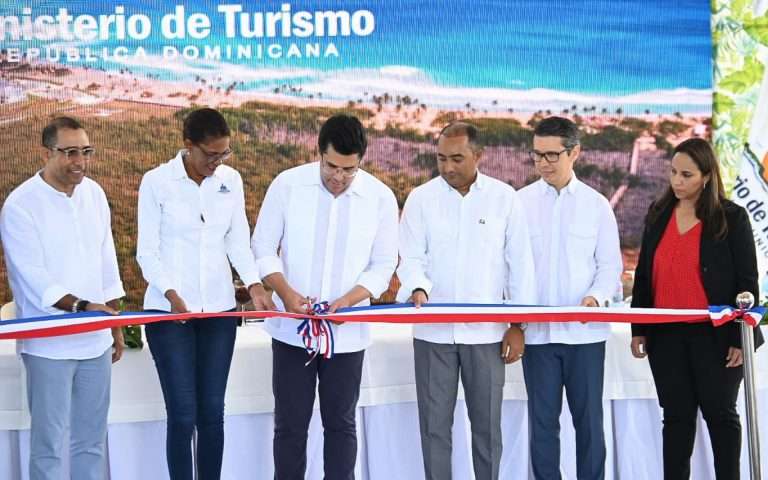
PLAYA MACAO, LA ALTAGRACIA. -The Minister of Tourism, David Collado, inaugurated the renovated access road and vehicle parking area in Playa Macao, in this eastern province of the country, with an investment of more than 53 million pesos.

“We are here again, on Macao beach, to honor our commitment to build a modern parking lot and rebuild the access road,” said Minister Collado.

He assured that these two projects directly benefit visitors and small businesses operating throughout the area of ​​this beautiful beach.

The work was carried out through the Executive Committee for Infrastructure of Tourist Zones (CEIZTUR) of MITUR.

The bus parking facility consists of a 1,962 square meter space adapted for 14 buses. It also includes restrooms, a bench area in the waiting zone, and green spaces.

Also a 340 square meter paved parking lot for 86 vehicles.

Meanwhile, the intervention of the access road includes 323 meters of asphalt, another 950 meters of sidewalk, along the entire length of the road to the beach, as well as 270 meters of paving stones and lighting.

The event was attended by key provincial and municipal authorities, as well as business leaders from the sector.

Work began in October of last year

The groundbreaking ceremony for the access road and parking area at Macao Beach was held by David Collado on October 18th of last year. The announcement promised 104 parking spaces for vehicles, as well as areas for motorcycles and buses. However, the Ministry's website states that there will be 86 parking spaces for cars and 14 for buses.

“The greatest significance of this project, which we are launching today, is the economic boost it will bring to the small businesses on this beautiful Macao beach. I have always said that tourism has a face,” Collado stated last October at the project's inauguration

With the refurbishment carried out, an organized ecosystem can be achieved for a much more efficient operation of the businesses established there and greater security for the more than 200,000 visitors who enjoy Macao beach each year.

BanReservas opens an office in Santiago with the presence of President Abinader

SANTIAGO.-President Luis Abinader led the inauguration of the El Dorado office of Banco de Reservas, located in an area of ​​high commercial activity in Santiago de los Caballeros.

The general manager of the financial institution, Samuel Pereyra, expressed that this modern and functional office significantly expands the institution's service capacity in this city, where the Bank has been present since its very foundation, firmly allied with all productive sectors throughout the Cibao region.

The bank executive stated that in this sense, the projection achieved has allowed for the promotion of banking services for the population and the democratization of credit, supporting all productive agents in the area, both rural and urban, in favor of the development of micro, small and medium-sized enterprises.

Creditsand deposits

Pereyra revealed that the loan portfolio to the Northern Zone of the country, as a whole, amounts to RD$59,200 million, of which 38% corresponds to Santiago; in turn, the deposit portfolio is RD$137,800 million, of which 36% belongs to the Heart City.

According to information from the Central Bank, 33% of the country's economically active population is located in the Cibao region, where there is a varied production of agricultural goods, mining deposits and activities of multiple companies, which provide the nation with important sources of production and businesses, as well as significant opportunities for job creation.

Currently, Banco de Reservas has 23 commercial offices, 9 remote banking services, 5 banking points and 47 BanReservas located in different commercial and service establishments in Santiago de los Caballeros.

The opening of the commercial office - located on Avenida 27 de Febrero at the corner of Penetración, in the El Dorado II sector - is one of the activities on the Presidency's tour in this district.

The event was also presided over by Vice President Raquel Peña and the Minister of the Presidency, José Ignacio Paliza. Also participating in the inauguration were Eduardo Estrella, President of the Senate; Rosa Santos, Governor of Santiago; and officials from the banking and business sectors of the country's Northern Region.

Airbnb launches anti-party technology tool for the US and Canada

Airbnb announced Wednesday the introduction of new anti-party tools in the US and Canada to help identify potentially high-risk bookings and prevent those users from taking advantage of the platform.

In June, the property booking platform announced that its temporary ban on parties would become a permanent policy. Since parties continue to happen, Airbnb is still working to enforce this policy, taking steps to curb unauthorized parties—that is, parties organized without the knowledge or consent of the hosts.

“It is an integral part of our commitment to our host community, which respects its neighbors and does not want to be part of the property damage and other problems that can arise from unauthorized or disruptive parties,” the company said in a statement.

To that end, the company released a statement explaining how the new tool would work. The system will analyze factors such as the history of positive reviews (or lack thereof), the amount of time the guest has spent on Airbnb, the duration of the trip, the distance to the listing, whether it's a weekend or a weekday, among many others.

The main objective is to try to reduce the ability of bad actors to organize unauthorized parties that negatively impact hosts, neighbors, and communities.

“A similar variation of this system has been tested in Australia since October 2021, where it has been very effective. We’ve seen a 35% drop in unauthorized party incidents in the areas of Australia where this pilot has been in place. We expect similar success when we begin testing this in the US and Canada,” Airbnb noted.

The technology is designed to prevent booking attempts. Airbnb assures guests who are unable to book entire homes due to this system will still be able to book a private room (where the host is more likely to be physically present) or a hotel room through Airbnb.

They reported that they will transparently communicate the results of this trial phase and the next steps in their ban on parties.

Source: Diario Libre USA

Families near the landslide in Santiago will be evacuated due to the possibility of further rain

0

In a press conference, the Minister of Public Works assured that they will be working 24 hours a day and asked the provincial governor, Rosa Santos, to communicate to the authorities of the Santiago City Council the measures that will be adopted.

SANTIAGO- Civil Defense and the Ministry of Public Works and Communications (MOPC) have taken the measure of evacuating the families closest to the landslide that occurred yesterday on Las Carreras Avenue in this city, as a preventive measure against the possibility of further rains.

This was reported on Wednesday by Deligne Ascención, Minister of the MOPC, during a visit to the affected area, where he ordered the institution he heads to conduct an evaluation of the entire surroundings. 

The official stated that the problem had been occurring unexpectedly, but it has now surfaced at a time when we did not expect it. Therefore, the first step will be to clear the debris, which will be done today, Wednesday, to try to protect the slopes and prevent further landslides.

The Ministry of Public Works and Communications (MOPC) is coordinating with Civil Defense and the General Directorate of Traffic Safety and Land Transportation (Digesett) to divert traffic on Las Carreras Avenue while the work to be carried out is evaluated and regrettable incidents are avoided, Ascención explained.

He asked for understanding from the citizens of Santiago who travel along the road where the incident occurred, given the unforeseen events that may occur, since measures are being taken, first of an organizational nature to create alternative and safe routes during the time that the evaluation lasts and, later with the solution of the works that will be carried out.

In a press conference, the Minister of Public Works assured that they will be working 24 hours a day and asked the provincial governor, Rosa Santos, to communicate with the authorities of the Santiago City Council and inform them of the measures that will be adopted.

Deligne Ascension. (External source).

The initial assessment to be carried out at the site of the collapse will be made up of a multidisciplinary team, including the Ministry of Public Works, Grupo Estrella, Constructora Mar, Onesvie, Civil Defense, Provincial Government and Digesset.

The "transformative" projects that Abinader referred to in his speech marking two years in office

0

SANTO DOMINGO– “In five years Pedernales will change, in 10 years it will be unrecognizable, and in 20 years it will be an example for the entire southern region,” President Luis Abinader said last night, referring to the Cabo Rojo-Pedernales tourism development project, one of the most ambitious plans launched by his government.

In his speech commemorating the second anniversary of his inauguration, the president referred to the infrastructure projects underway in the province of Pedernales, stating that the port of Cabo Rojo will be ready for the arrival of tourists in November 2023.

President Abinader addresses the nation from Santiago. (External source).

“The construction of the first hotel is already out for tender, and the tenders for all the hotels in the first phase, which are 11, will be posted monthly. The airport designs are almost ready to be put out for tender,” Abinader noted while speaking from the Gran Teatro del Cibao in Santiago, an address made on the 159th anniversary of the Restoration War.

Abinader announced that work on the Bergatín project in Puerto Plata will begin in the coming weeks, after more than a year of design work.

“These projects will be a global example that we can all see and will have a significant impact on the lives of thousands of Dominicans; they will definitively change the face of the entire country and will bring thousands of direct and indirect jobs, boosting local economies and contributing to great economic growth,” he declared.

Amber Highway

Referring to the Amber Highway, announced in August 2020, he specified that the work has not been able to start because the government is not willing to carry out failed operations like the "Samaná highway".

“Of all the projects announced for Santiago 9 months ago, the only one we have not yet been able to start, and I want to acknowledge this, is the Amber Highway, because this government is not willing to have failed or poorly executed projects, like the Samaná highway that condemned Dominicans for years to an unfair and disproportionate shadow toll,” he said.

He also indicated that his government wants to do “many things, but to do them well. Our adherence to the law leads us to be cautious and to respect procedures even knowing that this can sometimes lengthen the process.”.

About Santiago

"And being here today, I want to refer, in a very special way, to Santiago, a city that has been forgotten for years and with which I have a very special family and emotional connection, and which is now part of the government's priority agenda, through concrete actions," the president said.

"Here we are making transformative investments such as the construction of the cable car; the monorail; the Gurabo Ravine; the entrance avenue to Santiago; and we have the Navarrete Bypass out for tender and the expansion of the Santiago-Licey highway budgeted, among others, because we are committed to the progress and well-being of this city and to giving it back what it justly deserves according to its contribution to the national economy," said Luis Abinader.

Public Works with more than 500 projects totaling RD$86 billion

President Luis Abinader also highlighted that the Ministry of Public Works and Communications currently has more than 500 projects underway, totaling RD$86 billion, including 9 ring roads and the expansion of the Santo Domingo Metro and Cable Car lines.

He also noted that during this time 87 projects have been completed with an investment of almost RD$15.4 billion.

Among the construction projects with the greatest regional impact are the 9 ring roads: those of Azua, Bani, Navarrete, Circuit 3 Santo Domingo, Moca, San Francisco, Santiago, Los Alcarrizos and Malecón de Nagua.

In Greater Santo Domingo, among the most important projects are the construction of Avenida Hípica, Avenida San Isidro, the Ecológica, from Ciudad Juan Bosch to Avenida Juan Pablo Segundo (Autovía del Nordeste), and the Andrés Overpass.

"Regarding mass transit projects, we are building the expansion of metro lines 1 and 2 in Santo Domingo and in Los Alcarrizos the extension of the metro and the cable car," he added.

Engineer Roberto Monegro believes that outdated laws limit the advancement of the profession in the country

0

SANTO DOMINGO – Since fifth grade, Roberto Monegro predicted he would become an engineer like his father, Darío Monegro, who has dedicated 50 years to the profession. He believes his own entry into the field may have been due to his father's influence. Nineteen years in the field have led him to affirm that engineering has become his deepest calling.

In light of last Sunday's celebration of "National Engineer's Day", we share an interview with this young engineer from the firm Modern Constructions Modcons SRL.

Engineer Roberto Monegro. (External source).

What does engineering represent in your life?

It's part of my daily life; I use it naturally in all my actions, both at work and in my daily life. Engineering is a development of skills and abilities that, when used with common sense, are capable of solving any situation that arises in the environment.

What contributions do you think this sector makes to the country's economy?

In our real estate development sector, from the hands that conceive the product, those who acquire them, those who develop them, those who supply the materials for their construction, until all these activities reach the point of positively energizing the nation's economic market, from the lowest to the highest income brackets, and directly benefiting the country through the taxes generated by all the aforementioned activities. But most importantly, the projection generated by the city's progress in international markets attracts foreign investment.

At what level would you place Dominican civil engineering?

Our engineering is comprehensive. In every area of ​​engineering, we have excellent professionals who, when they come together for a common project, each fulfill their role, always striving for excellence. 

How much do you think engineering has evolved in the country?

We are making progress, but we could achieve greater progress if we could abolish certain obstacles in project approval departments in our country, due to outdated laws that severely limit the evolution of engineering and prevent us from taking on challenges that would allow us to compete in major international markets.

What challenges do you think they currently face in light of the new trend towards sustainable development?

The challenge is this: either we adapt to market demands using techniques and technologies that help us remain competitive in sustainable ways, or we fall behind. In these times, our competition is international, since globalization is readily available to almost every citizen of the world. Therefore, one of the biggest challenges is to interact and reach agreements internally as a country, in order to implement projects that are at the forefront of our times.

Given the rise in construction material costs and the challenges of our times, how do you envision the future?

We have to adapt. I've always said that the world took a double step up overnight with the pandemic and the Russia-Ukraine war, and the biggest thing is that if we stop... we all lose. 

The future lies in reinventing ourselves with new ideas, as the world evolves and we must keep pace. The time has come to join forces and together position our precious country to compete internationally at the level these times demand, attracting investments that will revitalize our economy and make us stronger and more sustainable. 

In the blink of an eye, we'll be in 2030. That's the future of competition. 

Two adults-only hotels will open in Miches

0

On October 1st of this year, two innovative adult-only tourism projects will launch in Miches, El Seibo province, one of the country's emerging tourist destinations. Both projects aim to attract free-spirited travelers from around the world with an all-inclusive model.

Temptation Grand Miches Resort and Temptation Miches Resort will open their doors with the support of the Mexican firm Original Group, and will create the ideal environment for a vacation with unique entertainment and the best gastronomy in the world, as explained by Carlos Del Pino, Director of Operations and Development of Original Group, during an interview on the program Hablemos de Turismo, produced and hosted by Miguel Calzada León.

Carlos del Pino. (External source).

Temptation Miches consists of a three-level structure with vibrant colors, with a preferred format for the natural market, with 382 housing units; while Temptation Grand Miches has a three-level building and 15 bungalows (pastel-colored villas) with between two and four rooms, 114 in total.

The new offerings include 14 room categories (master suite, presidential suites and villas), with pools, jacuzzis, private pools and beach access.

The lobby, ceilings, and room corridors are designed in a curved style (inspired by the female body), so that when the customer arrives at any of the Temptation hotels, they forget about stress and disconnect from everyday life.

“What we are seeking from Miches is to make history, attracting our American, Canadian, European, Central American and South American clients, so that they can get to know this destination that aims to make us popular in new markets,” said Del Pino.

The tourism entrepreneur reported that Original Group's goal is to reach 2,000 rooms in the coming years.

“We understand that after Cancun, the next logical step, and where we need to be, is Punta Cana, due to its proximity to the airport, and hopefully, it will continue to develop further. Last year, we accepted an invitation to the Pedernales area because the government is heavily promoting that area.”.

Del Pino indicates that they are betting on the Dominican Republic and its tourism development, which is currently the number one destination in the region: “even more active in promotion and presence than Quintana Roo itself, and the political focus of President Luis Abinader, who has supported us, as has Banco de Reservas, is to continue growing. Without them, we wouldn't have been able to be here: the Dominican Republic is in fashion, will continue to be in fashion, and has so much to offer.”.

He added that at Fitur Madrid 2021, instead of being at the Mexico stand, they cancelled and put everything in the Dominican Republic.

“What better platform than this, with the presence of President Luis Abinader, executives from Banco de Reservas and Banco Popular, and all the influential people in the tourism industry? We will continue to do our part in promoting, first the country, second the destination, and third our brand.”.

The conversion of the Duarte Arroyo Barril Port into a cruise terminal will generate US$31.2 million in revenue for the country in the first year

0

The initiative, which will have an estimated investment of US$60 million, proposes the rehabilitation and construction of an infrastructure that allows the arrival of vessels with up to 8,500 passengers, Oasis type, in addition to developing a maritime terminal with capacity to receive 4 cruise ships at the same time.

SANTO DOMINGO.- The new cruise terminal in Arroyo Barril-Samaná, whose conversion process was announced by the competent authorities, will generate revenues for the country of US$31.2 million in the first year due to the total spending of cruise passengers and crew.

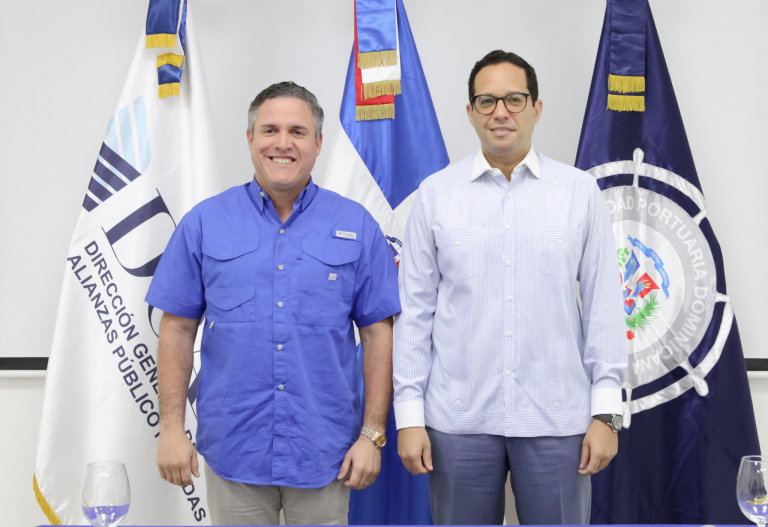
The Dominican Port Authority (APORDOM) and the General Directorate of Public-Private Partnerships (DGAPP) announced the start of the competitive process for the private initiative to convert the Duarte Port in Arroyo Barril-Samaná into a cruise terminal and tourist facility zone, under the modality of a public-private partnership, pursuant to Law 47-20 and its implementing regulations.

The CEO of DGAPP, Sigmund Freund, highlighted that this project is part of President Luis Abinader's government's decision to position the country as a Caribbean Cruise Hub.

Jean Luis Rodríguez and Sigmund Freund. (External source).

Freund explained that, in addition to the new cruise terminal in Arroyo Barril-Samaná, the project includes a complementary tourist facilities area where cruise passengers will have access to leisure and entertainment options. He added that the project is estimated to generate US$31.2 million in revenue for the country in its first year, based on total spending by cruise passengers and crew.

He added that this new terminal will boost tourism and trade in the province and create approximately 1,050 new direct and indirect jobs.

Likewise, Jean Luis Rodríguez, executive director of APORDOM, indicated that currently, the Duarte Port, inaugurated in 1977, has 19 permanent employees and its operations are based on the reception of general loose cargo, so the cruise terminal will represent a great employment opportunity for the area, which will lead to social and economic development for the entire Northeast Region and the Central Cibao.

Jean Luis Rodríguez pointed out that this process is the first time in the history of the Dominican Republic that the concession of a port is carried out through a public-private partnership, since they are generally established through concessions, as provided by Law 70-70 that creates the Dominican Port Authority.

The initiative, which will have an estimated investment of US$60 million, proposes the rehabilitation and construction of an infrastructure that allows the arrival of vessels with up to 8,500 passengers, Oasis type, in addition to developing a maritime terminal with capacity to receive 4 cruise ships at the same time.

This port is expected to receive 161 cruise ships per year from Miami, Puerto Rico, Cuba, Curaçao, Barbados, Montego Bay, St. Lucia, Tampa Bay, and New York. The cruise terminal to be developed in Arroyo Barril would join the existing Amber Cove and Taino Bay terminals in Puerto Plata, and Port Cabo Rojo in Pedernales, a project currently under construction, making them the only four tourist terminals in our country with the infrastructure to receive Oasis-type vessels.

Retaining wall collapses on Santiago Avenue

0

For more than 10 years, members of the relief agencies had been warning of the danger posed by that wall due to the cracks it had.

SANTIAGO- One of the retaining walls on Las Carreras Avenue collapsed Tuesday afternoon in this Cibao city, protecting the land where dozens of residential apartments and commercial businesses are located.

The collapse occurred around 5:00 p.m. due to the rains that have been occurring in the city in recent hours.

Civil Defense reported that no one was injured because the structure collapsed when no vehicles or people were passing by.

The rescue agency closed the road until representatives from the Ministry of Public Works and the mayor's office arrived at the scene to conduct assessments.

The affected wall runs along Las Carreras Avenue toward the Monument to the Heroes of the Restoration. Rescuers fear that the structure on the other side of the avenue, where the Fire Department headquarters and the plaza housing the Santiago Municipal Electoral Board are located, may also collapse.

For more than 10 years, members of the relief agencies had been warning of the danger posed by that wall due to the cracks it had.

Las Carreras Avenue is one of the busiest land transportation routes in Santiago during working days.

Source: Diario Libre

500 new rooms will be added to Bayahibe's tourist offerings

“The signing of this historic agreement marks a turning point for tourism here in Bayahibe. We could well define it as the unstoppable rise of this paradisiacal destination,” Collado stated.

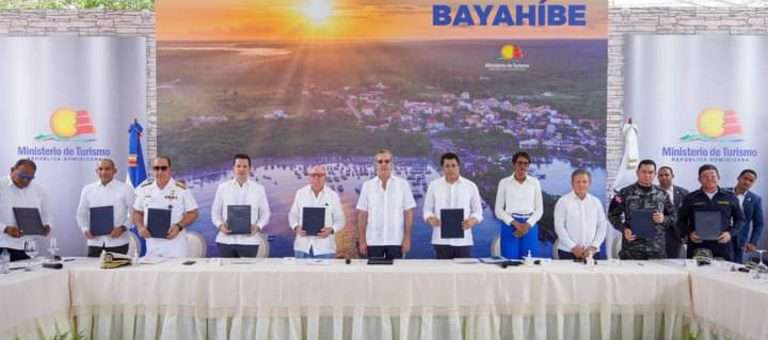
BAYAHIBE, LA ALTAGRACIA- President Luis Abinader and Tourism Minister David Collado announced on Monday the construction of 500 new rooms in Bayahibe and launched the territorial reorganization plan for this destination in the eastern region.

The information was provided during the signing of an agreement between eleven public and private institutions, in an event led by President Abinader and Minister Collado.

“The signing of this historic agreement marks a turning point for tourism here in Bayahibe. We could well define it as the unstoppable rise of this paradisiacal destination,” Collado stated.

Through the agreement, each entity assumes the commitment to concrete actions to be carried out immediately, aimed at strengthening Bayahibe as a destination, with the construction of more rooms, infrastructure works and security.

Agreement signed to strengthen tourism in Bayahibe. (External source).

Through this agreement, the Ministry of Tourism commits to developing and implementing the Tourism Territorial Planning Plan for Bayahibe.

Likewise, through its Executive Committee for Tourist Area Infrastructure (CEIZTUR), it will carry out the expansion of the entrance park, located in front of the City Hall offices.

It will also include the area from the current bus parking lot, the park with water features, to the top of the viewpoint, including the Bayahibe flower forest and the Bayahibe sign.

The Ministry of Tourism will also begin construction of the new parking lot and the expansion of the bus parking lot on land that will be donated by Central Romana Corporation LTD.

The agreement, signed in the presence of President Abinader, was also signed by the Ministry of the Environment, the National Institute of Transit and Land Transportation (INTRANT), the Dominican Republic Navy, and the Dominican Port Authority.

It was also signed by the Bayahibe Municipal Council, the Tourist Police (POLITUR), the National Police and the National Directorate for Drug Control (DNCD).

Paris-José Martí Phase II, a reality about to become a commercial attraction

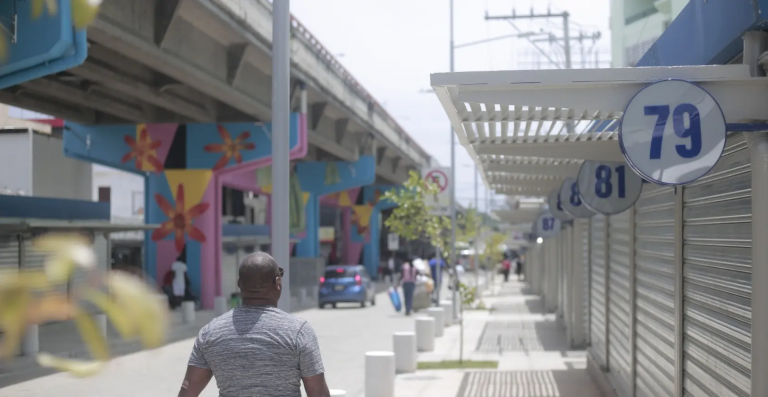
With this project, "La París and its surroundings," which involves an investment of RD$440 million, a total of 136 informal vendors have been relocated along the route. In the first phase, 84 of the approximately 700 vendors scattered from the Huacalito building to Josefa Brea were settled.

SANTO DOMINGO.- The chaotic scene that has characterized the famous Paris Avenue for decades, where hundreds of entrepreneurs converge daily offering a wide variety of combined deals, is trying to leave behind its characteristic disorderly style, to make way for a more comfortable place where its protagonists can have a dignified space to market their products.

We share this article, published by the newspaper El Día, which outlines the improvement works being carried out to enhance the environment for merchants.

The second stage of the project to renovate Paris Street from Duarte Avenue to José Martí is a reality, and in a matter of days it will be delivered by the authorities.

The new section will accommodate some 58 street vendors in an equal number of modules, allowing them to carry out organized work and leave behind the slum-like conditions of that area.

Optimism has taken hold of the beneficiaries, who express satisfaction with the work carried out by the "Action, Entrepreneurship and Transformation Foundation", led by David Collado, Minister of Tourism.

With this project, "La París and its surroundings," which involves an investment of RD$440 million, a total of 136 informal vendors have been relocated along the route. In the first phase, 84 of the approximately 700 vendors scattered between the Huacalito building and Josefa Brea were settled.

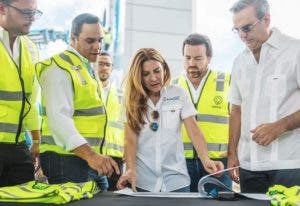
Reviewing the construction plans.

Upon delivering the first phase, David Collado stated that it is one of the most impactful urban redevelopment projects in the country, as the area had been a prime example of the prevailing disorder for the past 40 years. The area's revitalization was the result of a partnership between Collado and Mayor Carolina Mejía, as David had initiated this work even before leaving the city council.

What is it about?
In addition to the metal booths or modules with roll-up doors and security system, the project was equipped with rainwater drainage, a pedestrian walkway, retaining walls, lighting, high-resistance cobblestone roads, a bay for unloading goods, trash cans, among other facilities, as well as security.

Martina Pimentel Moreno, president of the Paris and Duarte Street Vendors Association, praised the civil works and explained that the intention of the project is to free up space not only so that the vendors can work peacefully and in adequate conditions, but also so that pedestrians can move around easily.

“There were countless situations here, the rule now is to have a minimum of ten years here, be Dominican and work every day, and yes, be a foreigner properly documented,” Pimentel commented.

He specified that the next section, from José Martí to Yolanda Guzmán, will be continued, according to what he has been informed, with funds from the District Council and the Government, as well as a mini-council that will be established in the area to oversee the project.

With 40 years in the area, Basilio Vásquez assured that they are much better off than before because now they don't have to collect the merchandise and they sell in decent conditions.

Fatima Perez, from the Shoe Importer, one of the collateral stores, like other merchants, remains hopeful that the work will be a positive change.

The transformation contrasts sharply with other sections that remain in complete disarray. Duarte Avenue and its surroundings have undergone several urban interventions. However, these have faded over time due to a lack of oversight.

Caribbean leaders hold special summit on climate change in the Bahamas

In this regard, Davis has denounced that the consequences of natural disasters have added some $5 billion to the Bahamas' national debt in recent years.

Taken from EFE

The heads of government of the Caribbean countries are convened starting today for a special summit on climate change in the Bahamas, with the aim of designing a common position ahead of COP27.

Bahamas Prime Minister Phillip Davis explained on Monday that the meeting will be geared towards establishing a “unified” Caribbean response to better reflect the common problems facing the region's states.

“This meeting will position the Caribbean region to take control of its destiny and present a unified position to the world at COP27,” Davis said at a press conference.

The 2022 United Nations Climate Change Conference, commonly known as COP27, will take place next November in the city of Sharm el Sheikh, Egypt.

“It is time to go on the offensive against the painful blows that climate change has dealt to the region, but we must stand united in the fight and convince the world that, for better or for worse, we are in this together,” Davis stressed.

The prime minister announced that his country intends to establish this meeting, sponsored by the United Nations Framework Convention on Climate Change, as an annual event, and that he hopes all countries in the region will participate.

Since taking office last year, Davis has been among the leading voices on climate change, often traveling to different countries to attend special conferences on the subject.

Furthermore, he has repeatedly called on multilateral organizations to forgive the climate change-related debts of small countries.

In this regard, Davis has denounced that the consequences of natural disasters have added some $5 billion to the Bahamas' national debt in recent years.

The new president of the Dominican College of Engineers, Architects, and Surveyors (CODIA) will demand compensation from the construction company for damages caused to the organization's structure

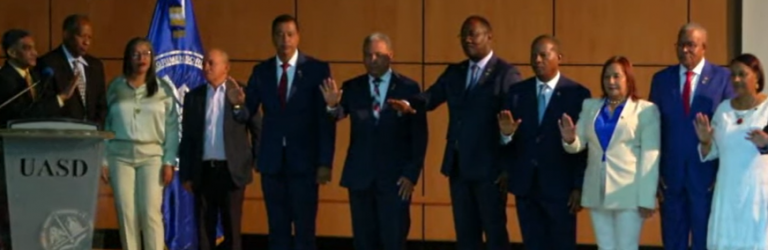
In his swearing-in ceremony, the new president spoke at length about his work plan: he will rescue the public image of the union and modernize it, advocate for opportunities for young professionals, manage inclusion in purchases and contracts, among other plans to achieve.

SANTO DOMINGO.- The Dominican College of Engineers, Architects and Surveyors (CODIA) will demand that the construction company that caused the collapse of part of the structure of the guild's building in June of this year compensate it for the damages caused.

Upon being sworn in yesterday as the new president, civil engineer Cristian Rojas Mora stated that it is up to the new board of directors to ensure that the company they hold responsible for causing the collapse of part of the roof of the CODIA physical structure can compensate for the losses caused.

Cristian Rojas Mora in his inauguration speech as president of Codia. (External source).

“That company has around 35 projects in Bávaro that lack a license; we were victims of the poor application of the country's construction regulations, of the lack of supervision by the institutions responsible for granting licenses and permits,” he declared in his inaugural address.

He called on the entities responsible for ensuring the proper management of construction projects to apply the requirements more rigorously from the design and construction stage to completion, as well as risk prevention and safety.

In his speech to a group of union members and representatives from the Ministries of Public Works, Tourism and Housing, Mora outlined a list of promises that he pledged to fulfill during his year in office.

“I want you to have the firm conviction that we will put all our energy, with God's help and everyone united, to improve the public image that Codia has not had for many years in this country,” he declared, expressing his “concern about the deterioration of the image of the guild both in the physical area and in everything that marks the professionals who make it up.”.

The new president of Codia pledged to ensure transparency and flexibility of conditions so that young engineers and architects and small businesses with little experience can access the state labor market, "which is our main client.".

"That bidders in public tender processes and other contracting methods be classified according to their financial capacity and experience, preventing a large company from competing with a small one, which causes inequity," he stressed.

Swearing-in of the new board of directors of Codia. (External source).

In that same order, he specified, he will fight to ensure that public institutions increasingly use the lottery system, thus giving greater opportunities to professionals with less experience and companies with fewer financial resources.

“We will continue to demand that private works be built within the established legal framework, with an engineering or architecture professional in charge of each process.”.

He explained that it is a commitment of his administration to insist on a general increase for engineering and architecture professionals in both the public and private sectors, so that they can have a decent standard of living.

“It is no secret that despite being one of the groups that contributes the most to the GDP, every year hundreds of professionals die in poverty and destitution. We will continue to manage their pensions with the Dominican State, since they are deposited with the Executive Branch,” Mora said.

The newly inaugurated president assured that he will go to President Luis Abinader and the National Congress so that Law 340-06 on Public Purchases and Contracts of Goods, Services, Works and State Concessions includes fundamental aspects such as the participation of Codia in the advisory committee, so that its members feel represented.

In his speech, Mora stated that he will try to modify Law 6160, which created the Codia, to ensure that the term of office for the Board of Directors is two years.

Yesterday the country commemorated "National Engineer's Day", created by dictator Rafael Leónidas Trujillo on January 1, 1953. And the president of Codia highlighted the role of the professional.

"Since its inception, engineering has been dedicated to creating things that solve everyday problems and proposals for improving people's quality of life, such as decongesting traffic, uniting communities through a bridge; in the same way that it creates structures and buildings, it can also create solutions to social problems.".

He guaranteed that under his administration, professional fees would be applied without delay to all construction projects, particularly those built under the low-cost housing trust law. “Under no circumstances can we continue to allow the Dominican College of Engineers, Architects, and Surveyors (CODIA) to lose millions of pesos throughout the year due to this illegitimate exemption from the professional fee.”.

In that regard, he maintained, “we will act in accordance with a ruling of the Constitutional Court that orders the Ministry of Public Works, now the Ministry of Housing, to deliver the list of works with the names of the construction companies and all the developers of the low-cost housing trusts so that the Codia can determine the value and the professional rate, since this tax is directed directly to the one who builds or designs the work.

He promised more continuing education to update and expand knowledge, in addition to holding congresses with national and international topics in the different branches that make up the guild, for which he asked for the help of the professional groups.

He said he will be vigilant to ensure that the names of the company responsible for the work are placed on all buildings being constructed in the country.

Mora proclaimed that the digital revolution had arrived at the Dominican College of Engineers, Architects, and Surveyors (CODIA), as the college would work towards automation, interconnection, and modernization. He concluded his extensive presentation by declaring that under his leadership, the college would defend its members and actively participate in all public procurement processes, adhering to ethics and best engineering practices.

Government contributes RD$800,000 in aid to housing beneficiaries

0

Santos announced that 126 projects are currently underway and 42 are in development nationwide, which will significantly improve the quality of life for Dominicans residing in 24 provinces. He stated that 2,500 homes will be delivered between now and the first quarter of 2023.

SANTO DOMINGO.-The Minister of the Presidency, Joel Santos Echavarría, revealed that the beneficiaries of the National Housing Plan Happy Family (PNVFF) receive more than RD$800,000 in aid from the Dominican Government, through four vouchers, whose objective is to enable them to own their own home in dignified conditions.

The official explained, in a note sent to the media, that the bonuses are granted by the Ministries of the Presidency (Minpre) and Women (MMujer), as well as by the General Directorate of Internal Taxes (DGII), which allows these low-income families to reduce their monthly payment.

Joel Santos Echavarría, Minister of the Presidency. (External source).

“The beneficiaries of the Happy Family National Housing Plan receive significant assistance from the Dominican State to reduce their monthly mortgage payments, such as RD$240,000 for the Initial Bonus and RD$4,000 per month for the 7-year Interest Rate Bonus, granted by the Ministry of the Presidency, RD$172,000 for the ITBIS Bonus applied by the DGII, and RD$135,000 for the Women's Bonus from the Ministry of Women, which adds up to an estimated total of more than RD$800,000 in aid so that families can fulfill their dream of owning their own home,” the minister stated.

The minister provided the information while accompanying the President of the Republic, Luis Abinader, to the handover of 120 low-cost homes in Los Alcarrizos, which will benefit the same number of families, with a private investment of RD$342.5 million.

Of the homes, 56 were delivered as part of the Happy Family National Housing Plan. The Praderas del Norte project will have 830 single-family and multi-family housing units, each with three bedrooms.

126 projects.
 Santos announced that there are 126 projects underway and 42 in development nationwide, which will significantly improve the quality of life for Dominicans residing in 24 provinces. He stated that 2,500 homes will be delivered between now and the first quarter of 2023.

About the PNVFF

President Abinader with families benefiting from the program. (External source).

The National Happy Family Plan is the first program of its kind to provide access to decent housing for Dominican families from social segments facing significant difficulties in acquiring homes, thereby reducing the housing deficit. This initiative marks the beginning of the largest national effort to provide access to homeownership, ensuring family safety and well-being.

This program is developed through a public-private partnership process, in which the State will provide citizens who apply with the resources to access financing through different types of bonds that will help with bank payments.

The three factors that Ellis Pérez considers to still be the main assets of Dominican tourism

0

SANTO DOMINGO.- The growth exhibited by tourism is not accidental; the Dominican Republic has achieved such development that it allows it to offer its non-resident visitors a complete experience, as competitive as the most demanding of the world's destinations.

For Ellis Pérez, one of the experts who knows the country's tourism best, the beach, the sun and the friendly treatment of Dominicans continue to be the best bait for foreigners who set foot on Dominican soil.

“Our sun that gives us a clear view, our beautiful beaches bathed by the blue sky with warm water, and the special people, hospitable, open, willing to serve, to give a smile, to offer you a coffee and talk with you, and this last one doesn't appear in many places today,” Pérez explained in a conversation with El Inmobiliario, a digital newspaper.

Ellis Pérez. (Fidel Pérez/El Inmobiliario).

He states that although he frequently hears "that we cannot rely on the sun and beach factor because today's tourism requires much more," and in fact he understands this, his opinion is that these three factors (climate, beach and friendliness of the people) remain the key to why the country receives many visitors.

He cites the case of tourists who come from the North and the deep South, such as Chile and Argentina, who describe the country as a paradise.

 “I understand that people today require more, they want to live a more complete experience and the Dominican Republic is giving it to them. We have been gradually developing a competitive gastronomy, the restaurants in Santo Domingo are very good, in addition to many other very attractive environments,” comments the veteran communicator.

Added to the above is the aspect of tax exemption on purchases "which has been an attraction for travel and we have that facility as many other places do, but we have it too.".

Regarding the provinces, he notes that they are also promoting their unique attractions, details that draw tourists in and that they enjoy. The Ministry of Tourism recently launched the "Tourism in Every Corner" project, which aims to showcase the charms of each province.

"That is to say, we have a product that has been expanding and improving; you have the entertainment of the hotels. When we started, we had nothing; today we do everything, we have whatever you want, and we compete globally.".

Don Ellis Pérez describes the current climate of difficulties in the world as "uncertainty," and in the face of that word, there are no guarantees, he says, because unforeseen events can occur at any moment. However, he understands that for the Dominican Republic, tourism is a living reality that exists because we have all the necessary elements.

“In the Caribbean, we are the island that is best endowed with water resources, even better than Cuba, which has more territory than us. We have a rich topography, meaning that the basic products that are the fundamental part of our offer as a tourist destination are very rich and extensive.”.

He suggests continuing on the right path, "making sure we do things right." He applauds the plan to renovate 25 beaches and their businesses because "tourism isn't just about going to fairs, but about taking care of the area where tourists are served, and ensuring the quality of the product that will be delivered.".

Housing was the sector where the Government approved the most projects in July

The report states that 34 public investment projects were approved last July, bringing the total to 308 in the first seven months of 2022 (January-July 2022).

SANTO DOMINGO.-  55.9% of the projects approved by the Government in July correspond to the Housing and Community Services function (19 projects), in particular to the Community Development sub-function (12 projects), according to the Ministry of Economy, Planning and Development.

The publication from the General Directorate of Public Investment, based on information from the National Public Investment System (SNIP), indicates that for the period January-July, 36.7% of approved projects correspond to Housing and community services (113 projects), followed by 32.1% to Health (99 projects), and 9.1% to sports, recreational, cultural, and religious activities (28 projects). Regarding the total cost of the projects, 61.3% will be allocated to the Health sector.

The report states that 34 public investment projects were approved last July, bringing the total to 308 in the first seven months of 2022 (January-July 2022).

The total cost of these 34 projects amounts to RD$21,606 million, and RD$132,931 million has been approved this year, according to the report “Public Investment in Data (DatoSNIP)” corresponding to July 2022.

It indicates that 63.3% of the approved projects correspond to the central government (195 projects), followed by municipal governments (56 projects) and companies (50 projects), which were approved at 18.2% and 16.2%, respectively.

The document indicates that the highest cost is for projects of the central government, amounting to RD$117,631.5 million (88.5% of the total approved in January-July).

It adds that the cost analysis of the projects shows that the largest approved amount corresponds to the Health sector, with RD$17,776.6 million (82.3% of the total amount approved in July). Of the amount approved for Health, 99.4% will be allocated to hospital services.


The document explains that, of the 34 projects approved in July, 8 were in the province of San Cristóbal, representing the largest number of projects approved at the provincial level, followed by El Seibo (5), Azua (4) and Santiago (3), while the rest are distributed in 11 provinces.

It specifies that 81.8% of the amount approved in July is for a project in San Pedro de Macorís intended for the construction of a public health center, with a total cost of RD$17,673 million.

Furthermore, for the period January-July, Santiago and San Cristóbal represent the provinces with the highest number of approved projects (27 projects each), followed by Santo Domingo and the National District, with 25 approved projects each.

Since January 2022, the report highlights, Santiago has held the position with the highest total cost of approved projects, amounting to RD$49,043 million, representing an increase of 3.5% compared to June. 


In July 2022, the implementing institutions with the most approved projects were the Presidential Commission for Provincial Development Support (9), the San Francisco Vicentillo City Council (5), the Ministry of Public Works and Communications (4) and the Ministry of Housing, Habitat and Buildings (4).

In June 2022, 136 projects were approved, and of these, 16 belonged to Santiago, representing the largest number of projects approved by location. It is followed by the provinces of Monseñor Nouel and Santo Domingo with 11, the National District with 10, and the southern provinces of Azua and Independencia with 8. The rest are distributed across 21 provinces.

The total amount of projects approved last month was RD$16,442.3 million, for a cumulative total of RD$111,325 million, the highest in the last five years.

Civil engineering: an ally in the development of cities

0

On National Engineer's Day, we pay tribute to the men and women who responsibly carry out the great task of building towns and cities, filling our society with progress and quality. Happy Engineer's Day!.

SANTO DOMINGO – The Dominican Republic celebrates “National Engineer’s Day” today. The Royal Spanish Academy defines engineering as the body of knowledge oriented towards the invention and use of techniques for harnessing natural resources or for industrial activity.

Reviewing different literature reveals a variety of engineering types, some of which place the number of specialties in this profession at up to 50, where new specialties are emerging every day with the advancement of technology and science.

Civil engineering, which we will be discussing, encompasses a broad area of ​​knowledge and is closely linked to the development of cities, and therefore, to the progress of societies. We often categorize a country's cities as metropolises to describe the modernity of their infrastructure, roads, and urban planning, which gives us an idea of ​​the level of well-being or high quality of life of their citizens.

Civil engineering is the engineering of innovation in cities; it defines their design and is therefore the profession of the present and the future.

Their practices may have begun between 4000 and 2000 BC in Ancient Egypt and Mesopotamia when humans began to abandon nomadic existence, creating the need for shelter.

 Civil engineering has a strong organizational component that achieves its application in the management of the urban environment, achieving a notable harmony between man and nature, not only in relation to construction, but also to maintenance, control and planning of human life in the environment designed from this same perspective.

This includes territorial organization plans such as disaster prevention, traffic and transport control, water resource management, public services, waste treatment and all those activities that guarantee the well-being of humanity that develops its life on the civil works built and operated by engineers.

“The very essence of Civil Engineering is centered on the responsibility of conceiving and materializing infrastructure works, indispensable for the provision of public services: communications and transport, water for cities, industries and agriculture; energy, building for housing, commerce, industry, health, education and tourism; and in recent decades concerned and occupied with the preservation of the environment.”.

Its origin

The first engineers were architects, who built walls to protect cities and the first buildings, for which they used some engineering skills.

The development of engineering passed from culture to culture, including Egyptian, Mesopotamian, Greek, Roman, Eastern and European, until what it is now in our time.

Before the Industrial Revolution (18th-19th centuries), civil engineering as a discipline did not exist. Builders inherited their knowledge, and architects used fine art techniques in their constructions.

The use of low-strength masonry in monumental and sculptural proportions prevailed. Leonardo da Vinci, René Descartes, and Isaac Newton were developing the foundations of engineering sciences, and in 1747, the Royal School of Bridges and Roads of Paris was created, and the term "Civil Engineering" emerged to differentiate infrastructure works from military constructions. 

With the invention of reinforced concrete to improve the construction of houses (William Wilkinson, 1854) and the large-scale production of steel (Henry Bessmer, 1856), during the Second Industrial Revolution (1850-1914), the transformation of urban buildings began and construction acquired an industrial character.

Engineers like Gustave Eiffel (1832-1923) are renowned for breaking with tradition by combining elegance with innovation, using new technologies (low corrosion steel) with efficient designs that optimize the size and shape of structural elements.

Civil engineering is everywhere and has changed the way we live. We see this clearly in self-sustaining buildings, where the aim is to use resources more efficiently, optimizing savings and investment processes, which represents a world of difference compared to the way of life of early humans.

Today, this profession faces challenges that past generations could barely imagine. Today, it is a priority to minimize the impact on ecosystems, take advantage of resources through smarter use, improve energy efficiency, and innovate in the development of sustainable alternative materials.

According to the analysis of the global outlook for civil engineering in 2025, carried out by the American Society of Civil Engineers, the world will be very different from today's; the population will increase and remain on the move, constantly relocating from one place to another, which will intensify the need to create sustainability in the face of the demand for energy, drinking water, transportation, and infrastructure.

It is not possible to conceive of societies without the helping hand of a civil engineer who, with his infrastructures and buildings, invade the walls, streets and communities of enormous and modern works.

Sources: CATDIC

My university degree

Ferrovial blog

ChooseCareer.net

The official information that builds

Marist University (Mérida)

20 areas in which a civil engineer works

0

SANTO DOMINGO –Civil engineering is a field rich in functions, offering professionals in this branch a wide range of career options. Here are 20 of the main ones:

  1. Buildings for commercial, residential and state use.
  2. Maintenance of aqueducts and their corresponding drainage works, sanitary installations such as drinking water systems, sewage systems and wastewater treatment.
    Hydromechanical installations (water supply).
  3. Projects aimed at harnessing hydroelectric power and other alternative sources.
    Urban, rural, and regional sanitation works, and erosion control works.
  4. Development of state-run urban planning and organization of public services related to hygiene, transportation and communications.
  5. River correction and regulation works.
  6. Testing and consulting services related to: Soil mechanics and geological studies.
    Seismic risk analysis and seismic resistance in buildings.
  7. Urban, rural and transport planning, evaluating its profitability and social impact.
  8. Urban permits and subdivisions under the horizontal property regime.
  9. Traffic studies in urban and rural areas.
  10. Water resources management and hydrological studies.
  11. Construction of civil works, working as a project designer or site manager.
  12. Topographic, cartographic, geodetic and cadastral work, drawing the graphic representation of a terrain in the form of a map that shows the relief of its surface.
  13. Lecturer in the Faculty of Engineering and University Administration.
  14. Inspector of public infrastructure: housing, buildings, roads, water supply and treatment.
  15. In the Geology Area, it collects, evaluates and analyzes information, topographic, soil characteristics, adverse environmental conditions such as strong winds or seismic activity to establish a firm foundation design, complying with safety and feasibility requirements.
  16. Structural analyst, performs calculations and computations of the work, beams, columns, foundations and evaluates through tests the resistance of the materials used in the construction and their mechanical properties (such as steel, concrete, soils, rocks, plastics), as well as the loads they support, in addition to considering the capacity to resist strong seismic impacts.
  17. Consulting in the public sector; their services are required in the ministries of Public Works, Housing, and others.
  18. Consulting in the private sector, collaborating with construction companies, consulting firms, professional association companies, joint ventures and private contractors for recovery and maintenance works.
  19. In the free exercise of the profession, he can dedicate himself to teaching, private consulting, giving technical courses and additionally has the license to approve and certify the execution of works verifying that they comply with the regulatory parameters.
  20. Structural analysis.

Source: Beta Engineer

10 incredible engineering feats

Some projects become benchmarks for any engineer, whether due to the innovative technology used, the complexity of the project, or the adverse weather and topographical conditions encountered during construction. We highlight some of the most incredible projects you should know about!

 Channel Tunnel

This incredible feat of engineering couldn't be left off the list, not only for its complexity but also for the benefits it brought to society. Built by French and British engineers and inaugurated in 1994, the tunnel connects Folkestone in southern England to Coquelles in northern France. The project boasts the longest underwater tunnel in the world: 50.5 km in length, 38 km of which are submerged. Approximately 13,000 people worked on the project, which took six years to complete. Eleven tunnel boring machines (TBMs) were used in a single excavation and lining cycle! Truly incredible, isn't it?

 Dubai Artificial Islands

The construction process of the  Dubai Islandsin the United Arab Emirates is astonishing to any engineering enthusiast. Built by a Dutch company in partnership with Nakheel Properties, the project aims to expand the country's coastline and boost tourism. The archipelago consists of three islands that can be seen from space! Before construction began, factors such as wave power in the region, tides, winds, and even the effects of global warming were taken into account. The islands' foundations were created through dredging: dredges removed sand from the seabed and deposited it in layers until the ideal height was reached. In this process alone, 94 million cubic meters of sand were used on Palm Jumeirah Island (the smallest and the first to be built), enough to build a 2.5-meter-high wall around the Earth!

Olmos Project

Considered one of the world's most complex engineering projects, the Olmos Irrigation Project, located in the Lambayeque region of Peru and conceived and built by Odebrecht, faced adverse natural conditions to be completed. One of the main challenges was the construction of a tunnel under the Andes Mountains, over 20 km long, as the excavations reached depths of up to 2,000 meters below the mountain surface and were subject to unpredictable geographical and geological conditions. It is the second deepest tunnel in the world! The Huancabamba River diversion project, carried out by Odebrecht Engineering & Construction, transformed a highly arid region into one of Peru's main agro-industrial centers.

Itaipu Hydroelectric Power Plant

This gigantic Brazilian project deserves a special place on the list, not only for its engineering achievements but also for the diplomatic challenges it presented. The hydroelectric plant was built on the border between Brazil and Paraguay and involved a consortium of several companies, including Odebrecht itself. Furthermore, the numbers are impressive: it took 16 years to complete, employed 30,000 people, and used 12.5 million cubic meters of concrete—enough to build more than 200 football stadiums! Today, Itaipu is the world's largest hydroelectric plant in terms of cumulative energy production: since it began operating in May 1984, it has generated more than 2.4 billion megawatt-hours.

Millau Viaduct

The Millau Bridgein southern France is known not only for its grandeur but also for its elegance. It is the tallest road bridge in the world, standing at 343 meters high, designed by the English architect Norman Foster and the French bridge engineer Michel Virlogeux. It is entirely cable-stayed, weighing 36,000 tons, which is not considered heavy for its size. Here's the secret: much of the structure was built from steel, a lightweight material resistant to temperature variations. The bridge deck was constructed on the ground and then moved from tower to tower using a hydraulic system. 

 Panama Canal

It's no coincidence that the Panama Canal is also known as the 8th wonder of the world. Built by the French and Americans, this great feat of engineering revolutionized global maritime transport, uniting the Atlantic and Pacific Oceans. What was once an expensive and extremely long journey around the South American continent was reduced to a crossing of just 81 km (50 miles), lasting 10 hours. Ships pass through three locks: Miraflores, Pedro Miguel, and Gatun, and an ingenious system lowers them using gravity. On average, 42 ships transit the Panama Canal each day, some 15,000 per year. 

 Museum of Tomorrow

Designed by Spanish architect Santiago Calatrava, the Museum of Tomorrowin Rio de Janeiro presented numerous challenges for the Odebrecht Engineering & Construction team due to the project's complexity. Because each curve is unique and non-repeating, engineers had to create numerous models and 3D simulations to ensure perfect assembly and a finish worthy of a work of art. The biggest challenge was working with different concrete molds. In a traditional construction project, the same mold can be used 8 to 10 times. However, for the Museum of Tomorrow, each mold was used only once, as none of the angles were repeated. Furthermore, the museum was designed from the back to the front, with the plumbing, ductwork, and water/sanitation systems embedded directly within the concrete structure itself! But it's no wonder: Santiago Calatrava made more than 500 watercolor sketches before arriving at the final design of the Museum of Tomorrow!

Burj Khalifa

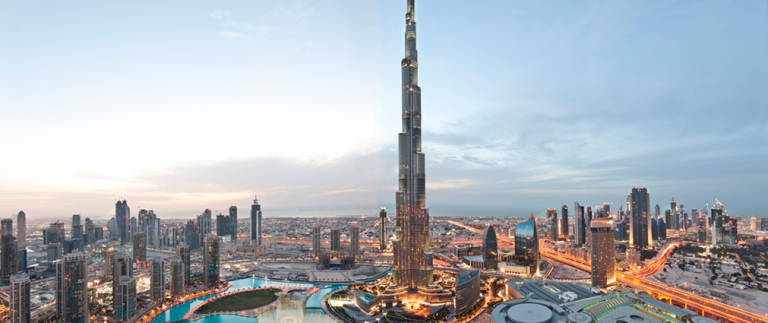
The world's tallest building couldn't be left out. At 828 meters tall and with 168 floors, the Burj Khalifa in Dubai, United Arab Emirates, can be seen from 95 kilometers away. The building's foundation alone, owned by the Emaar Group, used 45,000 cubic meters of concrete, with 192 pillars driven more than 50 meters deep. It also has 57 elevators and eight escalators transporting people within the building. Seen from above, the Burj Khalifa is shaped like a fleur-de-lis, a symbol of royalty.

International Space Station

Who says a space-based structure can't be on this list? The International Space Station (ISS) is the largest project of its kind and the largest structure ever to orbit the Earth. With permanent accommodation for six people, the ISS's primary function is to house astronauts while they conduct research impossible on our planet due to the difference in gravity. The structure weighs over 400 tons and cost approximately US$150 billion to build. It can be seen with the naked eye from various locations on Earth!

 Charcani V Hydroelectric Plant

This project, initiated in 1979 and completed in 1987, located near the city of Arequipa in the Peruvian Andes, deserves a special place on this list due to the numerous challenges it faced during its construction. Approximately 95% of the work was underground, passing through the active Misti volcano, and affected by seismic activity that occurred up to 50 times in a single day! Furthermore, the teams worked in extremely high temperatures. And as if that weren't enough, the work was carried out at an altitude of nearly 4,000 meters, which complicated logistics. Having overcome all these challenges, the result was a remarkable project with 135 MW of power capacity, which continues to supply approximately 77% of the population of Peru's second-largest city with renewable energy.

Source: OEC World