


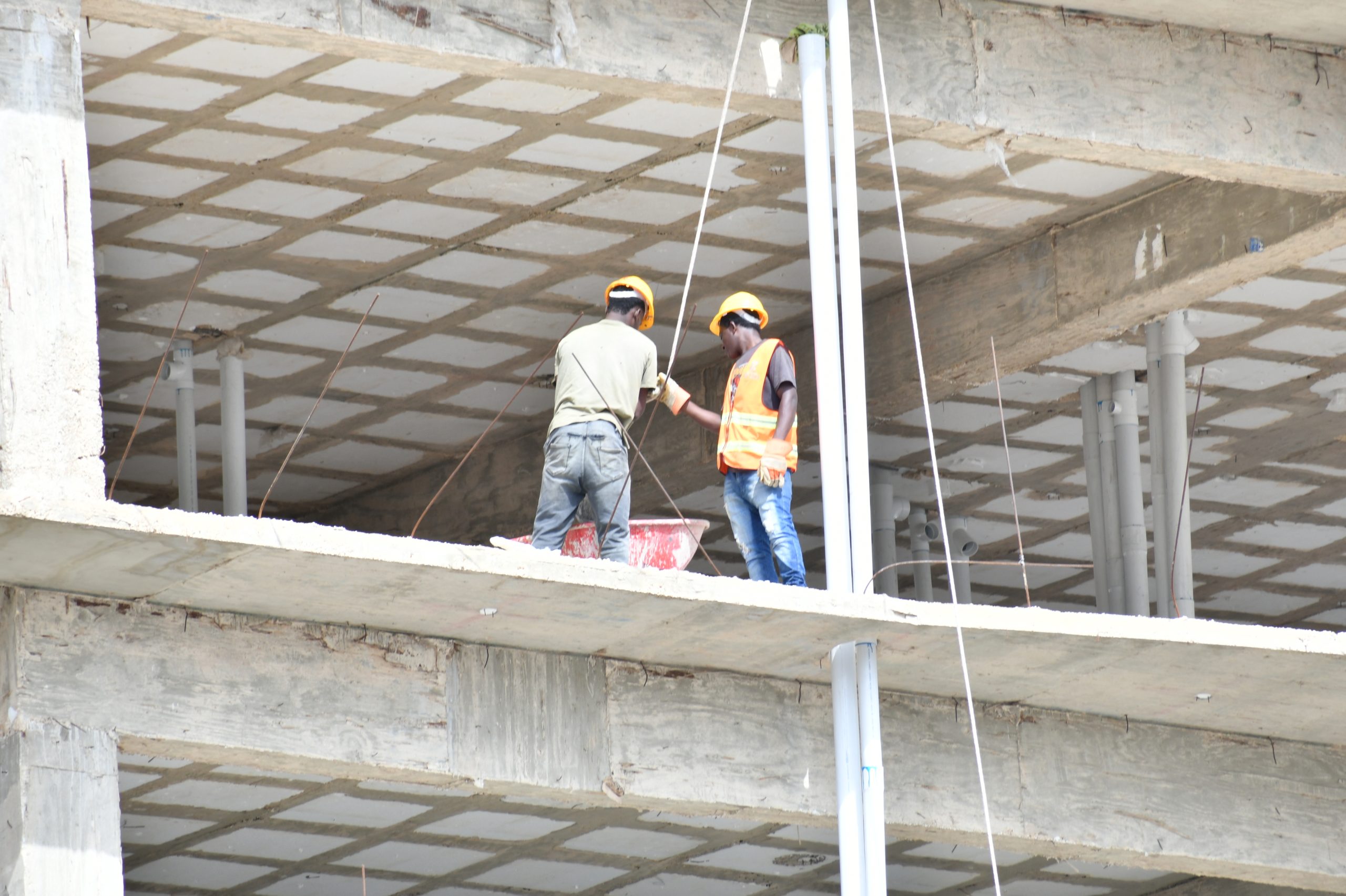
A report aimed at international investors identifies immigration policy as the biggest risk to the Dominican construction boom
SANTO DOMINGO – In its most recent report on the Dominican Republic, aimed at international real estate investors, the international consulting firm Global Property Guide dedicates a section to the construction market that doesn't discuss cement, permits, or interest rates. Titled “A labor force the sector cannot easily replace,” it describes the construction sector as “the most significant structural risk on the supply side.”
GPG cites research from the National Migration Institute (INM), published in June 2026 based on its Construction Sector Survey, according to which Haitian workers represent 68.3% of the Dominican construction workforce compared to 31.1% of Dominicans, a proportion that, the report adds, exceeds 70% and can reach 90% in the "gray work" phase, when the structures are cast and the work is more intense.
And it adds a specific warning: the deportation policy in force since April 2025 is already generating, in the words of the report itself, "project delays, partial shutdowns and higher logistics costs," an unusual paragraph within a document intended to calculate returns and exchange rate risk.
Warning with papers
Global Property Guide does not invent the figure: the data is taken from Ensecon-2025, presented by the INM on June 25, 2026 as the first measurement of this type in the country and whose disaggregation adds a nuance that even the international report itself does not highlight: the dependence on Haitian labor is greater in formal companies (69.1%) than in the informal sector (61.3%).
In other words, contrary to the common assumption that informality is the main channel of entry for migrant workers, it is the formally registered construction companies, which in theory are more exposed to labor and immigration inspections, that depend even more on that workforce.
The detail about the "gray work" phase that GPG adds, with Haitian participation of up to 90%, also suggests that the dependency is not evenly distributed: it is concentrated in the heaviest and least qualified part of the construction process, precisely the one that is most difficult to mechanize overnight.
The risk that GPG anticipates has a policy that produces it
The deportation policy that Global Property Guide blames for “delays” and “higher logistics costs” has a date of birth: April 6, 2025, when President Luis Abinader announced a package of 15 immigration measures, the most extensive tightening of his administration.
These measures include: 1,500 additional soldiers to the 9,500 already deployed on the border, 13 more kilometers of wall (to complete the 67 kilometers planned), 750 new immigration agents, immigration control offices in all provinces, a protocol for verifying immigration status in public hospitals, a Specialized Prosecutor's Office for Migration Affairs, and a citizen observatory coordinated by Miguel Franjul, director of Listín Diario.
When presenting the package, the president himself explicitly referred to the sector that Global Property Guide points out today: “the construction of cities cannot continue to depend solely on manual labor that encourages irregular migration,” he said, calling for the acceleration of “low labor intensity construction techniques.”.
The “Dominicanization of employment” did not reach the construction sector
The April 2025 package itself included an explicit program of “Dominicanization of employment”, with tripartite salary increases of 25% in free zones and 30% in the tourism sector, designed to attract Dominican workers to those sectors.
The construction sector, which the president singled out for its reliance on "manual" and "irregular" labor, was excluded from that direct wage incentive.
The only mechanism aimed at bringing Dominican labor into the construction sector was a more discreet measure: allowing beneficiaries of the Supérate social program to take jobs in “construction and agriculture” without losing their benefits.
Fifteen months after its announcement, this measure lacks a public evaluation of its results, and the proportion of Haitian labor documented by the Ensecon-2025 survey, 68.3%, shows no sign of decreasing.
The boom that Global Property Guide says is at risk

The deportation of Haitians has been a consistent policy during the Luis Abinader administration. (External source).
What's at stake, according to the Global Property Guide, is a sector that will experience its best moment in at least a decade in 2026. After contracting 1.8% in 2025, construction grew 6.6% in the first quarter of 2026, 6.7% in the second, and 14.9% in June, the largest monthly expansion of the year, surpassed only by mining (18.1%), and alone accounted for around 30% of the overall economic growth that month, according to the Central Bank.
Bank credit directed to the sector increased 22.6% year-on-year, an additional RD$34 billion; the sector represents about 15% of the Dominican GDP, and 95.9% of the works in execution correspond to private investment.
The construction cost index calculated by the ONE, meanwhile, has remained relatively stable, from 236.17 points in December 2025 to 240.31 in June 2026, a year-on-year increase of just 1.94%, with no signs yet of the price increase that Global Property Guide anticipates.
This cost stability, viewed alongside the report's own warning, allows for two opposing interpretations. One is that the migration risk identified by Global Property Guide remains, for now, more of a possibility than a fait accompli: the machinery of deportations and border control has expanded in terms of troops, walls, and agents, but it has not managed, or has not sought, to measurably reduce the Haitian workforce that sustains the current boom.
The other is that this boom, financed with record credit and driven by private investment, has become so labor-intensive that any real disruption to that supply, which an effective tightening of immigration would produce, would hit first the sector that is currently driving the country's growth the most.
A risk that politics has yet to reconcile
No Dominican authority has presented, to date of this report, a public roadmap that resolves this tension beyond the presidential call to mechanize the industry.
What is remarkable is that the most explicit formulation of that tension, between a growth model that in practice depends on Haitian labor and a migration policy designed to restrict it, does not come from the Dominican political debate, but from a real estate investment bulletin that assesses risks for foreign capital.
Global Property Guide measures immigration policy as a variable that can affect the return on investment, but in doing so, it leaves in a single paragraph, with a survey title and all, a contradiction that the Dominican authorities have not yet explained how they plan to resolve.
IN NUMBERS
• The source quote: Global Property Guide describes immigration policy as “the most significant supply-side structural risk” for Dominican construction, under the title “A labor force the sector cannot easily replace.”
• Haitian labor in construction: 68.3% of the total (INM, Ensecon-2025, presented on June 25, 2026); 69.1% in formal companies; 61.3% in the informal sector; up to 90% in the “rough construction” phase, according to the breakdown cited by GPG.
• GPG’s warning: the deportation policy in effect since April 2025 is already causing “project delays, partial work stoppages, and higher logistics costs.”
• Immigration measures of April 6, 2025: +1,500 soldiers on the border (up to 11,000), +13 km of wall (up to 67 km), +750 immigration agents; Wage increases for “Dominicanization of employment” of 25% (free trade zones) and 30% (tourism), none directed at construction.
• Construction growth: -1.8% in 2025 → +6.6% (Q1 2026) → +6.7% (Q2 2026) → +14.9% year-on-year in June 2026, the best month of the year; ~30% of June's economic growth; credit to the sector +22.6% (BCRD).
• Construction Cost Index (ONE): from 236.17 points (December 2025) to 240.31 points (June 2026), +1.94% year-on-year, with no signs, so far, of the price increases anticipated by GPG.
Recommended readings:
- Global Property Guide confirms a real estate boom in the Dominican Republic
- An unprecedented decade of real estate appreciation in the Dominican Republic, according to Global Property Guide
- Global Property Guide places rental profitability in Santo Domingo at close to 9%, surpassing Mexico and Brazil







