SANTO DOMINGO.- The floor is one of the key elements within the structure of a home, as it directly influences the living conditions, hygiene, comfort and safety of its occupants.
The report published by the National Statistics Office (ONE), in the "Booklet I on structural characteristics of housing", presents a breakdown of the data from the X National Population and Housing Census 2022".
This document analyzes the structural characteristics of the Dominican housing stock, including the materials used in floors, roofs and walls, as well as the internal distribution of the houses, based on the construction conditions recorded in the national territory.
Based on the results of the study, it is established that cement is the predominant material in the floors of private homes occupied in the Dominican Republic, concentrating 50.9% of the national total, followed by ceramic with 34.1% and mosaic with 10.4%.
It leads with a greater presence in rural areas
Census data shows that cement is present in 1,880,477 homes, consolidating its position as the most widely used material nationwide.
Its use is more pronounced in rural areas, where it reaches 712,568 homes, equivalent to 70.1%, while in urban areas it is recorded in 1,167,909 homes, representing 43.6%, which shows differences in construction patterns according to the territory.
They maintain a significant stake
Ceramic tiles are the second most common flooring material, found in 1,260,490 homes (34.1%). Their presence is more significant in urban areas, where they are found in 1,055,792 homes (39.4%), while in rural areas they are found in 204,698 homes (20.1%).
The mosaic, for its part, is found in 383,611 homes (10.4%), with a greater concentration in the urban area (337,873; 12.6%) compared to the rural area (45,738; 4.5%).
Complementary materials within the housing park
The report also records the presence of other materials that, although less widespread, are part of the composition of floors in homes across the country.
Granite is found in 62,561 homes (1.7%), with a greater presence in urban areas (59,654; 2.2%) than in rural areas (2,907; 0.3%). Marble appears in 22,056 homes (0.6%), distributed as follows: 20,359 in urban areas (0.8%) and 1,697 in rural areas (0.2%).
Similarly, earth is found in 69,620 homes (1.9%), with a higher incidence in rural areas (44,254; 4.4%) compared to urban areas (25,366; 0.9%). Wood is found in 6,601 homes (0.2%), with 4,101 in urban areas and 2,500 in rural areas.
Finally, the “other” category includes 8,644 homes (0.2%), distributed in 6,264 in urban areas (0.2%) and 2,380 in rural areas (0.2%).
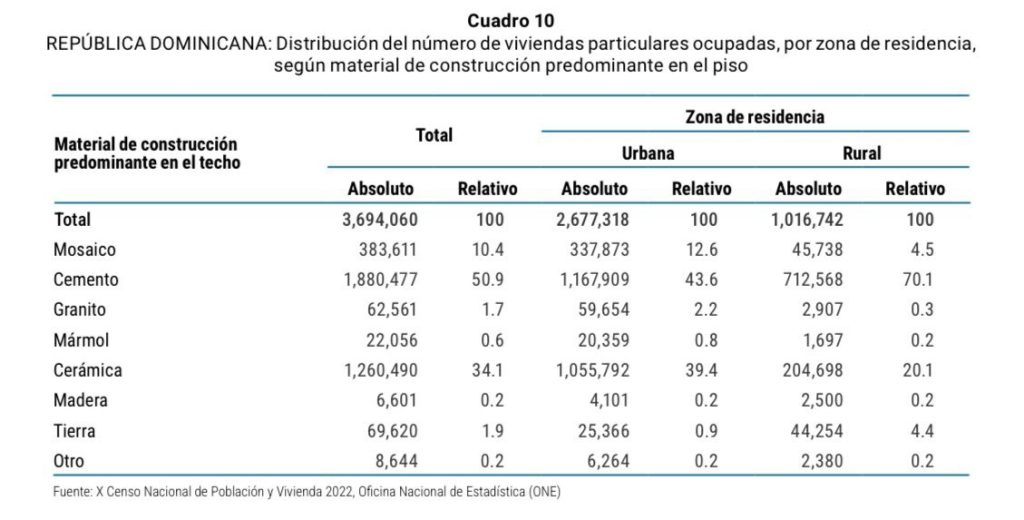
Distribution of materials in floors nationwide
The total number of private homes occupied in the Dominican Republic amounts to 3,694,060, of which 2,677,318 are located in urban areas and 1,016,742 in rural areas.
Within this total, cement predominates with 1,880,477 homes (50.9%), followed by ceramic with 1,260,490 (34.1%) and mosaic with 383,611 (10.4%). The remaining materials have a smaller share, including granite (62,561; 1.7%), marble (22,056; 0.6%), earth (69,620; 1.9%), wood (6,601; 0.2%) and other categories (8,644; 0.2%).
Recommended readings: