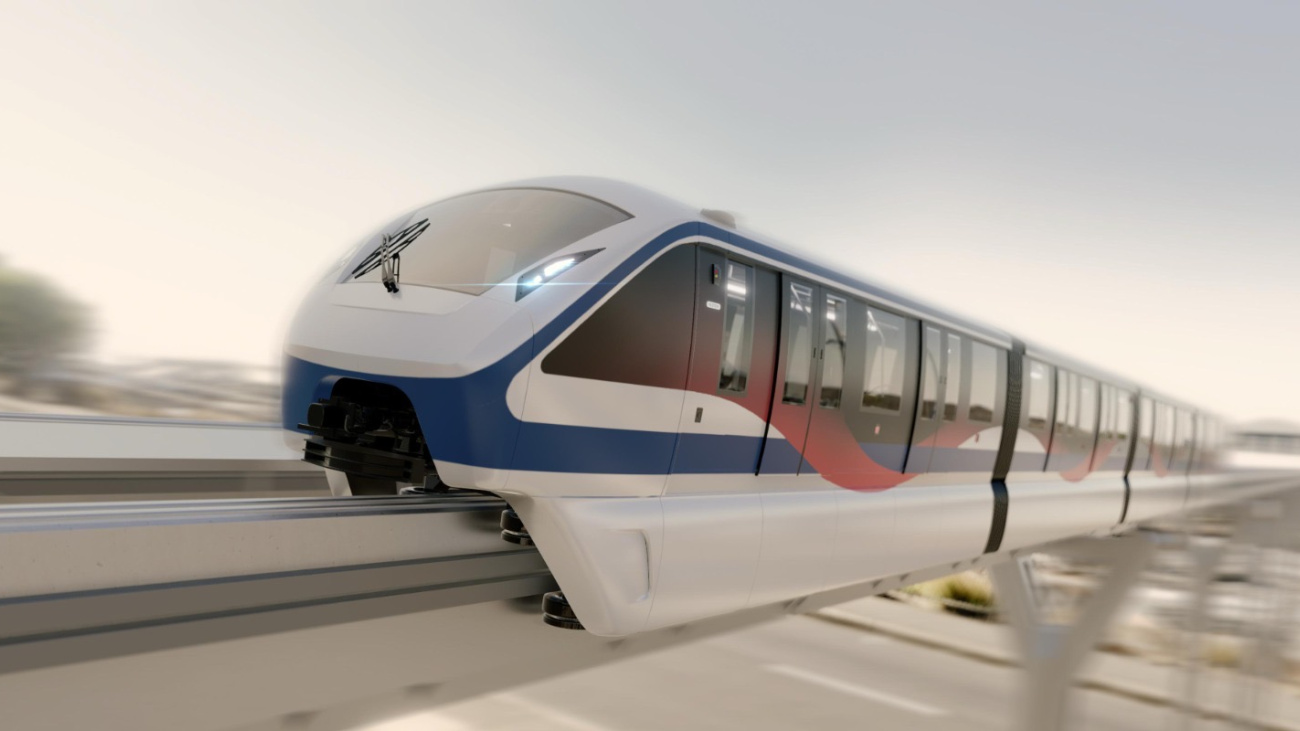
SANTO DOMINGO.– Between Wednesday, January 28, and Thursday, January 29, 2026, the Santo Domingo Monorail returned to the center of the public agenda with new technical data, dates, and projections: an estimated investment of USD 900 million, a route of 10.5 to 11 kilometers, and an operational goal of 306,000 passengers per day in its first stage, according to information released by FITRAM and statements by Minister José Ignacio Paliza.
Context and study of Systra
The Santo Domingo Monorail project is based on a technical mobility study conducted by the international firm SYSTRA, which analyzed travel patterns and the preferences of public transportation users in Greater Santo Domingo. The report revealed that 54% of users prioritize time as their main travel criterion, compared to 15.3% who prefer cost and 9.1% who prefer mode of transportation, confirming that travel time and traffic congestion are currently the main urban mobility challenges.
The diagnosis identified the high demand for transportation between Santo Domingo East and the National District as one of the most critical issues, a corridor heavily reliant on Metro Line 2 and bus routes affected by congestion. SYSTRA also detected high passenger flows at the interchanges of Metro Lines 1 and 2, as well as a lack of sufficient synergy between urban and interurban transportation, warning that the current infrastructure will not be able to absorb the projected growth in demand without new solutions.
In addition to demand, the research assessed the project's urban and environmental integration, considering the strategic location of stations, mixed land use, integration of local businesses, creation of public spaces under the viaduct, integrated drainage systems, universal accessibility, and mitigation of impacts such as noise and vibrations. Based on these variables, the company concluded that an elevated, guided rail system, such as a monorail, is the most efficient alternative for serving the East-National District corridor, increasing transport capacity, and reducing travel times.
From the work to the territory
Under construction, the project package includes an elevated viaduct with sections ranging from 9 to 18 meters in height, sidewalks 3 meters wide, bike lanes in the National District, and a new bridge exclusively for the monorail over the Ozama River, parallel to the Ramón Matías Mella Bridge; in Santo Domingo East, the viaduct would be located in the central median of the highway to reduce the impact on the existing road configuration.
Operation capacity and times
In operation, there will be trains with a minimum frequency of 90 seconds, speeds of 60 to 80 km/h and a system capacity of up to 30,000 passengers per hour per direction; the scheme contemplates initial operation with 4-car trains (capacity of 562 passengers per combination) for an offer of 22,480 passengers/h/direction, scalable to 6-car trains and up to 34,160 passengers/h/direction in future expansions.
In terms of travel time, the route announced by Minister José Ignacio Paliza proposes an 18-minute terminal-to-terminal journey between Santo Domingo East and the National District, compared to current trips that can exceed one hour during peak times. Paliza added that studies indicate a “very minimal” level of evictions or expropriations, with an estimated four properties so far.
Dates, tenders and expansions
The director of OPRET, Jhael Isa Tavárez, indicated that the bidding process for the construction of the monorail would conclude on March 25 , and mentioned a four-year horizon for the contracting/execution, aligned with the 48-month projection that has been presented as an implementation framework.
Regarding the expansion, FITRAM proposes that after the first stage, the system would extend towards Pintura to connect with Line 3 of the Cable Car and, in a third phase, towards the Duarte Highway to connect with Line 2C of the Los Alcarrizos Metro, reinforcing the network effect of the SIT-SD.
Projection
With an estimated investment of USD 900 million and a target demand of 306,000 daily passengers, the Santo Domingo Monorail is entering a phase where the key will be the transition from design and bidding to construction schedules, road interferences, expropriation management, and intermodal coordination. Meanwhile, OPRET maintains that the Metro currently moves 400,000 people and that the goal of the integrated system is to reach nearly one million users, displacing private vehicles as the primary mode of transportation.
You may also be interested in: