


The project strengthens local training in semiconductors and opens new opportunities for the country's technological development
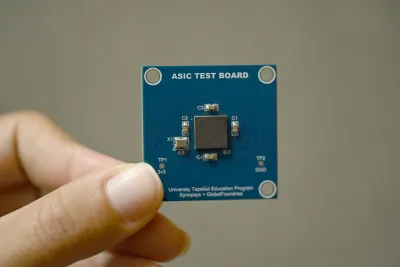
SANTO DOMINGO. The Pontifical Catholic University Madre y Maestra (PUCMM) developed the first university microchip in the Dominican Republic, designed and verified by professors, students and graduates of the country and subsequently manufactured in silicon through an international industrial process.
The device was developed using a tapeout, employed in the semiconductor industry to take a design from architecture and simulation to manufacturing. The circuit incorporates an arithmetic logic unit, registers, and control systems to execute operations and process instructions.
Manufactured using 180 nanometer technology
Manufacturing was carried out by Global Foundries using a Multi-Project Wafer (MPW) run, utilizing the 180-nanometer GF180MCU process. The prototype measures 2,935 × 2,935 millimeters, and 50 units were produced, subsequently encapsulated, and validated.
Synopsys provided design and training tools, while Keysight facilitated solutions for design, simulation, measurement, and testing. The initiative was developed within the framework of Chip Design to Tapeout, part of the Synopsys Academic & Research Alliances (SARA) program.
Training of specialized talent
The project involved professors Javier Marte, Justin Bueno, Julien Philippe and Rafael Batista, along with graduate Denys Merkushev and student Jeison Hernández.
In addition to manufacturing the circuit, the experience strengthened the capabilities of students and teachers in semiconductor technologies and established links with universities such as Purdue University, University at Albany–SUNY and University of California, Santa Cruz.
Prepare a chip for artificial intelligence
As a next step, the university is working on a new generation of microchips with neural processing capabilities geared towards artificial intelligence applications.
The initiative comes at a time when the Dominican Republic is seeking to expand its participation in the global semiconductor chain, in line with Decree 324-24 and the National Strategy for the Promotion of the Semiconductor Industry (ENFIS).
Four engineering programs obtain ABET accreditation
During the STEM Transforma RD event, PUCMM also announced ABET accreditation for Civil Engineering, Electrical Engineering and Mechanical Engineering, which join Industrial and Systems Engineering.
The university has the Mechatronics Engineering, Telematics Engineering and Computer Science Engineering programs currently undergoing accreditation.
The development of the microchip and the progress in accreditations reflect the effort to expand specialized training and prepare Dominican professionals to participate in more complex technological industries.
Recommended readings:






