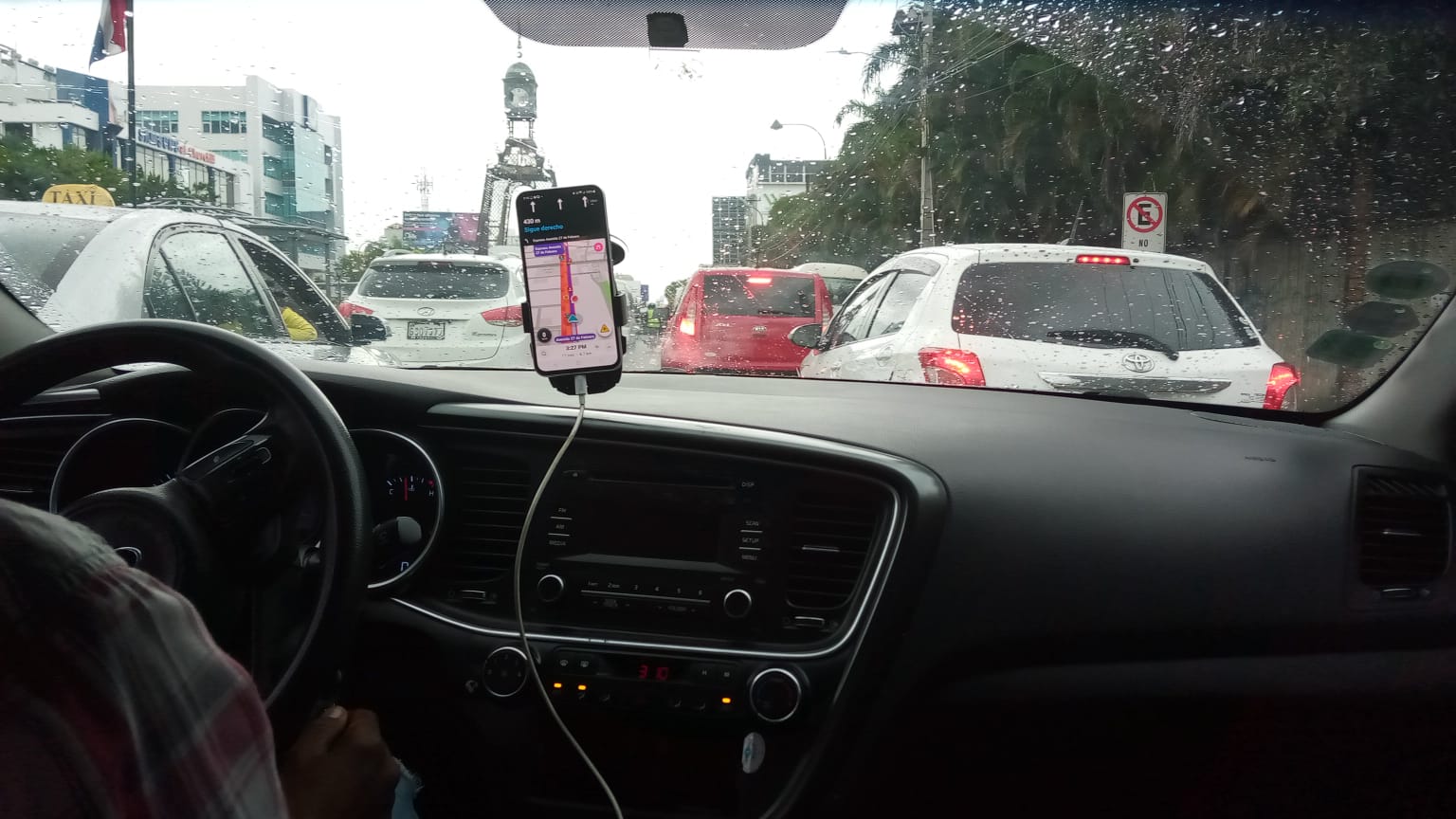
Every ten additional minutes spent in traffic jams is associated with a 0.8% higher likelihood of experiencing depressive symptoms, according to a study published in the Journal of Transport & Health, which analyzed commuting patterns and depression in 11 Latin American cities
SANTO DOMINGO – There's a moment every driver in the capital knows by heart: the engine running, the air conditioning blasting, the car not moving, and inside, something else moving, and not for the better. It's the tension rising up the back of your neck, your foot pressing the brake harder than necessary, the horn of the car behind you that feels like a personal attack.
The Dominican Republic's traffic jam isn't just a mobility problem. It's a physiological event that seeps into the psyche, generating spikes in anxiety, more so in some people than others.
And the numbers bear this out. At the close of 2025, the Dominican Republic's vehicle fleet reached 6,640,871 units, according to the Vehicle Fleet Bulletin of the General Directorate of Internal Taxes (DGII), 446,819 more than the previous year, a growth of 7.2% in a year in which the economy barely grew 2.1%, the lowest figure in a decade, according to the Central Bank.
The math of road construction is stark: the National District accounts for 28.6% of the total, and Santo Domingo province for 16.5%, meaning that Greater Santo Domingo has over 2.9 million registered vehicles in a territory that, since 2012, has not seen any comparable large-scale road infrastructure projects. The roads haven't grown. The number of cars has.
The result is that, on average, residents of Santo Domingo, and urban areas in an increasing number of provinces, lose two hours a day in traffic jams, time that could be better used for productive activity, rest or family life.
Two hours, every day
In the week that the world marks World Road Safety Week, this year between today May 11 and the 17th, it is worth going beyond the accident numbers and talking about what traffic does to the body and mind.
Science has been documenting this for some time, although in the Dominican Republic, specific academic research on stress and urban commuting is still scarce. The study closest to the regional context is that of Wang, Rodríguez, Sarmiento, and Guaje, published in 2019 in the Journal of Transport & Health, which analyzed commuting patterns and depression in eleven Latin American cities and found that every ten additional minutes of congestion is associated with a 0.8% higher probability of experiencing depressive symptoms.
The most readily available local reference is the 2016 Mobility and Road Safety Education Report, conducted by the firm Sigma 2, which documented that 83.4% of residents of Greater Santo Domingo consider traffic bad or very bad, although without measuring clinical impact on health.
On a physiological level, Gary W. Evans, Professor of Human Ecology at Cornell University, and Richard E. Wener, of Brooklyn Polytechnic University, demonstrated with a sample of 208 commuters that longer commutes are associated with higher salivary cortisol levels and lower cognitive function upon arrival at work. This study, published in Health Psychology in 2006, remains a key reference in the field. However, none of these studies have yet measured the effects of commuting in Santo Domingo.
What you can control inside the car
The traffic jam won't disappear tomorrow, although the Government has announced interventions on at least 30 roads in Greater Santo Domingo, with staggered schedules for the public sector and turning restrictions at 19 critical intersections, according to the National Institute of Transit and Land Transportation (Intrant).
It's progress. But while Winston Churchill, Gregorio Luperón, February 27th, and Máximo Gómez avenues are being reorganized, you're still there, in the same spot as always, at 8:15 in the morning.
What to do with that time? Redefine the traffic jam as your own time. Not as wasted time, but as the only minutes of the day when no one can ask you for anything, enter your office, or burden you with a task. Some use it for podcasts or audiobooks; others, for music they don't listen to in any other context. The brain appreciates the change of pace.
Practice diaphragmatic breathing. It sounds clinical, but it's simple: inhale for a count of four, hold for two, exhale for six. Repeating this three times lowers your heart rate measurably.
It's not just intuition: a study from Beijing Normal University, published in Frontiers in Psychology, demonstrated that diaphragmatic breathing reduces cortisol levels and improves sustained attention in healthy adults under stress. It's done with the car stopped, without anyone noticing, and without letting go of the steering wheel.
Don't compete. Road rage is triggered when drivers perceive traffic as a personal threat or an injustice. The same study by Wang, Rodríguez, Sarmiento, and Guaje identifies that it is delays caused by congestion, not free travel time, that are associated with depressive symptoms, suggesting that the perception of being blocked and powerless is the central mechanism of road stress.
Recognizing that the person next to you or behind you doesn't want to be there either, deactivates a good part of the mechanism. The bottleneck isn't chasing you. It's chasing everyone.
Leave earlier or later
Traffic index data published in national media, constructed from Google Maps information for the National District, show that congestion begins to ease after 7:00 p.m.
The morning rush hour occurs between 7:00 and 9:00. Leaving 45 minutes earlier, or working on staggered entry schedules as proposed, can mean the difference between being stuck for two hours and a reasonable forty minutes.
The fact that the real estate sector cannot ignore
There's a conversation the Dominican real estate market is starting to have openly, though it still lacks volume: a project's location isn't measured solely in square meters or finishes. It's also measured in minutes of life.
Academic research supports this. A study published in PLOS ONE by researchers from Sun Yat-sen University and Beijing Normal University found that the built environment, mixed uses, proximity to work, and access to transportation are key factors in determining the distance of daily commutes and, therefore, the quality of life of residents.
The same Latin American study confirms this from the opposite angle: users of formal transportation are 4.8% less likely to experience depressive symptoms than private drivers, according to Wang, Rodríguez, Sarmiento, and Guaje. The conclusion for the real estate market is straightforward: proximity to transportation is not just a matter of convenience.
An apartment in a corridor with direct access to the subway, or a mixed-use development that allows you to work, shop, and play without needing a car, is not just a more convenient product. It's a product that gives the buyer back one or two hours of their daily life.
And that, in today's market, should be as prominent a sales pitch as the swimming pool or the gym. Because ultimately, the question every buyer asks, though not always in those exact words, is the same: how much of my life am I going to sacrifice to get here?
Recommended readings:
- Venezuelan businessman: “In a couple of years Punta Cana will be like the capital, with traffic jams everywhere.”
- What's happening at the Juan Pablo Duarte Bridge? We'll tell you, along with alternate routes to ease the traffic jam
- I don't use the subway! What does that have to do with the real estate market?