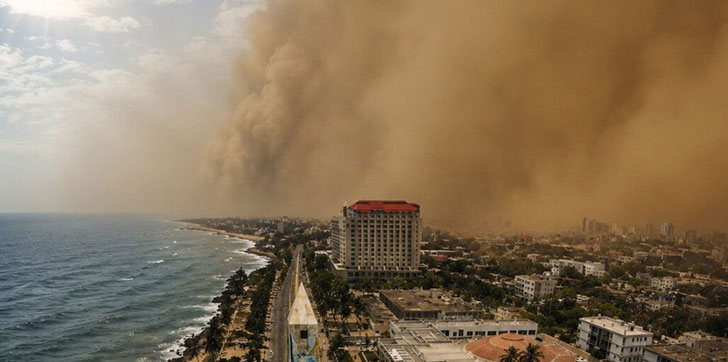
Although it can affect air quality and cause respiratory discomfort, this natural phenomenon also helps fertilize ecosystems, regulates climatic processes, and can even limit the formation of hurricanes
SANTO DOMINGO.- Every year, between the end of spring and the beginning of autumn, millions of tons of dust detach from the Sahara Desert in Africa and embark on a journey of thousands of kilometers over the Atlantic Ocean to reach the Caribbean, Central America and parts of North America.
The phenomenon, known as Saharan dust or the Saharan Air Layer, often raises concerns about its effects on air quality, especially among people with asthma, allergies, or respiratory illnesses. However, experts agree that it also plays essential roles in maintaining the planet's climatic and ecological balance.
According to the BBC, this mass of hot, dry air laden with mineral particles forms over North Africa and is driven by the trade winds, which carry it across the Atlantic. Under certain conditions, these clouds can travel more than 10,000 kilometers before reaching the Caribbean.
A frequent visitor to the Caribbean
Although it often draws attention when it reduces visibility or makes the sky more opaque, the arrival of Saharan dust is not an extraordinary event. According to the US National Oceanic and Atmospheric Administration (NOAA), cited by the BBC, more than 100 million tons of African dust cross the Atlantic every year.
Science communicator Oliver Roosevelt Sánchez Guillén explained in an article published by Al Momento that these episodes are more frequent between June and August, precisely during the period of greatest activity of the cyclone season in the Caribbean.
The particles are lifted to several kilometers in altitude by strong atmospheric currents over the Sahara and are subsequently carried by prevailing winds toward the Americas. Sometimes, the concentrations are so high that they can alter the color of the sky and produce particularly intense sunrises and sunsets.
Not all the effects are negative
Despite the concern it often generates, Saharan dust fulfills important functions for various ecosystems.
According to National Geographic, the particles transported from Africa contain minerals such as iron and phosphorus, essential nutrients for oceans and tropical forests. A significant portion of this material ends up being deposited in the Atlantic Ocean and the Amazon basin, where it acts as a natural fertilizer.
The publication points out that much of the phosphorus that the Amazon rainforest needs to sustain its extraordinary biodiversity comes precisely from these dust clouds that cross the ocean year after year.
Furthermore, experts indicate that these air masses help regulate certain climatic processes. According to the BBC, mineral dust absorbs and reflects some solar radiation, contributing to the atmosphere's thermal balance.
An unexpected ally against hurricanes
One of the lesser-known aspects of the phenomenon is its influence on the hurricane season.
As Telemundo Miami explains , the Saharan Air Layer introduces large amounts of dry air into the tropical atmosphere. This dryness hinders the formation of storms and can limit the strengthening of developing tropical systems.
National Geographic magazine adds that dust-related currents also generate wind shear, an atmospheric condition that can weaken or prevent the formation of tropical cyclones.
For this reason, many meteorologists consider Saharan dust to be one of the natural factors that help to moderate cyclonic activity during the first months of hurricane season.
The health risks
However, the phenomenon also has less favorable effects.
Airborne particles can irritate the eyes, nose, and throat, as well as aggravate pre-existing respiratory conditions.
The health organization ADARS warns that high concentrations of dust can increase episodes of allergies, asthma and other respiratory conditions, especially among children, older adults and people with lung diseases.
For its part, the CCH Gazette points out that the finest particles can penetrate deep into the lungs, which is why health authorities often recommend precautionary measures during periods of higher concentration.
How to protect yourself?
Among the most frequent recommendations are:
- Avoid prolonged outdoor activities when concentrations are high.
- Wear a mask if you need to be outdoors.
- Keep doors and windows closed to reduce the entry of particles into the home.
- Drink enough water to counteract the dryness of the environment.
- Wear protective eyewear if eye irritation occurs.
- Pay special attention to children, the elderly, and people with respiratory illnesses.
Much more than sand in the air
Far from being simply a cloud of dust, the Saharan Air Layer is an atmospheric phenomenon that connects continents, influences ecosystems, and participates in climatic processes that affect millions of people.
As National Geographic summarizes, these particles that originate in one of the world's largest deserts can end up fertilizing the Amazon, feeding marine organisms, modifying air quality in the Caribbean, and even influencing the intensity of hurricanes that form over the Atlantic.
That's why, whenever the sky takes on a grayish hue or the horizon appears less clear than usual, it's not just dust suspended in the atmosphere: it's the visible trace of a journey that began on the other side of the ocean.
Recommended readings: