


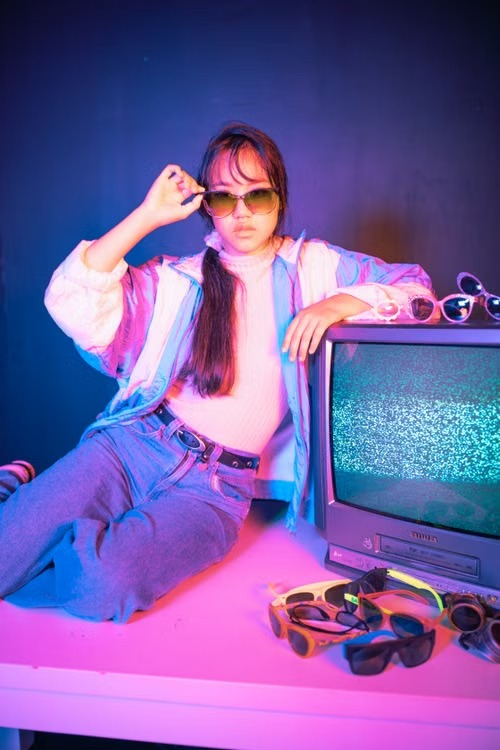
A photograph, a couple of instructions, and a few seconds. That's how thousands of people are traveling back to the 80s without buying a ticket to the past or opening a family photo album. Perhaps the biggest novelty, and the danger, of this trend isn't time travel itself, but rather that handing over a personal photo stops feeling like giving away information and starts feeling like a game
SANTO DOMINGO – Fashion is fun, personalized, and almost irresistible to share. But behind the bouffant hairstyles, shoulder pads, extravagant makeup, and vintage clothing, there's a less glamorous question: what do you give up when you hand over your face to artificial intelligence?
There's something absurd about discovering that you could have survived the '80s with far more style than you imagined: your hair appears fuller. Your shirt has colors that probably no one would dare to combine today. In the background, there might be a nightclub, a family living room, a neighborhood street, or that grainy texture of analog photographs. And, miraculously, the image reflects you back, looking just like you used to.
The recipe and the hook
The recipe for the new viral trend is simple: upload a photograph to an artificial intelligence tool, ask it to preserve the person's features, and change the setting, clothing, hair, and aesthetics to turn it into an image that looks like it came from the 80s.
The trend began to spread strongly on social media during September 2026.
Indian Express, from India, reported the wave of retro portraits on Instagram and X, while UOL Tilt, from Brazil, described the phenomenon as a new Instagram trend, in which users imagine what they would have looked like during that decade.
In India, even politicians and public figures joined the game, and in the Dominican Republic it has been no different, as Guido Gómez Mazara, director of Indotel, was seen on social media posting his 80s snapshot.
And perhaps that's the first clue as to why it works so well. The machine doesn't just change a photo: it gives you back a version of yourself.
Nostalgia has always been a powerful fuel for popular culture, but artificial intelligence added something that old family photographs couldn't offer: instant personalization.
It's no longer about looking at how our parents dressed or what childhood parties were like. Now we have to ask ourselves how we would have fit in during that era. And the result blends two ingredients that are particularly effective on social media: personal fantasy and the possibility of displaying it.
Financial Express, also from India, found that searches related to ChatGPT skyrocketed in the country at the same time as the trend for 80s-style photos was expanding. Some searches related to prompts for creating the images saw extraordinary increases.
The barrier to participation is minimal. You don't need to know how to edit photos or learn Photoshop. Artificial intelligence does the heavy lifting, and the user receives a visual reward in seconds.
It's an almost perfect formula for social media: little effort, eye-catching results, and an image that invites sharing.
And there is research that helps to understand why these types of tools can influence social behavior. In 2025, researchers from the University of Copenhagen, the University of Michigan, and the Pioneer Center for AI conducted an experiment with 680 American participants, divided into focus groups.
They tested different forms of AI assistance in a social network-like environment, and the result was paradoxical: some tools increased participation and the amount of content produced, but at the same time decreased the perception of quality and authenticity of the conversations.
The study didn't specifically analyze the trend in photos from the 1980s. But it does offer an important clue: AI can make it easier to produce things we want to share, although that ease can also change our perception of authenticity.
And social media, of course, is built around sharing.
The exchange we hardly ever see
Here begins the less fun part of the story. When someone uploads a photo to turn it into an '80s-style portrait, what they see on the screen is a completely new image. The data exchange that made that image possible remains hidden behind the "generate" button.
A photograph can contain much more than a face: other people, minors, a home, a location, personal belongings, uniforms, documents accidentally visible, or any other element that appears in the frame.
And the face deserves special attention.
In February 2026, more than fifty data protection authorities and agencies from different countries signed an international declaration on images generated by artificial intelligence.
The declaration was coordinated by the Global Privacy Assembly and was supported by, among others, authorities from Canada, Spain, France, Germany, Italy, Mexico, Brazil, Colombia, Argentina, Portugal, Panama and Peru.
The message wasn't that artificial intelligence is bad. It was much more precise: realistic images and videos of identifiable people can raise privacy concerns when produced or used without knowledge or consent.
Authorities highlighted risks such as non-consensual intimate images, defamatory portrayals, harassment, and exploitation, with particular concern for minors. They also called for transparency, effective mechanisms for removing harmful content, and specific safeguards for children.
Among the signatories was Philippe Dufresne, Canada's Privacy Commissioner, along with data protection authorities from dozens of jurisdictions.
The warning
In June 2026, the Canadian privacy office concluded an investigation into X Corp. and Xai, determining that the launch of Grok's image-generating tool lacked sufficient safeguards to prevent privacy-related harm. The investigation found that the tool had enabled the generation and circulation of non-consensual sexual images of real people, including women and children.
That doesn't mean that someone taking an 80s-style photo is creating a sexual deepfake, nor that their image will necessarily end up in one, and it's important to recognize the difference.
The risk isn't in the 1980s photo itself. It's in the fact that a digital photograph can become raw material for uses its owner never imagined.
The problem isn't conspiracy theories, it's a lack of attention. Amidst the privacy warnings, a journalistic temptation also arises: to report that these trends are a secret strategy by tech companies to collect our faces, something that has not yet been proven.
A study published this week by The Living Draft in India explicitly states that there is no evidence that the 80s photo trend was deliberately designed to collect faces or facial data.
What is happening is something much simpler and verifiable: users are voluntarily handing over personal photographs to artificial intelligence services to obtain a fun result.
There's no need to imagine a conspiracy to ask a legitimate question: do we know what happens to the photograph after it's uploaded?
The answer depends on the service, its policies, the specific product, and the user's privacy settings.
Therefore, one of the most sensible recommendations is also one of the least exciting: before uploading an image, check what the service's policy says about storage, review, use of content, and improvement of its models.
Most people don't do that, and it's understandable. Nobody opens a lengthy privacy policy because they want to know what they'd look like with shoulder pads and one of those phones that looked like an ice pack.
The second journey: from AI to networks
There's another layer: once the photograph is created, the second part of the ritual usually follows, which is sharing it directly to Instagram, Facebook, WhatsApp, TikTok, and others.
The image then ceases to be solely in the environment where it was generated and enters an ecosystem where it can be copied, downloaded, forwarded and republished, and academic research has already documented that artificially generated faces can be used to create fake profiles.
The study, published in the Journal of Online Trust and Safety (volume 2, number 4) on September 18, 2024, and authored by researchers from Northeastern University and Indiana University Bloomington, analyzed 1,420 X accounts with faces generated using GAN networks, concluding that they are used to spread scams, spam, and coordinated messages in an inauthentic manner.
The researchers also estimated that tens of thousands of active accounts could be using those types of faces.
A selfie doesn't automatically make someone a victim of impersonation, but the more visual material of a person exists online, the greater the chance that someone can reuse it. Today's photograph could be the training material, reference material, or manipulation tool for tomorrow.
Be careful when children appear
In September 2026, an investigation by WIRED, in the United States, along with the Tech Transparency Project, reported that between the end of 2025 and mid-2026, more than 350 video ads with AI-generated child abuse sexual material had been located on Meta platforms.
Some of the manipulated images were based on real photographs of minors. Meta removed the ads after they were reported.
It's an extreme scenario and very different from a retro family photo, but it serves to remind us of something essential: a photograph published on the internet can quickly escape the context for which it was created.
It's not about stopping playing
Perhaps the most reasonable conclusion isn't to abandon the trend. After all, there's something genuinely fun about imagining yourself in another decade, if you were born in a later one, and nostalgia is part of cultural life, so AI offers a new way to play with it. The key is to do so knowing what the trade-off is.
A good rule could be as simple as this: if you wouldn't hand that photograph over to a stranger on the street, it's worth pausing for a second before handing it over to an unknown application.
It also helps to avoid photographs that contain documents, addresses, financial information, or other sensitive data in the same frame; to be especially careful when children or third parties appear; and to be wary of unknown applications that promise to reproduce the exact same viral effect.
Perhaps the biggest novelty, and the danger, of this trend isn't that artificial intelligence could take you back to the 80s. It's that it has made handing over a personal photograph stop feeling like handing over information and start feeling like a game.
And therein lies the true magic, and the true challenge, of these trends: they make you forget that behind every image there is a person. And that, although AI can invent a neon-lit past for you, the face you give it belongs to the present.






