


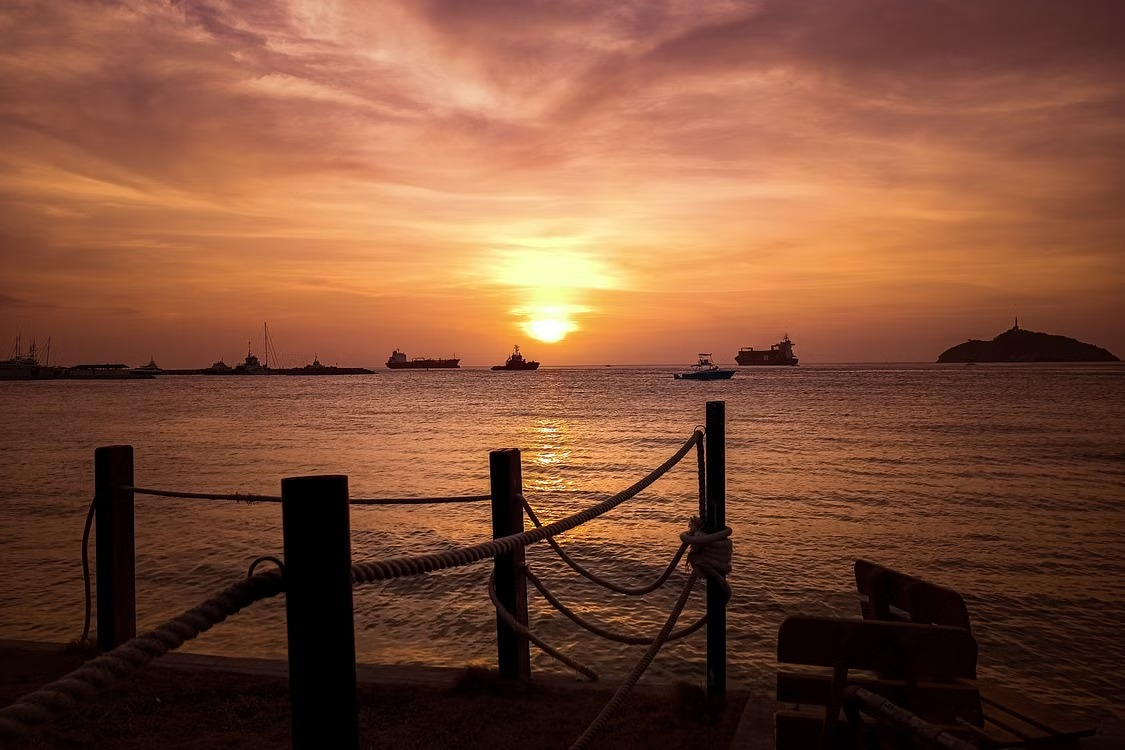
In the Dominican Republic, autumn doesn't herald itself with red leaves and low temperatures. It arrives in a different way: the rain changes, the days grow shorter, and the light begins to fade earlier
SANTO DOMINGO – Autumn begins in the Northern Hemisphere in a few days, but in the Dominican Republic it won't arrive with a blanket of yellow, red, and ochre leaves. There will be no need to sweep sidewalks covered in foliage or take coats out of the closet, nor will the trees suddenly appear bare.
September can feel too much like August, October lingers in the heat, and November can still find anyone seeking shade. And yet, autumn arrives, almost on tiptoe, as if it knows that in the tropics it will have to learn another way to announce itself and exist.
The cycle of rain, humidity, and the sky changes. Ah! The light changes. And there is a change that is perhaps the most silent, but also one of the most noticeable: it begins to get dark earlier.
In Santo Domingo, on September 1, 2026, the sun set at 6:53 p.m.; on October 1, it will set at 6:28 p.m., and on November 1, at 6:06 p.m. In two months, the afternoon will have lost almost 47 minutes of daylight.
The autumn equinox will arrive on September 22nd, marking the astronomical beginning of the season in the Northern Hemisphere. The calendar changes, but the city, apparently, does not.
The Dominican Republic is so close to the equator that the idea of four seasons might seem like a cultural import. Christmas arrives with heat, Easter arrives with heat, and August, September, October, and November can follow one another without anyone feeling the need to change their wardrobe for seasonal clothing.
A country without marked differences
But the National Statistics Office explains it differently. In its environmental statistics bulletin, comparing weather stations in Santo Domingo between 1991 and 2021, it points out that the country does not show marked temperature differences between them, as occurs in temperate countries.
The average maximum temperatures during that period ranged from 30.2 to 32.2 °C, while the minimums ranged from 21.4 to 23.1 °C. The difference becomes clearer when you look up and expect rain: average summer and autumn rainfall was approximately double that recorded in winter and spring. The Dominican autumn, then, isn't necessarily seen in the leaves. It's felt in the water.
A station that speaks with a different light
Perhaps that's why light is one of the best ways to photograph the Dominican autumn. Because the light at this time of year is different; the leaves don't have to turn red for the landscape to change. The sun sets a little lower, the evenings begin to draw in earlier, and the shadows take on a different texture and direction.
For those who look through a camera, there are days between September and December when everything outside seems to offer itself in a hue that wasn't there just a few weeks before.
Light, moreover, is not merely an aesthetic matter. It is one of the main environmental cues that the body uses to synchronize its circadian rhythms, the biological cycles that organize, among other functions, sleep and wakefulness.
Scientific literature on light, circadian rhythms, and sleep explains that the human biological clock adjusts to the light-dark cycle and that variations in lighting can influence rest, activity, and other physiological processes.
That's why autumn in temperate countries isn't just a picture postcard. When the days get considerably shorter, some people experience changes in mood, sleep, appetite, and energy levels.
The U.S. National Institute of Mental Health identifies this pattern as seasonal affective disorder: when the changes are significant and recurrent enough to constitute a clinical condition.
The most well-known pattern begins in late autumn or early winter and usually subsides during spring and summer.
Life is different in the tropics
Research on seasonal affective disorder has focused for decades on countries in mid- and high latitudes. A meta-analysis published in 2025, which compiled 24 studies and 32,866 participants, found an association between higher latitude and a higher prevalence of both winter-pattern seasonal affective disorder and its subclinical form.
But in tropical regions, research emerges where the story changes.
In Townsville, Australia, at 19 degrees south latitude, a study published in 1996 found a higher proportion of seasonal symptoms associated with summer than with winter among the participants.
The researchers noted that heat and humidity were the environmental factors that most influenced the mood and behavior reported by the participants, and they raised the need for further research into seasonality in tropical climates.
Another study conducted in Chiang Mai, Thailand, at 19 degrees north latitude, also found a higher frequency of seasonal patterns associated with summer than with winter, although its authors cautioned against methodological limitations and noted that the results could not be generalized without caution.
The tropics, then, are not outside the map of emotional seasonality. What is still lacking is sufficient data on how it manifests itself.
In the Dominican Republic, the reviewed evidence does not support the claim that autumn produces seasonal depression in the general population. Nor does it support the assertion that the decrease in daylight has the same effects here as at much higher latitudes.
What is known, however, is that light plays a role in regulating circadian rhythms, that seasonal changes can affect some people, and that studies conducted in tropical regions have found different patterns, in some cases linked to heat and humidity.
The question remains open: what is autumn like in the Caribbean?
A season made of nuances
The Dominican Institute of Meteorology, INDOMET, uses the language of transition to describe October in the Dominican climate context and recalls that the country has recorded a significant frequency of tropical cyclone impacts during that period.
It's a much more Dominican way of understanding the season: here autumn doesn't necessarily arrive with cold, it can arrive with afternoon rain, an open window while the wind changes, the smell of wet earth, a sky that turns gray sooner than expected, or that golden light that lingers for a few minutes on the buildings.
It can also arrive with something as simple as looking at the clock at six in the evening and realizing that night has come early. And perhaps someone is looking for autumn on the thermometer when they should be looking for it in the sky.
The house also receives the station
There is one final reason to consider this season from this perspective dedicated to the space we inhabit. Light enters through the windows, moves across the walls, and changes the way we perceive a room.
Research on natural light and circadian rhythms has shown that the light-dark cycle is a fundamental cue for the biological clock and that exposure to ambient light can be linked to sleep, mood, and alertness.
Therefore, a tropical dwelling should not be thought of solely as a structure that provides shelter from the sun.
It is also a place to receive it: a well-oriented window, a balcony, a gallery, a patio or a shade that allows you to stay outside, are elements that make the house participate in the rhythms of the day.
In the tropics, where the difference between seasons can be subtle, perhaps architecture has the precise task of allowing inhabitants to perceive these small changes. Not to transform the house into an autumnal home, but to ensure that the connection with the sky is not lost.
Autumn can also be a way of looking
Perhaps that's why September, October, November, and December hold something special for photographers: the light begins to fade earlier. Shadows retreat to different places, and the sky seems to have less time to transform before nightfall.
A season that elsewhere is heralded by bare trees can reveal itself here in a wall illuminated in gold for ten minutes, in a palm tree silhouetted against the deep blue sky (when the Saharan dust lets up), in a wet and glistening street that reflects the houses after the downpour, in a cloud that turns the afternoon silver, or in the last glow on the buildings before the city lights come on.
Dominican autumn doesn't need to paint the leaves; it simply needs to change the light. And perhaps that's its tropical way of reminding us that no season goes completely unnoticed. Some simply speak more quietly.
Recommended readings:






