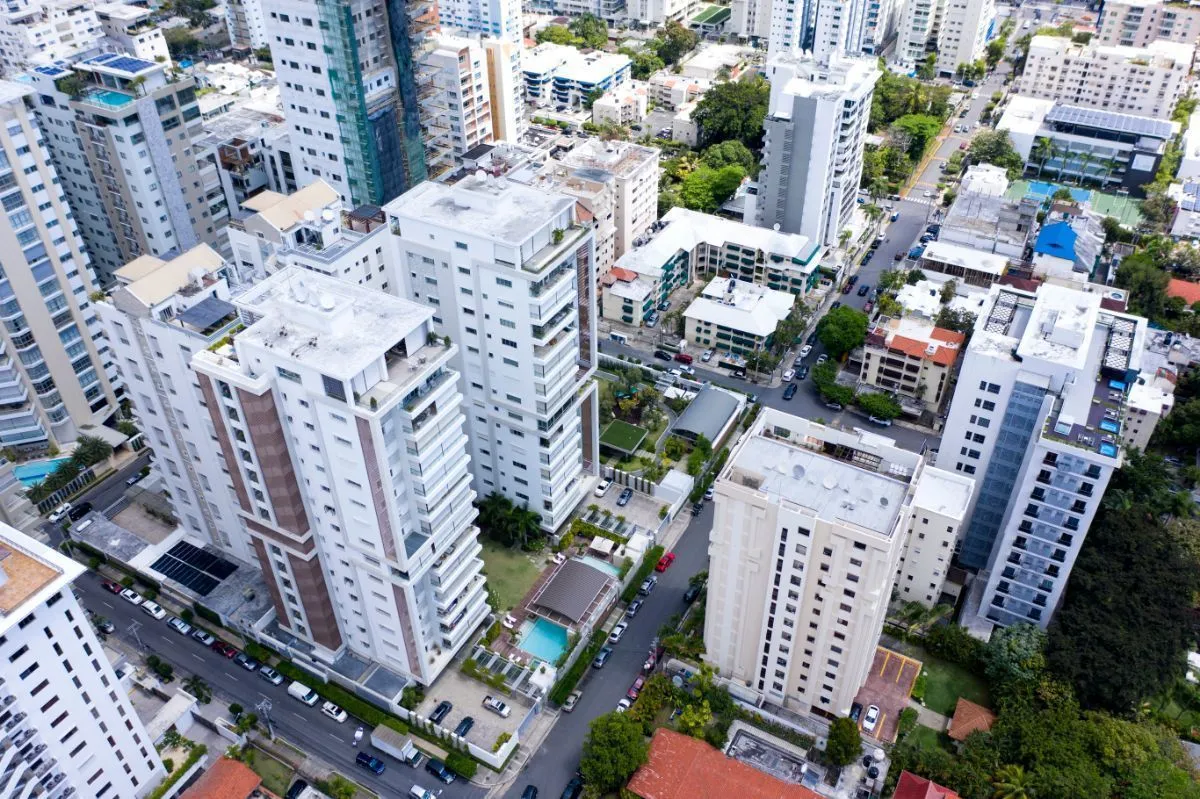
It's not just an address. Offices, housing, banks, hotels, restaurants, and services have transformed this area of Santo Domingo into the most sought-after business ecosystem in the country. When I receive an office space request, one location is constantly mentioned:
"We want Piantini." Sometimes I ask: Why Piantini? And the answer isn't always entirely clear. The client knows they want to be there. Their executives want to be there. The head office recognizes the area. Their customers are nearby.
But what makes this location so valuable? Piantini is bordered by four important axes of Santo Domingo: Winston Churchill, Abraham Lincoln, 27 de Febrero and Gustavo Mejía Ricart avenues.
However, its value isn't limited to those streets. Piantini is part of a larger ecosystem known as the Central Polygon, along with areas like Naco, Serrallés, Paraíso, and Evaristo Morales.
This area is home to a significant portion of the city's corporate and financial activity. And that creates something that is extremely valuable in real estate: proximity.
A company doesn't just rent square meters
When a company decides to locate in Piantini, it's essentially buying access to an ecosystem. Banks, corporate offices, shopping centers, international hotels, restaurants, supermarkets, pharmacies, clinics, gyms, and other services coexist within a relatively small radius.
An executive can meet with an international client staying nearby, have a banking meeting, lunch with another client, and return to their office without crossing the entire city. And for a multinational company that regularly hosts regional executives, that also has value.
The concentration of hotels like JW Marriott, InterContinental, Aloft, and Marriott Piantini reinforces that corporate component. But there's another factor that I increasingly consider important: where the employee lives and how they get around.
Time is also part of the occupancy cost
I'm privileged to live and work nearby, and I increasingly appreciate being able to walk to a meeting. In a congested city, that's more than just convenience. It's quality of life. It's productivity. It's time.
Corporate employees don't just need to get to their desks. They need parking, lunch, errands, client visits, and, at the end of the day, a place to get home. That's why parking has become one of the most important components of the corporate product in Santo Domingo.
In our market, we see a benchmark of approximately one parking space per 30 m² in many competitive corporate properties, although each building has different characteristics. A spectacular building with an insufficient parking ratio may cease to be suitable for a particular user.
Piantini has also become a place to live
This point seems fundamental to me. The growth of high-end residential towers around the corporate district is bringing living and working closer together. This allows for something Santo Domingo increasingly needs: reduced commutes. Living close to the office, the children's school, the gym, the supermarket, the doctor, and the places where much of daily life unfolds is beginning to have an economic value that is difficult to reflect solely in the price per square meter.
Then we better understand why companies continue to request Piantini. But Piantini isn't for everyone. And here's the important part. Good advice doesn't begin by saying that every client has to be in Piantini. Naco, Serrallés, Evaristo Morales, Bella Vista, and locations on avenues like John F. Kennedy, Luperón, 27 de Febrero, and Sarasota, among other areas of Santo Domingo, can offer better solutions depending on the operation.
A company with hundreds of employees might prioritize accessibility and transportation. Another might need ample parking. A professional firm might particularly value image and proximity to its clients. And yet another company might find a much more favorable cost-efficiency ratio outside of Piantini. The right location depends on the business.
So why Piantini?
Because it has achieved something difficult to artificially construct: concentration. Businesses attract services. Services attract people. People attract restaurants, shops, hotels, and housing. And all that activity, in turn, attracts businesses. It's a cycle that strengthens the value of the location. That's why, when a client tells me, "Piantini is expensive," my next question is:
Expensive compared to what? Because the analysis shouldn't be limited to the cost per square meter. It's necessary to measure what the company gains in return: access, time, talent, clients, image, services, parking, and quality of life for those who work there.
Piantini won't be the right location for every company. But for those whose business, clients, and employees find value in that ecosystem, paying a premium can make sense. Ultimately, a company doesn't just choose where to locate its offices. It chooses where it wants to operate from. And in corporate real estate, a good location isn't necessarily the most expensive or the most prestigious. It's the one that makes the business run more efficiently.
Recommended readings: