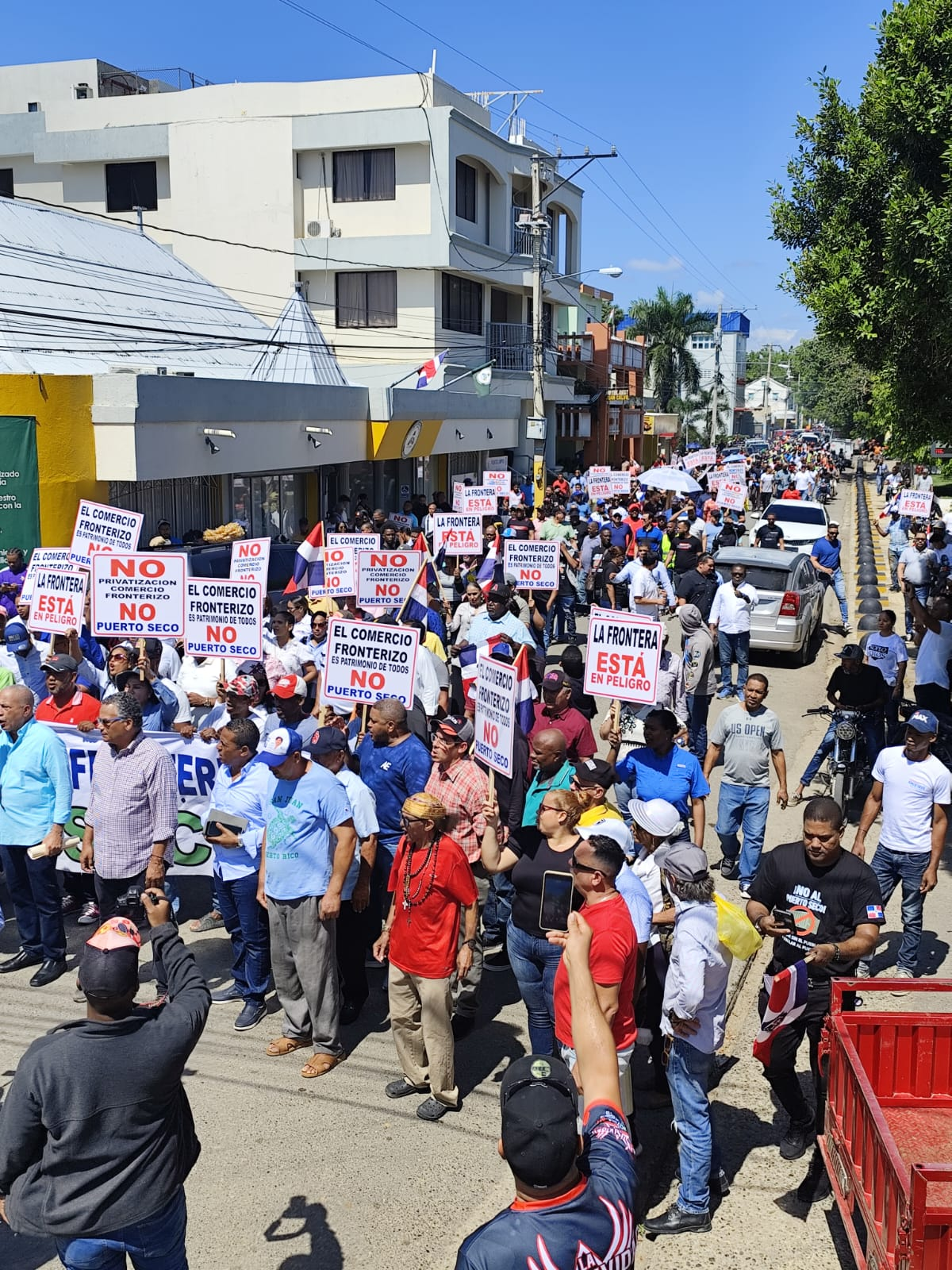
They warn that the proposal would affect the binational scheme built over decades on the border
SANTO DOMINGO – President Luis Abinader's announcement regarding the construction of dry ports on the border has begun to generate rejection among merchants in Dajabón, who warn that the initiative could transform the binational exchange model developed in the area over decades and affect the commercial dynamics of the local businesses.
A model built since the 1980s
The official proposal announced by President Abinader in February of this year contemplates the installation of logistics infrastructure under the free zone regime, with an investment of 300 million dollars from the private sector, aimed at reorganizing trade on the border.
However, from the perspective of local businesses, the measure is seen as an intervention in a system that, they claim, has been progressively built by the actors in the area themselves.
Merchant Ismael Mateo indicated that this model is not recent, but rather has roots in the sustained work of generations. “Binational trade began to take shape in the 1980s thanks to merchants from Dajabón and other border towns,” he stated.
“We created a business model that delivers results, that the numbers back up, that we created an ecosystem in which we all benefit,” he stated.
He argued that, over time, this exchange has generated shared results and benefits in the region.
Displacement of local commerce
In that context, Mateo denounced that the implementation of dry ports could change the control of the commercial system at the border. "Today, some economic groups intend to privatize trade, to create these so-called dry ports, and they want to take over all the effort we've made over these 40 years," he stated.
He warned that the measure not only implies a logistical change, but a transformation in the way binational trade is managed.
Rejection and mobilization at the border
The merchant made his statement while participating in the march held yesterday, Tuesday, April 28, in protest against the measure announced by the Government. “We are marching; we are against the implementation of this business model that seeks to take away ours and keep it for themselves,” he stated.
He also assured that the opposition to the project will continue over time, "This is a fight that has only just begun, we remain steadfast in this struggle and we will take this to the very end," he stated in declarations to El Inmobiliario.
The activity was organized by the Chamber of Commerce, the Dajabón business and trade council, the Montalvo Center, the Nuestra Señora del Rosario parish, the border exporters association, among others.
Trade as the basis of the border
Mateo insisted that trade is an essential part of the economy and social dynamics of the border region. “Trade is the heritage of the border,” he concluded.
Recommended readings: