


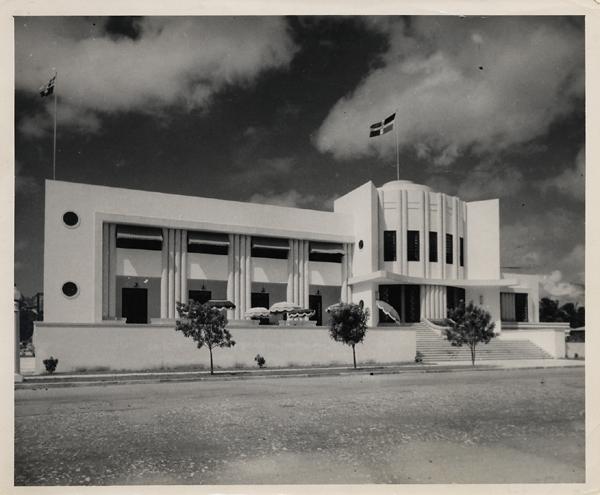
It is not just a building, it is a symbol of the history of the birthplace of the Constitution and of the country, where every corner tells a story and every crack whispers secrets.
SAN CRISTÓBAL – There are buildings that not only stand on solid ground, but also permeate the collective imagination of a city, a generation, and an era. The HotelSan Cristóbal, located in the city of the same name, is one of those buildings that, although it now serves as a training center for hotel staff, was once an icon of the grandeur of its time.
The building was the work of architect Henry Gazón Bona, who was also a musician, astronomer, and a key figure in Dominican official urban planning, as he left his mark on works such as the Mercado Modelo, the Casa Vapor, and the Palacio del Partido Dominicano in the capital city.
He conceived this hotel in a combination of modern neoclassical style, with elements of the so-called "official style" that characterized the works of the regime and the Art Deco so popular in the 40s and 50s, not in its purest form, but as a decorative and structural influence visible in its geometric lines, symmetry, austere ornamentation and monumental volumes, according to the academic project Architecture and Urbanism in San Cristóbal developed by UNPHU.
It had two levels and 14 rooms, decorated with century-old mahogany and mirrors integrated into the structure. The facade , with a front staircase and raised central block, gave it a monumental, almost theatrical presence, reflecting the taste of the tyrant Rafael Leónidas Trujillo.
The San Cristóbal hotel became the symbol of the city and not only hosted visitors, it was the design of a messianic ambition that placed San Cristóbal, as was the desire of the tyrant, on par with the capital or Santiago.
Music, memory and school
Many stories unfolded in those halls, in the rooms that still whisper secrets no one hears. The hotel was a meeting place for officials, diplomats, artists, and businesspeople, especially during the 1950s and 1960s, when receptions, dances, gatherings, and even weddings were held there, later becoming legendary.
There, musicians, orchestras and artists performed, enlivening the nights of a city that, at times, was the capital, many years after hosting the Constituent Assembly that drafted the first national Constitution in 1844.
Although Santo Domingo remained the official capital, Trujillo transferred symbolic and administrative functions to his hometown, building the Palace of Ceremonies and turning it into the informal seat of power.
Thus, San Cristóbal was the capital twice: once by constitutional will, and again by authoritarian will.
The hotel hosted parties and gatherings featuring national and international artists. It was common to see figures like Johnny Ventura and other artists of the time delighting audiences with their music. In addition, art exhibitions and cultural events were presented, enriching the lives of the residents of San Cristóbal.
Over time, the Hotel San Cristóbal gradually lost its prominence due to political changes, new tourist routes, and urban decay. However, its commitment to service never disappeared. Today, the building houses the Caribbean Institute for Tourism Training (IFTC), a school that combines academic training with real-world hotel operations.
The IFTC offers more than 30 specialized courses in areas such as cooking, pastry, customer service and hotel management, taught by the Dominican Institute of Technical and Professional Training (INFOTEP) and more than 500 active students keep the original function of the building alive, adapting it to the needs of contemporary tourism.
What it meant

Today, its facade still stands as a witness to what it once was and still retains vestiges of its former glory. (External source).
For the city, the establishment was more than just a building: it was a symbol of modernity, of centrality, of local pride, in a city marked by the fearsome figure of Trujillo. The Hotel San Cristóbal represented the civic side of an era: the desire to project oneself, to entertain, to celebrate.
Today, its facade still stands as a testament to what once was, preserving vestiges of its former glory. The walls that once echoed with laughter and music now silently hold the memories and secrets of a golden age.
It is a place where the past and present meet, vibrating in different ways, inviting everyone to remember and appreciate the rich cultural heritage. And although orchestral music no longer fills its halls, the echo of a city that dreamed big remains within its walls.
| In addition to its rooms, it offered: |
| – Restaurant with Creole and international cuisine |
| – Event hall with capacity for more than 200 people |
| – Indoor gardens and terraces for social gatherings |
| – Bar service and live music on weekends |







