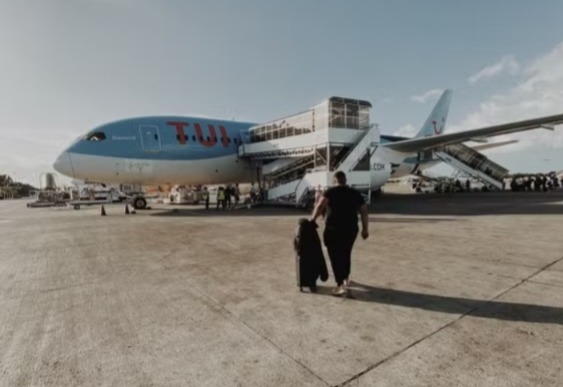
The proposal to charge an additional US$10 per ticket adds at least one new charge to a structure that already includes more than eleven fees and taxes
SANTO DOMINGO. – The government's proposal to apply an additional charge of US$10 to airline tickets, included in the package of fiscal measures called the Anti-Crisis Plan, has set off alarm bells in the aviation sector.
The Dominican Association of Airlines (ADLA) warned that the measure, designed to mitigate the impact of the international rise in oil prices and cargo transport costs, could affect the country's competitiveness as a tourist destination and as a regional connectivity platform.
One ticket, eleven taxes
To understand the scope of the proposal, it is necessary to examine the fiscal architecture that already supports each airline ticket in the Dominican Republic.
According to data from the Civil Aviation Board (JAC), an international ticket currently includes at least eleven fees and taxes.
The aeronautical fee established in article 284 of Law 491-06 on Civil Aviation distributes the charges among multiple State institutions:
- The Ministry of Tourism receives US$7 per passenger (divided between image promotion and the Executive Committee for Infrastructure in Tourist Zones, Ceiztur)
- The Dominican Institute of Civil Aviation (IDAC) charges US$5.50.
- The Specialized Civil Aviation Security Corps (Cesac) receives US$1.50
- The Dominican Air Force, US$1.00
- The Civil Aviation Board (JAC), US$0.50
- The departure tax of US$20 per passenger — divided into US$10 for entry and US$10 for exit.
- The 18% ITBIS on the rate
- The US$10 tourist card for non-resident passengers
- Aerodom's airport infrastructure usage charge, and phytosanitary control fees
The result: Dominican taxes represent between 20% and 40% of the total value of a ticket, depending on the destination.
On the Santo Domingo-New York route, for example, the tax burden is equivalent to 40% of the ticket price, double the regional average of 20%, according to estimates from the Dominican Policy Observatory (OPD).
On a route like Santo Domingo-Bogotá, Dominican taxes exceed US$108 on a base fare of US$104, according to data published in the press in 2022.
Joker chronology
The accumulation of taxes on airline tickets is not new. The current structure is the result of decades of decrees and laws that added charges to fares without eliminating the previous ones.
Law 199 of 1966 created the tourist card for the entry of foreigners into the national territory. Five decades later, Decree 430-17 of December 4, 2017, converted that payment, US$10, into a charge incorporated directly into the price of air and sea tickets.
The following year, the General Directorate of Internal Taxes (DGII) issued General Rule 08-2018 to regulate the procedures for refunding that charge to Dominican citizens who had been charged incorrectly.
In 2022, the Civil Aviation Board eliminated that charge for Dominicans and foreign residents through Resolution 217-2022, although maintaining it for foreign tourists.
Decree 99-14 was another piece in that puzzle: it established the specific distribution of the funds collected by the departure tax among the Ministry of Tourism, Ceiztur, IDAC, Cesac, the Air Force and the JAC.
Other decrees, such as 225-07, equalized the aeronautical fees charged to regular and charter flights.
Law 491-06 of December 2006, which created IDAC as a technical regulatory body and JAC as an auditor, also consolidated the legal framework for airspace use fees.
That year, the country also obtained Category I status from the United States Federal Aviation Administration (FAA), opening its aircraft to the international market.
The proposed new $10 tax in 2026 would, in that context, be another link in a chain that the sector has been pointing out as excessive for years.
The voice of the industry
ADLA President Omar Chahín acknowledged the international context that motivated the government's proposal, but warned of its collateral effects. "When access to the country becomes more expensive, the impact doesn't fall solely on the airlines. It also affects passengers, the tourism sector, commerce, and, in general, the entire value chain linked to air connectivity," he stated in a press release issued on June 12, 2026.
Chahín proposed the creation of a technical committee with the Government, aeronautical authorities, the tourism sector and airport operators to evaluate alternatives that contribute to fiscal stability without compromising air transport.
Among the alternatives proposed by ADLA is a comprehensive review of the cost structure of air activity, including the price of aviation fuel (avtur) and airport fees.
What the indices show
And there are figures that support the industry's concerns. According to data from the International Air Transport Association (IATA) cited by columnist Eliana E. Gómez in Hoy Digital on June 12, 2026, the Dominican Republic collected approximately US$285 million in specific air transport taxes during 2024, an average of US$29.5 per passenger. With the new tax, that average would exceed US$39 per passenger.
The Regional Center for Sustainable Economic Strategies (CREES) ranked the country 16th out of 20 nations evaluated in the tax and fees pillar of the Air Transport Competitiveness Index in Latin America and the Caribbean.
In the subcomponents of other taxes and fees, the country falls to 17th place; in taxes on ticket sales, to 18th. In total operating costs, which include fuel, overflight and ground handling, the position is even worse: 17th out of 20.
The International Civil Aviation Organization (ICAO) has established in its policies (doc. 8632) that taxes collected on air tickets must be used exclusively for the maintenance and improvement of the civil aviation system, not for other State responsibilities.
The IDAC occupies, year after year, the third or fourth place among the largest tax collectors of the Dominican State, surpassed only by the DGII and the General Directorate of Customs (DGA).
The cost of flying in regional perspective
The Dominican Republic maintains one of the lowest airport usage fees in Latin America, surpassed only by Brazil and Belize, according to the same index prepared by ALTA and Amadeus.
However, when the rest of the taxes and charges are added, the country ranks among the three worst performing nations in terms of total costs, along with Argentina and Jamaica, according to data published in July 2025 by the tourism portal Arecoa.
Aircraft handling costs are also a factor: the average at Dominican airports is around US$2,000 per operation, compared to US$774 in Guatemala City, for example.
The proposal and Congress
The new US$10 charge per ticket was included in the so-called Anti-Crisis Plan presented by the Minister of Finance, Magín Díaz, on June 11, 2026. The measure must be evaluated by the National Congress as part of the corresponding legislative process.
While the debate opens in Parliament, the aeronautical sector seeks to ensure that the discussion transcends the tax sphere and is framed within a vision of development for civil aviation and tourism competitiveness.
Recommended readings: