


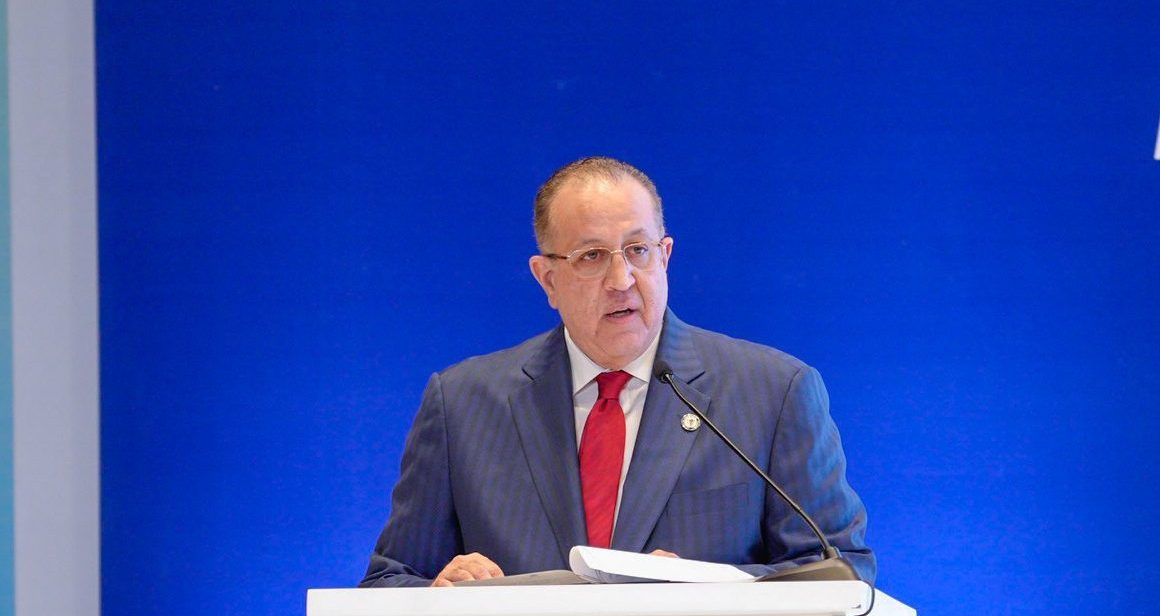
Minister Magín Díaz announced that he will not accept pressure to settle debts without documentation and that no disbursement will proceed without prior documentary verification
SANTO DOMINGO.– Twenty-five days after the promulgation of Law No. 16-26, which orders the payment of old debts to contractors, the Minister of Finance and Economy, Magín Díaz, clarified that it does not cover works carried out without a contract, but rather those whose supporting documentation does not exist for chronological reasons, since the current standards of the Comptroller's Office were not in effect 10 or 15 years ago.
On May 1, the Executive Branch enacted Law No. 16-26, published in Official Gazette 11240, whose text allows, “in an exceptional manner”, the review of claims for works “executed with or without a formal contract”, through a commission that must evaluate the admissibility of each case and, before recommending its recognition and payment, verify the consistency and available documentary support.
The measure impacts companies that carried out works for the State without the documentation now required by the Comptroller's Office.
The aforementioned law authorizes the Dominican State to settle debts with construction companies that carried out public works without having the complete documentation currently required by the regulations in force.
Furthermore, it includes cases in which the certifications and requirements demanded today by the Comptroller of the Republic simply did not exist when the works were carried out, one or two decades ago.
Inter-institutional commission and verification filters
The official acknowledged, however, a procedural inconsistency in the structure of the rule: unlike a similar law approved in the past, on this occasion the payment mandate was established first and the inventory of receivables was left for later, when the technically advisable process would have been the reverse.
Díaz assured that before any payment is authorized, the Treasury will convene a commission chaired by the minister himself and composed of the Budget Director, the Director of the General Directorate of Public Procurement and the Comptroller of the Republic, the body that has the final say on disbursements.
Additionally, each counterpart ministry – Public Works, Housing, Health and Education – must certify that the work claimed was actually carried out and warned that works ordered verbally will have practically insurmountable difficulties in being recognized within the process.
No pressure: "If something can't be paid for, it won't be paid for."
Díaz categorically ruled out the possibility of external agents influencing payment decisions. He stated that none of the agencies participating in the commission would endorse claims that did not meet the established documentary requirements, and that his ministry would not compromise its institutional reputation by accepting applications that did not comply with the requirements.
Magín Díaz made these statements on the television program El Día, which is broadcast on Telesistema, channel 11.
A long career of struggles
On May 1st of this year, the Executive Branch enacted Law 16-26, which mandates the recognition, validation, and payment of outstanding debts owed to contractors of the Dominican State, following a long history of numerous professionals who have been demanding payment for work performed for more than two decades.
The Codiano Institutional Committee (CIC), created for this purpose, recently told El Inmobiliariothat at least 18 professionals linked to these claims have died in recent years while waiting for a definitive solution from the State.
The law includes files related to works carried out for entities such as the Ministry of Education, the National Institute of Hydraulic Resources, the National Institute of Drinking Water and Sewerage, and the Office of Supervising Engineers of State Works.
Recommended readings:







