


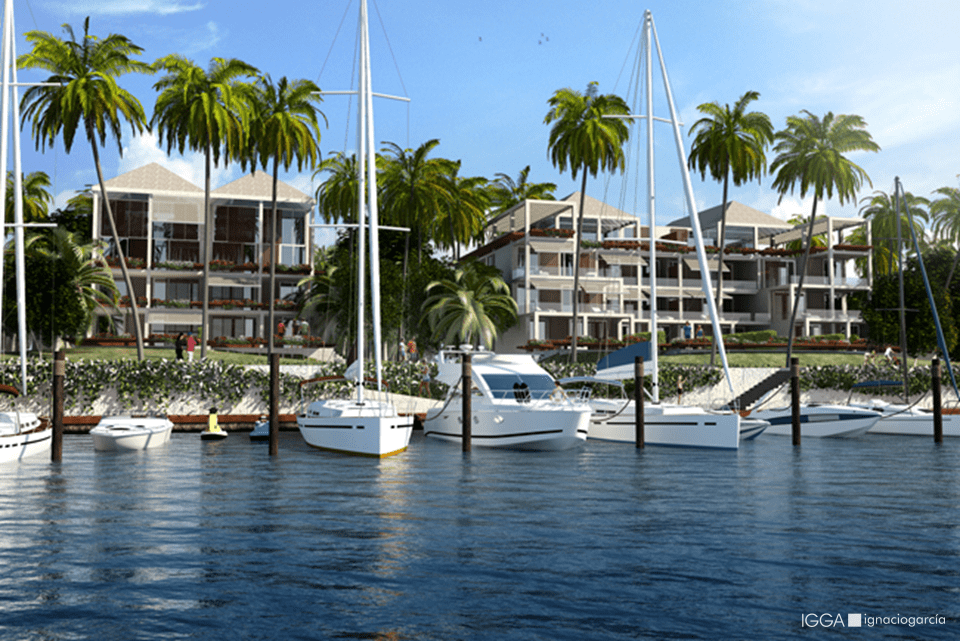
The project garnered millions in promised funding, political backing, and international visibility. Fifteen years later, the complex remains unfinished, with no verifiable full operation, and has become a prime example of announced capital that was never fully deployed.
SANTO DOMINGO. – It was December 30, 2008, when the real estate sector welcomed an ambitious project: Punta Perla Caribbean Golf, Marina & Spa Resort, whose first stone to give way to the beginning of it was executed by the then President of the Republic, Leonel Fernández and Prince Albert II of Monaco, in addition to investors and guests of the highest business and social rank.
The promise was that it would be a tourism and real estate development in Cabeza de Toro, Punta Cana, with an approximate investment of US$2.5 billion, to develop 8,800 residential units, four boutique hotels, three golf courses, and an inland marina, on a 10.2 million square meter plot of land with 3.5 kilometers of beachfront.
Expectations were high regarding its economic impact and the international projection of the resort destination.
Agreement with China and financing
In October 2010, the Dominican Ministry of Tourism announced that the Bank of China and the China Foreign Trade Bank had agreed to finance the completion of the first stage of Punta Perla with US$462 million, defining it as "the first Chinese capital investment in the country" destined for real estate and tourism infrastructure.
The agreement was structured by the Thon Yung investment fund with the participation of engineering and construction companies such as IPPR and Jiang Xi Zhong, and was presented by the then Minister of Tourism, Francisco Javier García.
A bad moment
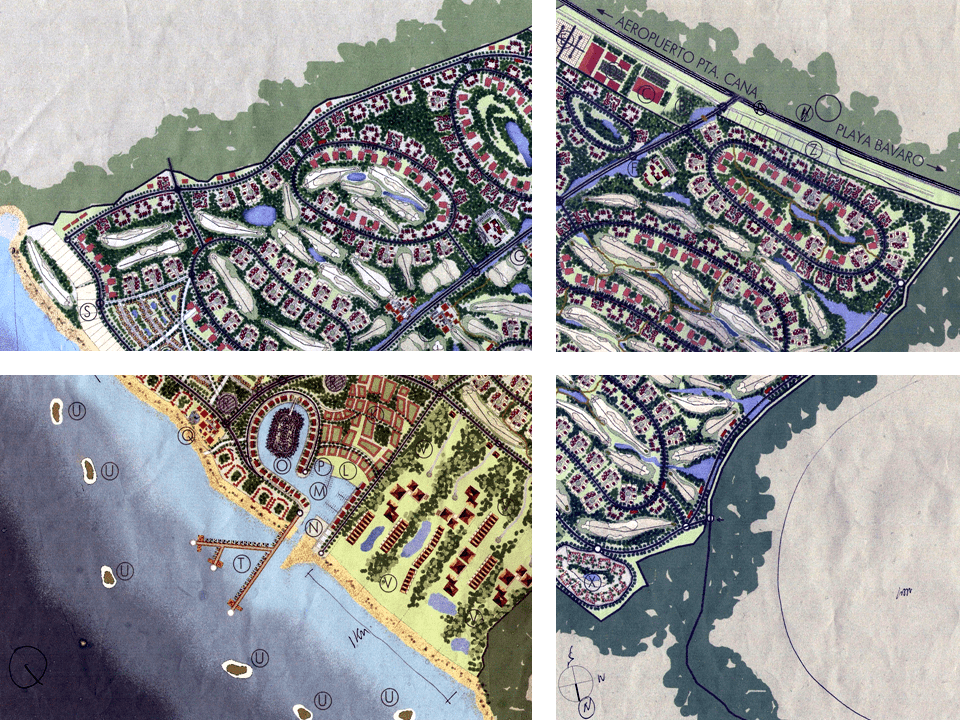
Punta Perla Master Plan. (External source).
Punta Perla was conceived and announced at a breaking point in the international financial system, which from September 2008 severely restricted global credit and affected the viability of large-scale real estate projects in multiple markets.
Despite the announced funding, the project never got off the ground as originally envisioned for full operation, nor was it fully completed within the timeframe established fifteen years ago.
While project executives stated in subsequent statements that the difficulties had been overcome and that work would proceed on pending phases (including access roads, the Beach Club, and the boutique hotel), there is currently no public evidence that Punta Perla operates as a fully developed resort with all its main components active and functioning as originally planned.
Technical reports from the time indicate that, even years after the Chinese agreement, the physical execution of the project maintained a limited presence of infrastructure works, and many of the originally declared phases, including additional golf courses, operating hotels and large residential units ready for delivery, remained in a state of incomplete progress or with an uncertain status of full execution.
What was actually built
The project progressed in several minor stages:
• Preparation of access roads and construction camps on the land.
• Construction of some model units for sale and preparation of basic infrastructure.
• Commencement of parts of the internal marina and preliminary work on sports fields, although these did not constitute a complete, functional resort complex.
Despite announcements of continuity by its promoters, there are no verifiable records of a full commercial opening of the resort or of complete hotel operation under that scheme.
In May 2009, the press reported that the architects responsible for the development, Esteban Becerrill and Ramón Ramírez of the firm B+R Arquitectos Asociados, assured that the first stage of Punta Perla, including approximately 1,200 residential units and key infrastructure works, would be completed in 24 months, and that “all the necessary technical and economic means” were available to meet that objective, maintaining the original master design of 8,500 to 8,800 units with golf courses, a marina, and luxury hotels.
In August 2010, after work stoppages attributable to the impact of the international financial crisis, Spanish businessman Ricardo Miranda Miret, president of the Punta Perla project, publicly acknowledged that the work had faced stoppages, but assured that these difficulties “have been overcome” and that in the coming weeks work would resume to finish and deliver the properties within the deadlines stipulated in the sales contracts.
Fifteen years later
The US$462 million investment announced in 2010 was a much-cited moment in the economic and financial relationship between the country and China, highlighted in Diario Libre as a historical precedent for bilateral financing.
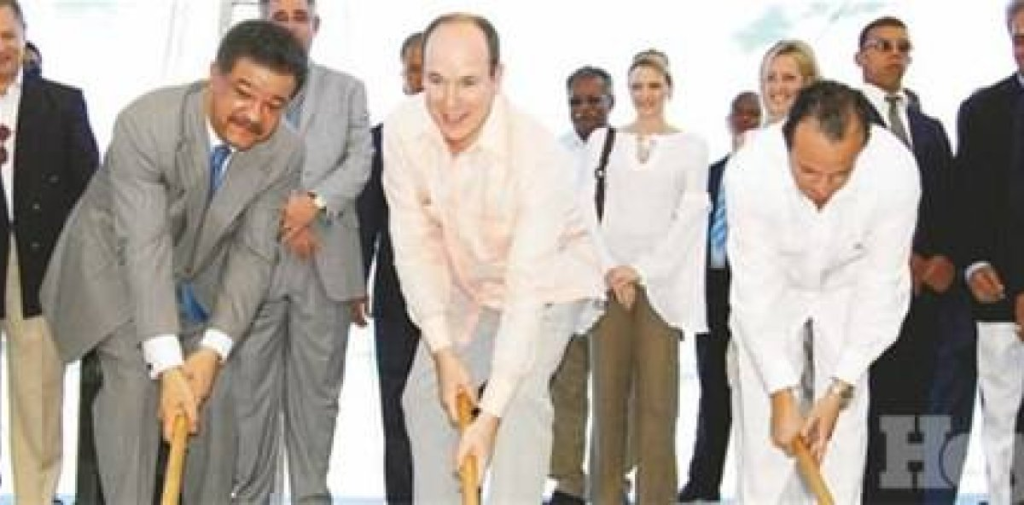
The first groundbreaking ceremony was led by then-President Leonel Fernández. (External source).
However, more than fifteen years after that announcement, there is no evidence that the financing has resulted in the full operation of the project or the development of sustainable real estate infrastructure on the proposed scale.
Academic reports have even gone so far as to describe the attempt as a failure or one that did not materialize in practice. The study “The Dominican Republic and the People’s Republic of China: Exchange, Trade, and Investment,” published by researcher Yuan Li with the support of the Global Foundation for Democracy and Development (GFDD) as part of its Studies and Reflections Series, analyzes the economic and trade relationship between the two countries and points out that the investment announcement for the Punta Perla project, although widely publicized, did not materialize to the projected level, describing the attempt as a failure in practice, without the projected development expectations being met.
Current context of the residential and tourism real estate sector
While Punta Perla is not yet fully operational as a resort, the Dominican real estate market has continued its expansion with other projects, many of them independent, active, and marketed in areas such as Cap Cana, Bávaro, and White Sands.
In parallel, substantial investments continue to flow into the country in the form of developments like Cruise On Land Punta Cana, an initiative that envisions over USD 700 million in foreign capital for a complex with approximately 6,000 rooms and spaces for entertainment, work, and leisure, projected to be developed over the next five years and generating an estimated 12,000 jobs once fully operational.
The Punta Perla case represents a paradigmatic example of the challenge faced by mega tourism and real estate projects in the face of financing realities, international economic cycles and local execution.
The announced US$462 million of Chinese capital in 2010 marked a landmark opportunity for the introduction of Asian capital into the Dominican real estate sector, but 15 years later it has not translated into a completed and operational real estate development on the scale originally promised.







