


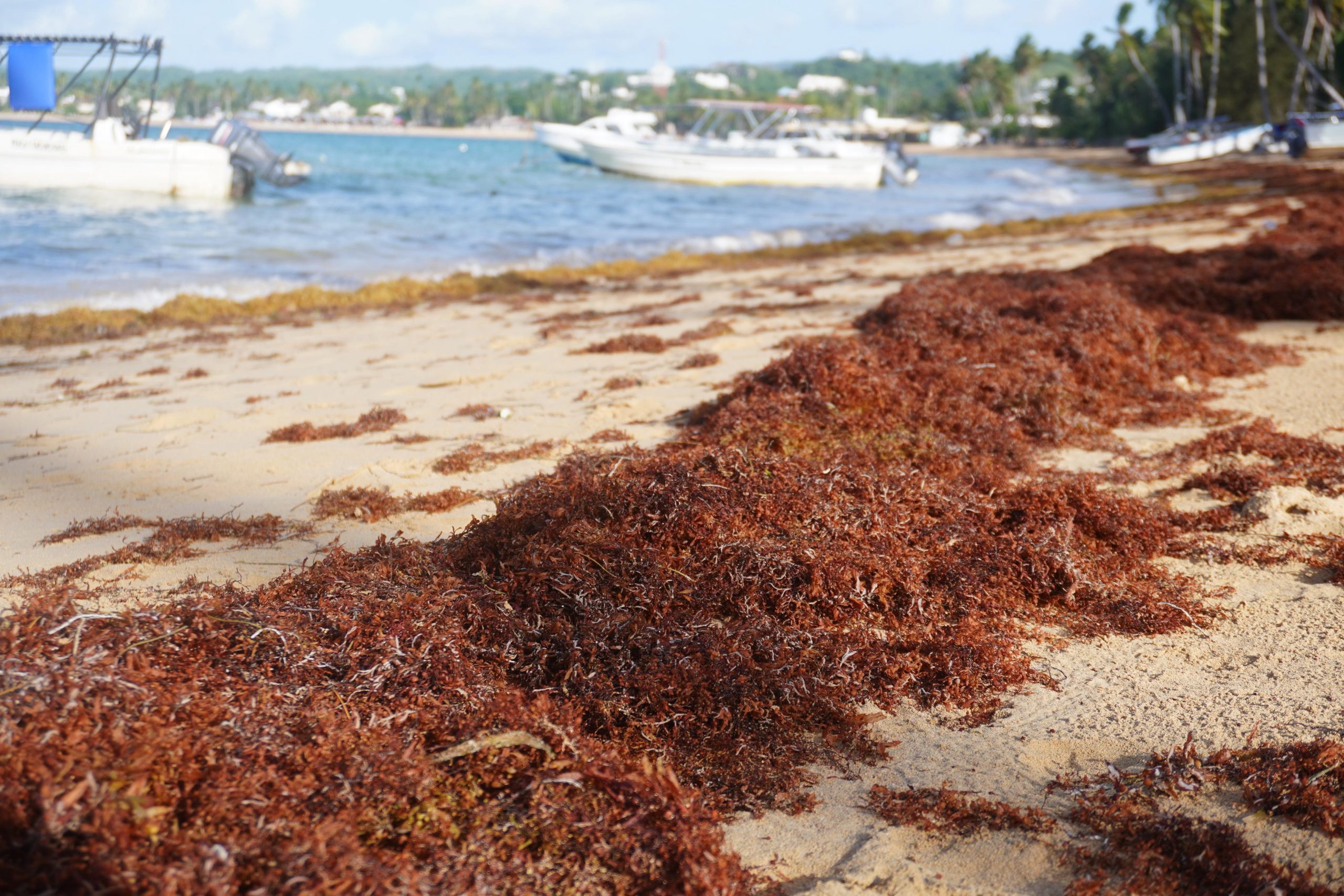
As algae invade coastlines and hit tourism and fishing, business leaders and environmentalists are calling for a legal framework to turn this threat into an opportunity, amid a legislative landscape marked by uncertainty and conflicting priorities.
SANTO DOMINGO.– More than a year after being submitted by Virgilio Barón Duluc, senator for La Altagracia, the bill for the prevention, collection, use and final disposal of sargassum remains unacknowledged by the Senate plenary, despite the fact that eight months ago the Permanent Commission on Environment and Natural Resources presented a favorable report with modifications.
The reasons for the bill's slow progress remain shrouded in mystery. The legislation is stalled in the Senate without a clear agenda for its second reading, a profound lethargy that could be due to an overload of other legislative matters, divergent priorities among committees, and insufficient public pressure.
This lack of momentum is compounded by uncertainty about the financial sustainability of proposals such as the special fund for the valorization of sargassum, which makes it difficult to attract political and technical support to advance their discussion.
Senator Barón Duluc has emphasized that “sargassum is no longer a seasonal problem; it is a structural crisis,” and is promoting the creation of a dedicated national fund, early warning systems, and open-sea collection protocols.
Meanwhile, joint initiatives are being proposed at the regional level: Mexico and the Dominican Republic are establishing a bilateral working group between their Ministries of Foreign Affairs and Environment to coordinate joint responses to this phenomenon, a type of cooperation that could serve as a catalyst to unblock the legislative process and strengthen state capacity for action.
Economic impact and regional experiences
Sargassum is not only an environmental challenge: it represents a multimillion-dollar burden for Caribbean economies. The United States Environmental Protection Agency (US EPA) estimates that, in years of large influxes, cleanup costs in the region can reach up to US$210 million annually, not including the resulting tourism losses.
According to The BVI Beacon, during the most severe peaks, tourism in the Caribbean has registered drops of between 7% and 35%, affecting 55% of hotels, which must allocate extraordinary resources to remove the seaweed and mitigate the bad smell and the loss of attractiveness of the beaches.
In the Dominican Republic, fishermen are facing significant losses: "In just one week it has cost me four propellers," one of them said in Higüey, describing how the thick carpets of sargassum clog the boats.
Economic losses have motivated other Caribbean countries to seek innovative solutions. The Washington Post reports that in Grenada, projects are underway to convert sargassum into biogas, fertilizers, and bioplastics, such as the True Blue Bay resort, which already uses gas derived from the seaweed to fuel its bakery.
Meanwhile, The Guardian highlights companies like the British firm Seafields, which are developing floating farms capable of capturing sargassum in the open sea before it reaches the coast, thus reducing methane emissions and cleanup costs. These experiences show that, with planning and technology, sargassum can be transformed from an environmental threat into an economic resource.
With the outcry over the waste law
The main associations in the tourism sector have expressed their concern. The Association of Hotels and Tourism (Asonahores), along with the American Chamber of Commerce and other associations, have stated that the reform to the Solid Waste Law (Law 225-20) completely ignores sargassum, which: compromises environmental sustainability, increases uncertainty about private investments, and limits the country's economic competitiveness.
Asonahores Vice President Anguie Lendor warned that by not considering sargassum as a special waste, the reform closes the door to useful mechanisms such as its disposal and recycling. She also questioned billing models based on gross revenue, which could discourage responsible waste management, and warned about monopolistic tendencies and a lack of institutional coordination.
Environmental voices
Although direct coverage of the bill by Dominican environmental voices is limited, organizations like Ecored, which has joined the business sector in several statements, have questioned the lack of a technical focus and the omission of sargassum from waste regulations, which jeopardizes environmental governance and circular economy goals.
Furthermore, academic and research circles highlight that the country functions as a "small laboratory" for experimenting with sargassum solutions, with initiatives in Punta Cana and Macao that include the use of seaweed barriers, specialized machinery, and studies to transform the seaweed into bioplastics, fertilizers, cosmetics, and biogas, underscoring the urgency of a legal framework that integrates these possibilities.
The logbook
The initiative, submitted on June 19, 2024, seeks to establish a permanent public policy to address the massive influx of sargassum seaweed to Dominican coasts. It has followed this legislative path:
– June 19, 2024: Submission to the Senate Legislative Secretariat.
– June 25, 2024: Reading in the Senate chamber and referral to the Standing Committee on Environment and Natural Resources.
– August and October 2024: Public hearings in Higüey and Punta Cana with hotel owners, fishermen, mayors, and experts.
– November 2024: Receipt of comments from the Environment and Tourism Committees.
– December 2024: Inclusion of tax incentives for companies developing uses for sargassum.
– January 2025: Presentation of the favorable report with modifications.
– Until August 2025: Stalled, with no agenda for a second reading in the plenary session.
“We cannot wait for the sargassum to overwhelm our beaches and coastal communities; we must act in an organized and forward-thinking way,” Baron Duluc had warned on the day of the presentation of the piece.
Key aspects of the bill
– Monitoring and early warning: creation of a national sargassum monitoring system.
– Institutional responsibilities: clear allocation of powers to ministries and municipalities.
– Special sargassum fund: public-private financing for cleanup, research, and technology.
– Productive use: incentives for industrial uses such as fertilizers, biofuels, or construction materials.
– Environmental regulation: prohibition of its disposal on beaches or in unsuitable landfills.
Science and urgency
While the National Congress keeps the bill on hold, the most recent studies from the University of South Florida (USF) reveal that the sargassum bloom in the central Atlantic and Caribbean reached 8 million metric tons in June 2025, one of the highest figures recorded for that date.
Scientists predict intense arrivals until October, due to wind and current patterns, and warn about the presence of arsenic and heavy metals in the algae, which limits its agricultural use without prior treatment.
Environmental organizations and tourism sector entrepreneurs insist that the lack of a legal framework leaves coastal communities without permanent tools, forcing them to respond each year in an improvised way to a problem that, according to projections, could intensify with climate change.







