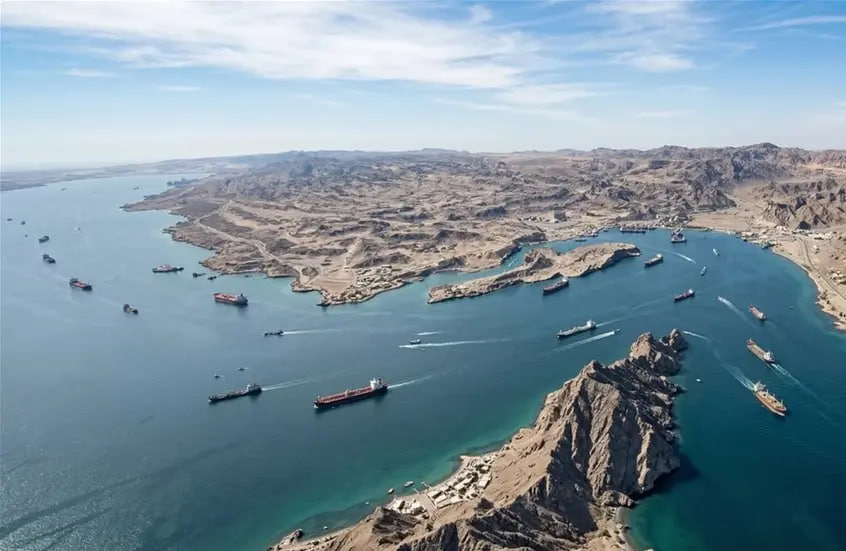
SANTO DOMINGO – The Strait of Hormuz is not just a strip of water between Iran and Oman. In practical terms, it is one of the arteries that keeps the global economy moving. Its importance becomes even more evident during times of tension, when any disruption to its transit ceases to be a regional issue and becomes a global problem.
The point where the world passes
This strait, which at its narrowest point barely exceeds 30 kilometers, carries approximately 20% of the world's oil consumption, as well as a similar proportion of liquefied natural gas. Data from the U.S. Energy Information Administration, cited by the BBC, estimates that around 20 million barrels of crude oil pass through it every day.
This makes the passage a true bottleneck: a narrow but indispensable route. Countries like Saudi Arabia, Iraq, Kuwait, Qatar, and the United Arab Emirates depend on this waterway to get their energy to international markets. Without it, much of the world's energy supply would simply have no direct access to the ocean.
National Geographic magazine emphasizes that, for many of these countries, the Persian Gulf is their only maritime route to the outside world. This makes the strait a structural component of global energy trade, not just another shipping lane.
Much more than oil
Although oil is the main focus of attention, the importance of the Strait of Hormuz extends far beyond that. Nearly a fifth of the world's liquefied natural gas, crucial for electricity generation and domestic consumption, also passes through this route, especially from Qatar.
Furthermore, according to the BBC, around a third of the global fertilizer trade passes through this point. This means that its operation directly impacts global agricultural production and, by extension, food prices.
Conversely, the strait also allows the entry of essential goods into the Middle East: food, medicine, and technology. It is, in other words, a two-way channel upon which both exporters and importers depend.
When it stops, the world feels it
The coverage by the Los Angeles Times and the Associated Press agree on one point: any disruption in the Strait of Hormuz is "extremely disruptive" for the energy market.
The impact is almost immediate. The reduction in maritime traffic caused by threats, attacks, or conflicts raises oil and gas prices, generating a chain reaction. Countries highly dependent on these imports, such as China and India, pass on this increase to their industrial production, which ultimately makes goods more expensive worldwide.
The BBC reports that, in recent periods of tension, this dynamic has forced governments to reduce energy consumption, modify working hours, and even implement rationing. The effect, therefore, extends beyond the markets: it reaches into everyday life.
A step that is difficult to replace
Alternative routes exist, such as pipelines in Saudi Arabia or connections to ports outside the Gulf in the United Arab Emirates. However, these infrastructures do not have sufficient capacity to replace the volume passing through Hormuz, according to The Conversation.
Reports cited by the online magazine Britannicawarn that completely avoiding the strait could significantly reduce the global oil supply. This confirms an uncomfortable reality: the world remains dependent on a narrow and vulnerable geographical passage.
Recommended readings: