


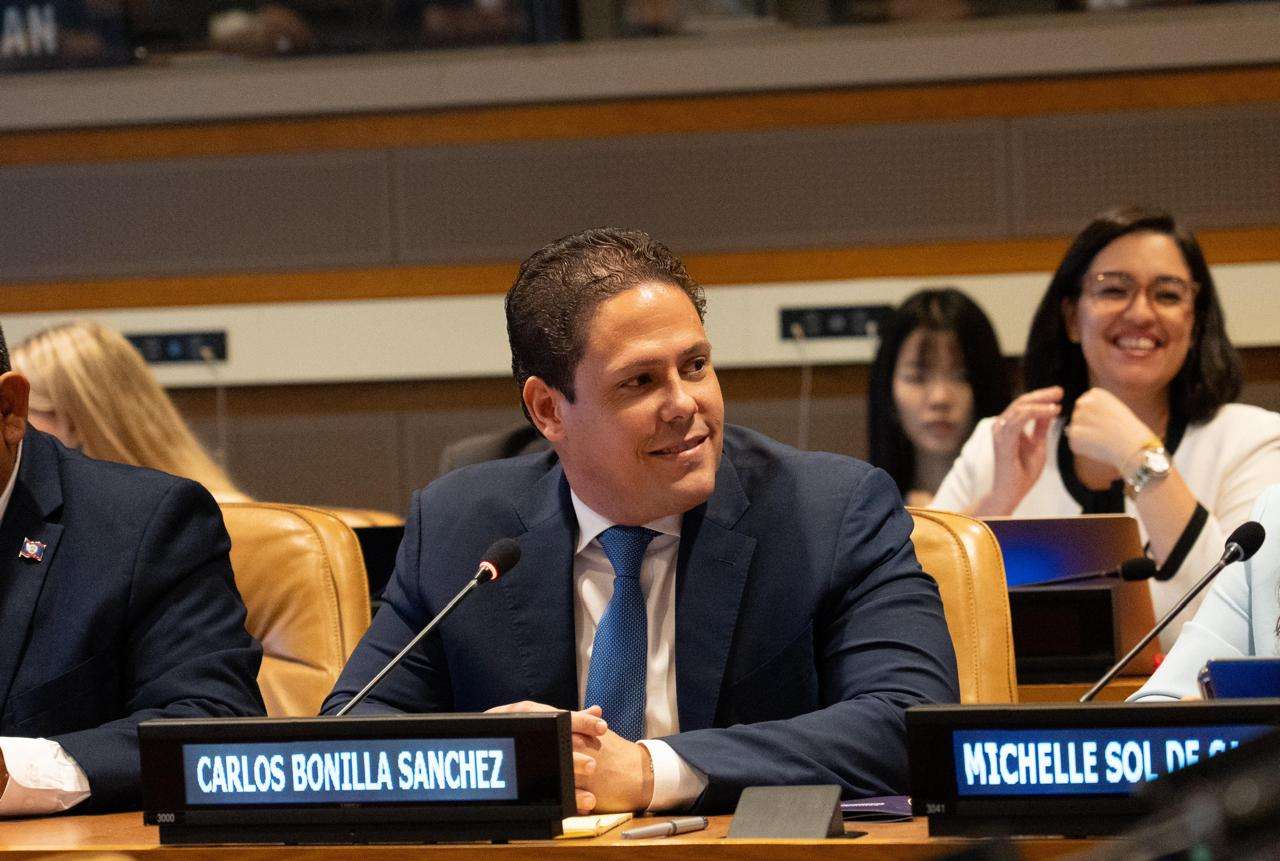
New York. – The Minister of Housing, Habitat and Buildings (MIVHED), Carlos Bonilla, said that the country has a deficit of 1,400,000 homes, of which one million are quantitative and 400,000 are qualitative.
He stated that through the agency he heads, the Ten-Year Housing Plan was presented, which unified criteria for the housing sector and thus combat the scourge.
While participating in the event "Transforming neighborhoods: national policies and local actions for sustainable urban development," organized by the Inter-American Development Bank (IDB) at the headquarters of the United Nations Human Settlements Programme (UN-Habitat) in New York, Bonilla highlighted the work of the current government and cited as an example the homes built and repaired through various programs, such as "My Housing" and "Dominicana Rebuilds.".
He also highlighted the enactment of the Territorial Planning Law, which provides municipalities with the necessary tools to organize their territories, in addition to the technical assistance they receive from the government.
“President Abinader’s government has invested the most and done the most to reduce this deficit, building more than 10,000 new homes with their property titles and repairing more than 50,000 homes,” the official said at the meeting in New York.
The official advocated for comprehensive solutions that address both the immediate needs of communities and the long-term goals of sustainability and resilience.
He proposed the implementation of robust national policies and effective local actions working together to address the challenges of urbanization in the nation. He also presented an overview of the challenges facing the Dominican Republic in this area.
Bonilla thanked the Secretary of the Interior, Justice and Decentralization of the Republic of Honduras, the IDB and UN-Habitat for the invitation, highlighting the importance of the event as a platform for the exchange of ideas and experiences on sustainable urban development.
The meeting was held on July 12, 2024 at the United Nations Headquarters in New York.
The session focused on exploring sustainable solutions for urban development through neighborhood improvement.
Visits in New York
Bonilla had an extensive agenda of activities in New York City, where he held a bilateral meeting with Ana Claudia Rossbach, Executive Director of the United Nations Human Settlements Programme (UN-Habitat).
The official also visited the New York City Police Academy, describing it as “an opportunity to learn about innovative ideas that improve our buildings, integrating advanced technology into training and the design of efficient spaces.”.
“Thanks to First Lieutenant Allan Oleaga and Police Officer Rosario Gatongarcia for showing us all the operations and infrastructure to apply and adapt this in our country,” he explained.
Similarly, Bonilla took a boat tour of New York City, where he visited residential, commercial, retail developments and outdoor spaces in GreenPoint.







