


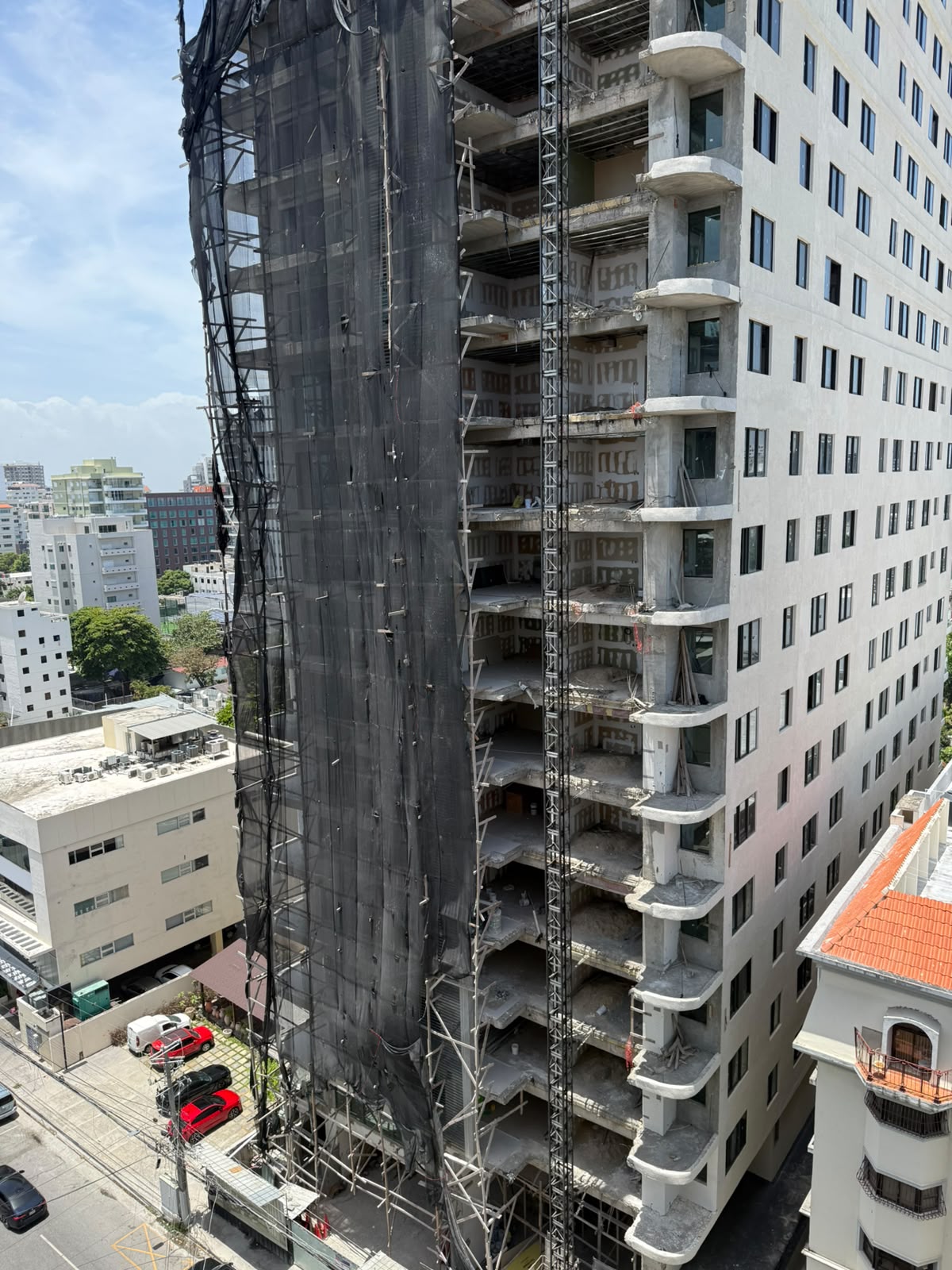
The authorizations granted for the tower violated municipal regulations regarding land use, density, height, and setbacks, rendering the main urban planning permits for the project ineffective
SANTO DOMINGO.– A decision by the Superior Administrative Court (TSA) has once again brought to the forefront one of the main concerns regarding urban growth in the National District: how far can a real estate project be transformed without deviating from the city's planning regulations?
The Fourth Chamber of the TSA declared the nullity of the main urban planning permits granted to the Everest Towerin Piantini, concluding that the authorizations issued deviated from the municipal provisions that regulate land use, housing density, building height and the minimum setbacks required.
The decision, contained in judgment no. 0030-1642-2026-SSEN-00280, dated July 9, 2026, accepted the contentious administrative appeal filed by the National District City Council (ADN), which questioned the legality of the certificates issued for real estate development.
Beyond a specific project, the ruling establishes that land-use planning regulations constitute a limit for urban development and that administrative authorizations cannot deviate from them when the public interest is compromised.
A project that changed dimension
One of the aspects that had the greatest weight in the judicial decision was the evolution of the project from its initial conception to the finally authorized version.
According to the court's assessment, the original proposal envisioned a 64-unit apartment. However, subsequent renovations and modifications led to the development of a mixed-use complex comprising 238 condominium-hotel suites, as well as restaurants, offices, event spaces, service areas, and a helipad.
For the judges, these modifications represented a substantial transformation of the initially approved project, considerably increasing the intensity of land occupation.
The ruling indicates that the projected density reached approximately 3,763 inhabitants per hectare, a figure higher than that permitted by the regulations in force for that area of the National District.
Height, setbacks and land use
The court also concluded that the authorized proposal exceeded the urban planning parameters established for that sector of Piantini.
Among the observations is a building with 22 levels above ground, in addition to complementary areas intended for restaurants, services, a mezzanine and a helipad, a configuration that exceeded the maximum height allowed for tertiary roads type A.
Furthermore, the decision points out that some approved side and rear setbacks were less than the regulatory minimum of four meters, a condition that, according to the court, directly affects aspects such as ventilation, natural lighting, safety, privacy and integration of the work with the urban environment.
The judges also determined that the challenged certificates contradicted the provisions contained in Municipal Resolution No. 94-98 and Ordinance No. 9/2019, through which the Territorial Planning Plan of the National District was approved.
A conflict that went to court
According to the statement, the construction of Everest Tower had generated opposition among residents and community representatives of the Piantini sector, who for several years questioned the magnitude of the project and the impact it would have on an area characterized mainly by its residential use.
Concerns raised included increased vehicular traffic, pressure on existing infrastructure, and the effects that high-density construction could have on mobility and the quality of life in the surrounding area.
The judicial decision aligns with these arguments, maintaining that territorial planning seeks precisely to balance real estate growth with the urban capacity of each sector.
Scope of the ruling
As part of the ruling, the Superior Administrative Court nullified the Certificate of No Objection to Preliminary Project No. ADN-DPU-2020-0466 (Resealed), the Certificate of Land Use and Building Setback, the Certificate of No Objection No. ADN-DPU-2021-1202, as well as the certificates DPU-CC-2023-0040, all linked to the Everest Tower development.
The ruling also specifies that any eventual authorization from the Dominican Institute of Civil Aviation (IDAC) regarding the heliport would only evaluate aspects related to air operational safety and does not replace the urban planning evaluation that corresponds to the municipal government.
The court concluded that the protection of the public interest in urban matters includes compliance with land use planning, mobility, environmental sustainability, legal security and the quality of life of citizens, for which reasons it ordered the annulment of the challenged permits and ordered that the decision be communicated to the parties involved, in addition to its publication in the Bulletin of the Superior Administrative Court.
Recommended readings:







