SANTO DOMINGO – Cost uncertainty, the transition to sustainable models, and increased data demands from financiers are redefining the construction sector globally. These conclusions come from the Global Cost Report 2026, prepared by the international consulting firm Currie & Brown, a company specializing in cost management and advisory services for infrastructure and physical asset projects. The report warns that real estate decisions are no longer based solely on traditional financial estimates. Today, factors such as price volatility, environmental performance, and the ability to plan early have become central variables for the viability of developments.
Costs under pressure and early planning
The report projects that construction costs in the United States will increase by around 4% in 2026, driven primarily by tariff uncertainty, labor shortages, and rising material prices. Significant pressures are also anticipated in Latin America: Mexico is expected to see an increase of between 4.5% and 6%, while Peru is projected to experience a rise of between 4.5% and 5.5%, both attributed to a lack of skilled workers, volatility in imported inputs, and limited contractor capacity.
The document emphasizes the strategy developers should adopt, noting that “projects with strong early planning, advance purchasing, and flexibility in materials will be better positioned to manage price fluctuations and protect schedules.” The central recommendation is to plan ahead, acquire ahead, and maintain adaptability, especially in projects that rely on specialized equipment or imports.
The report also delves into the financial structure of projects. According to the Global Cost Report 2026, in 2025 the average total cost of a development was primarily distributed across the construction phase, which accounted for 51.9% of the total budget (hard costs). This was followed by soft costs, such as design, engineering, permits, and management, at 17.6%; site development represented 15.7%; and tenant improvements reached 14.7%. This breakdown explains why any pressure on materials, labor, or regulatory compliance has an immediate and widespread impact on the final cost of real estate projects.
Sustainability is no longer optional
One of the most striking findings of the study is the environmental impact of the sector. “Approximately 40% of emissions are linked to the built environment,” the report states, which also projects that by 2050 nearly 200 billion square meters of new space will be required, while a large proportion of existing buildings will need some level of modernization.
For Currie & Brown, the change is already underway: “By 2026, sustainability will shape construction everywhere. Expectations have changed and will demand real transformations in design, construction, and management.” The report argues that early carbon measurement throughout a building's lifecycle, electrification, decarbonization, energy efficiency, and resilience planning against climate risks are becoming operational priorities.
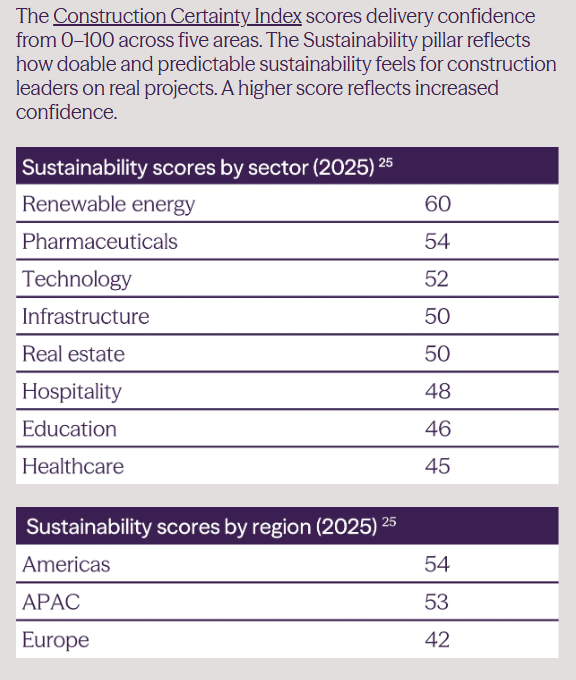
It also points out that the cost of achieving sustainability goals is decreasing thanks to falling prices for technologies such as solar energy, batteries, and efficient lighting systems, facilitating their adoption in new projects. Another significant change is cultural. It is no longer enough to design sustainable buildings; now they must demonstrate their real-world performance once operational, an increasingly common demand among occupants and investors.
Data and financial confidence: the new language of capital
The report incorporates findings from a survey of 1,060 senior decision-makers in construction and infrastructure, the results of which feed into the Construction Certainty Index, an indicator that measures confidence in project delivery. The conclusion is that funders demand verifiable metrics from the early stages.
“From day one, using benchmarking and scenario modeling allows for comparing materials, planning costs, and making sound decisions throughout the building's lifecycle,” the report emphasizes. This approach reflects a shift toward more disciplined financial structures, where cost predictability and risk control directly influence capital approvals. The document adds that the early integration of sustainability and cost experts leads to more reliable, long-term decisions, both in new developments and modernization processes.
A sector entering a new phase
Beyond the specific figures, the Global Cost Report 2026 proposes a structural shift in how real estate projects are conceived. The combination of robust data, environmental metrics, and early planning is emerging as the new operating standard. The report itself summarizes this with a direct warning: “The organizations that do best will be those that plan ahead, measure what matters, and treat carbon and resilience as part of an integrated approach.”
Recommended readings: